


The government is hiding a paper on the “worst credible accident” involving ammunition Britain has supplied Ukraine.
Details of the worst case scenario for an accident involving containers full of depleted uranium shells have been pulled from the National Archives by government censors.
The risk assessment’s removal from public view will add to concerns about the safety of Britain sending such a controversial weapon to Ukraine.
Depleted uranium (DU) is a chemically toxic and radioactive heavy metal produced as waste from nuclear power plants.
Scientific debate continues about DU’s long-term risks to human health and the environment in post-conflict zones.
In Iraq it has been blamed for birth defects and a spike in cancer cases.
When David Cameron was prime minister in 2011, he ruled out using depleted uranium for his Libyan regime change operation.
The British military insists any environmental risk from DU is low – and outweighed by the need to give Ukraine extremely dense 120mm shells to pierce Russian armour.
However, even within government there have long been concerns about its potential side-effects.
In 1981, the Atomic Weapons Research Establishment compiled a file titled: “Estimated consequences of the worst credible accident involving unit load containers filled with 120mm depleted uranium (DU) ammunition.”
It was declassified in 2015 and accessible to the public for the next three years at the National Archives in Kew, London. It is unclear who, if anyone, read it during that period.
The file was then reclassified in 2018 as part of a review of 100,000 files on radioactive material by the Ministry of Defence (MoD). Around 67,000 of those files were returned to the public by 2021.
But the dossier on depleted uranium dangers is either still under review or has been selected for permanent censorship.
‘Transparency is critical’
David Cullen, director of the Nuclear Information Service, told Declassified: “The reclassification of this document illustrates the dragnet approach taken by the MoD in removing historical nuclear files. We were told that these files were being assessed for information that could be of use to states that want to develop nuclear weapons.
“A risk assessment for DU ammunition, which is essentially repurposed nuclear waste, would not be of any practical use in nuclear weapons development. This lends credence to the view that many of the removed files just contain information that is inconvenient or embarrassing for the MoD.”
Doug Weir, an expert at the Conflict and Environment Observatory, commented: “The MoD has historically sought to manage the public acceptability of DU through the selective interpretation of studies and research areas.
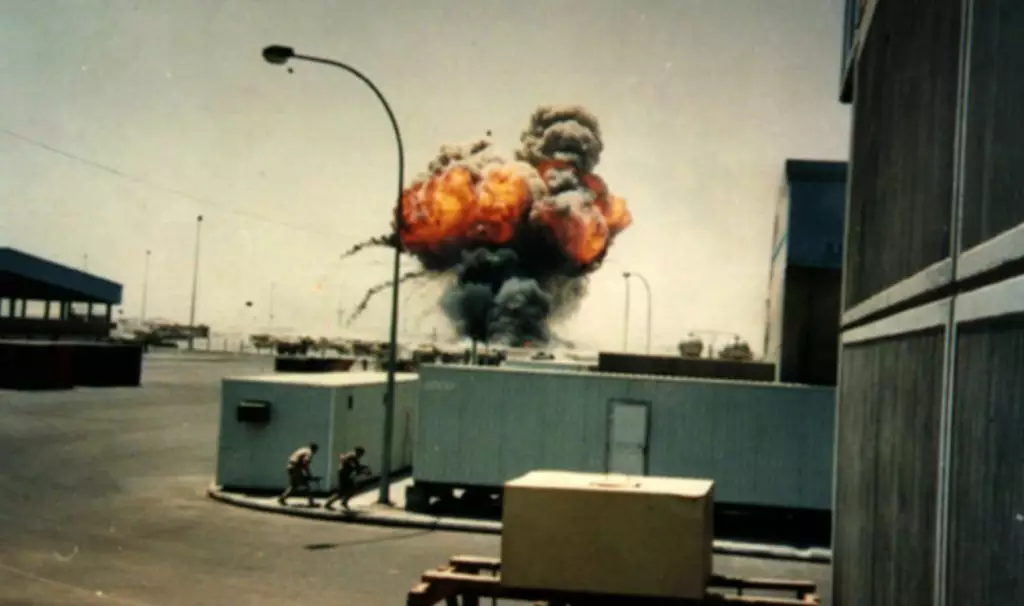
“Transparency is critical to understanding the risks it can pose to civilians and service personnel; the 1991 Camp Doha fire is an example of how incidents involving DU stocks in theatre can generate exposure risks and demand major remediation efforts.”
The fire started in US ammunition stocks at an army base in Camp Doha, Kuwait, and damaged more than 600 120mm DU rounds.
The blaze caused $40m in damages and injured 56 people, including four British soldiers. During the clear up, three people were killed by unexploded ordnance, with troops having to stay upwind of the smoke and wear masks to avoid breathing hazardous DU dust.
The Pentagon has denied supplying any of its own DU to Ukraine, although a US army instructor was present at a briefing Britain gave Ukrainian tank crews on the ammunition.
Russia also has DU shells but is not believed to have fired them yet in Ukraine, according to Britain’s armed forces minister.
An MoD spokesman said: “Alongside our granting of a squadron of Challenger 2 main battle tanks to Ukraine we will be providing ammunition, including armour piercing rounds which contain depleted uranium. Such rounds are highly effective in defeating modern tanks and armoured vehicles.”
He added: “The British Army has used depleted uranium in its armour piercing shells for decades. It is a standard component and has nothing to do with nuclear weapons or capabilities.”
The Atomic Weapons Establishment declined to comment.


Escalation
Rishi Sunak’s decision to send Ukraine 14 tanks with DU rounds, which we revealed last month, sparked a furious reaction from Vladimir Putin.
The Kremlin said it escalated nuclear tensions with the West – despite the fact DU rounds are not atomic weapons – and used it to justify deploying ‘tactical’ nuclear weapons to Belarus.
The incident sparked a debate in the House of Lords on the supply of depleted uranium.
Lord Vernon Coaker, a defence spokesman for Labour, said Keir Starmer’s party “fully supports” supplying Ukraine with DU.
But Conservative peer Richard Balfe said: “The present times seem very much like 1913. Every few weeks, there is a ratcheting up of confrontation and no one has any apparent desire to end this and seek peace.”
He added: “There are health hazards involved and the UN has looked at them. Is the Minister morally happy that we are now supplying depleted uranium shells to Ukraine? When will we begin a serious search for peace?”
Former Liberal Democrat leader Menzies Campbell expressed concern the ammunition “is likely to cause chemical toxicity, which can result in skin irritation and kidney failure.”
He went on to accuse Sunak’s government of having “handed Mr Putin an ill-founded but successful propaganda opportunity to claim falsely that the allies are seeking to introduce a nuclear element to the conflict”.
Kate Hudson from the Campaign for Nuclear Disarmament warned: “We are fast approaching the situation where a nuclear war will be fought in Europe.”


Phil Miller is Declassified UK's chief reporter. He is the author of Keenie Meenie: The British Mercenaries Who Got Away With War Crimes. Follow him on Twitter at @pmillerinfo
ZNetwork is funded solely through the generosity of its readers.
Donate




