

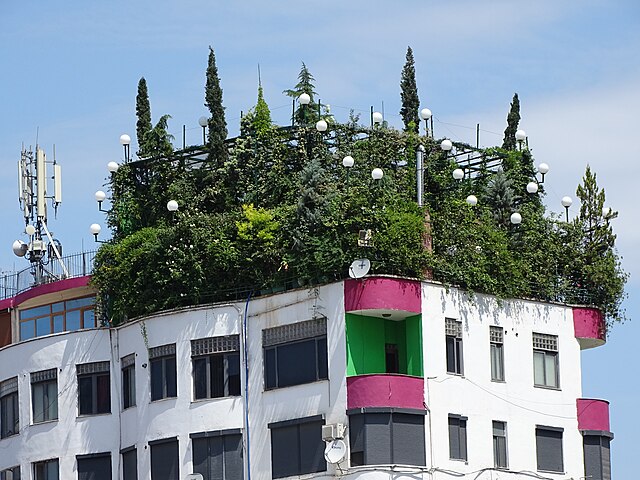
Cities across Aotearoa New Zealand are trying to solve a housing crisis, with increasing residential density a key solution. But not everyone is happy about the resulting loss of natural habitats and biodiversity.
Some homeowners in Dunedin, for example, are vehemently opposed to potential higher-density development in their area. They fear the loss of nature and increased use of concrete and other non-permeable surfaces it might entail.
One developer acknowledged the “juggling act” councils can face when trying to balance the need for more homes with preserving natural environments.
The issue isn’t going away, given the national shortage of affordable housing and the growing emphasis on increased density under the National Policy Statement on Housing and Urban Development.
However, we argue that incorporating nature within built environments is not just possible, it’s essential.
Density with biodiversity
Urban nature helps buffer the devastating impacts of increasingly frequent and serious climate-related events in cities, such as flooding and heat waves.
By embracing nature-based solutions, we can lessen the impact of these events while enjoying biodiverse surroundings (which are also beneficial to human wellbeing).
Initiatives in other countries can be a guide. Melbourne, for example, has a goal of planting 3,000 trees a year to achieve a 40% tree canopy cover by 2040. This is to combat increasing temperatures and improve biodiversity.
Toronto has policies to address air quality, the urban “heat island” effect, and stormwater management. The most significant is a green-roof bylaw requiring all high-density developments to have 20-60% of their roof area vegetated.
Unfortunately, New Zealand has not been good at creating biodiverse residential developments. Higher density often results in less green space and more hard surfaces.
Urban nature has value
Our research group, Aotearoa BiodiverCity (part of the publicly-funded People, Cities, Nature research programme) explores how to achieve more biodiverse cities through better and more strategically designed medium-density development.
As part of this ongoing and yet-to-be published work, we have examined 25 developments of different sizes across four New Zealand cities. This revealed considerable variation in how well developers had integrated biodiversity. The majority were glaringly deficient in healthy, ecologically meaningful vegetation.
Our analysis revealed that shifts to medium-density often mean a loss of nearly two-thirds of the original permeable area, including green spaces vital for stormwater management and biodiversity.
We’ve discovered numerous barriers and challenges to achieving nature-rich cities. Fundamental is a lack of national policy and regional strategies that specifically consider biodiversity in residential development.
Instead, the focus is on protecting significant indigenous habitats, reflecting an apparent assumption that biodiversity in residential areas has no value. In fact, it has enormous potential to contribute to city-wide biodiversity, and is vital to human wellbeing and climate change adaptation.
Set targets and measure outcomes
The lack of guidelines also creates large differences between council standards for developments. How much space is left for planting, for example, is dictated by the maximum building coverage on a site. This can range from 35% in Upper Hutt to as high as 50-60% in Lower Hutt, Wellington and Dunedin.
When district plans and residential design guidelines do call for maintaining or increasing vegetation, there are no specific biodiversity goals or targets. Nor are there plans to measure and monitor biodiversity during or after construction.
Professionals working on urban built environments reveal a tangle of barriers to implementing greening strategies. Cost is a big one, with developers perceiving a safer return on investment from prioritising dwellings or car parking, despite many people being willing to pay more for homes in greener neighbourhoods.
Design guidelines, including landscaping specifications, are often subject to developer discretion. This can mean they adhere to few environmental mitigation measures, and potentially neglect the natural environment.
More broadly, New Zealand has few precedents for incorporating green elements in denser developments. Solutions such as vegetated roofs and water-sensitive urban design are seen as experimental and risky rather than mainstream.
Strengthening council district plans to include requirements for preserving and enhancing urban green spaces should be a priority. This would include clear and attainable biodiversity targets, with quantifiable outcomes.
A new tool to score developments
Our team is developing the New Zealand Biodiversity Factor (NZBF), an assessment tool tailored for residential neighbourhoods. Once available, it will offer clear guidance on integrating nature into new developments, and provide performance scores and practical improvement suggestions.
Using urban design principles sensitive to biodiversity, the NZBF will score developments on a variety of features: extent of permeable area, vegetation quality in public and private spaces, and street layout.
Driveways and roads are the “monsters” eating up valuable permeable space. Prioritising good public and other transport options over car parking outside every home helps create a more biodiverse living environment.
Loss of permeable space can be mitigated at the planning stage by exploring housing layouts, building higher, and fostering greener urban landscapes.
Councils have many things to consider beyond biodiversity, of course, as well as limited financial resources for maintaining natural areas. This could be offset by enabling residents to manage their own neighbourhood green spaces, as has been successfully implemented overseas.
But attaching biodiversity targets to residential development will be a necessary first step. As urban populations grow, we’ll have to adapt to higher-density living. That does not mean we have to miss out on nearby nature.
ZNetwork is funded solely through the generosity of its readers.
Donate




