


On Tuesday, the U.S. Bureau of Labor Statistics (BLS) announced that the share of workers represented by unions was 11.2% in 2023, down slightly from 11.3% in 2022. This news of stagnation is especially sobering for the American labor movement because the past year was full of major victories and growing momentum. The UAW’s ‘stand up’ strike led to record contracts for autoworkers, graduate students around the country won union elections, and public support for labor unions reached near-record highs—especially among young Americans.
The decline of the American labor movement since the 1970s has been a major cause of stagnating wages and rising income inequality, and contributes to U.S. workers facing more dangerous working conditions than their counterparts in other wealthy countries. With the 2024 presidential election approaching, however, it is crucial to look beyond these economic consequences—as important as they are—and to recognize that the decline of American labor unions also leaves American democracy vulnerable.
That is the conclusion of our recent EPI report on labor unions and the use of ballot drop boxes during U.S. elections. Since ballot drop boxes are a highly secure way to increase access to voting during elections, the Republican Party has sought to limit their use as part of a broad assault on voting rights. During the 2022 midterm elections, for example, we found that unified Republican control of a state government was associated with a 95% decrease in ballot drop boxes per capita. Seventeen states completely banned ballot drop boxes—and all but one of them had either a Republican governor or a Republican-controlled legislature. By contrast, Democrats championed the John Lewis Voting Rights Advancement Act (VRAA) of 2021—national legislation that included protections against numerous state-level voting restrictions, including those related to ballot drop boxes. Sens. Joe Manchin (D-W.Va.) and Kyrsten Sinema (I-Ariz.), however, joined Republicans to block these reforms in early 2022.
In the face of these threats, labor unions have led a struggle at every level of government to defend and expand voting rights. At the national level, labor leaders endorsed the VRAA and lobbied for greater access to ballot drop boxes. As AFL-CIO President Liz Shuler demanded, “We need mail-in voting and ballot drop boxes… in every community… in every state.”
At the state level, unions recently coordinated simultaneous protests in Atlanta, Washington D.C., Miami, Phoenix, and Houston against disenfranchisement laws sweeping Republican-led states. “The most brazen of these bills—some already passed into law—would suppress high-turnout voting methods by banning ballot drop boxes,” one protest organizer explained. Unions even fought for access to ballot drop boxes at the county level. For example, when a councilmember in Luzerne County, Pennsylvania, proposed banning drop boxes during the 2022 midterm elections, unions rallied outside the local courthouse to voice their dissent.
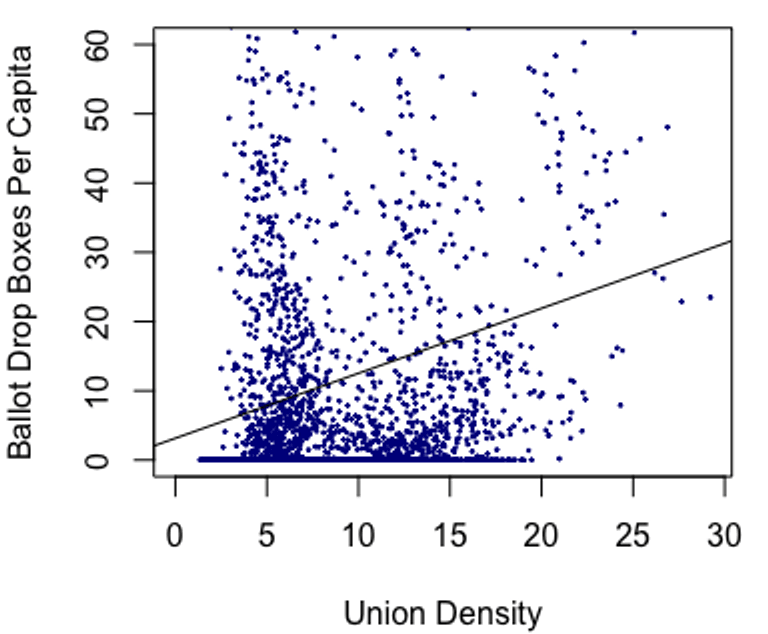
To examine the relationship between such union efforts and access to ballot drop boxes, we analyzed data on all 17,935 drop boxes available during the 2022 midterm elections. As Figure 1 displays, we found a positive association between county-level union density and ballot drop boxes per capita. Using multilevel negative binomial regression models and controlling for various county-level socioeconomic factors and the partisan control of state government, we found that a one-percentage-point increase in union density was associated with a 9.8% increase in the number of ballot drop boxes per capita. This means that a new organizing drive that brought just 1 out of every 10 workers into a labor union, for example, could more than offset the decrease in ballot drop boxes associated with Republican control of a state government.
Figure 1: Relationship between county-level union density and ballot drop boxes per capita during the 2022 midterm elections.

With this week’s BLS report in mind, however, we must remember that the reverse also holds: Decreases in union density can lead to further restrictions on ballot drop boxes. Consider the state of Wisconsin, where union density decreased by 4.4 percentage points after then-Governor Scott Walker eliminated collective bargaining rights for public-sector workers. Our results suggest that a decline in union density of that magnitude is associated with the disappearance of more than 40% of ballot drop boxes in the average county.
With voting rights under attack, it is hard not to see the decline of labor unions as an enabling factor in the erosion of America’s democratic institutions. We need a resurgence of the labor movement not only to improve wages and working conditions for U.S. workers, but also to enable unions to continue their vital fight to defend American democracy.
ZNetwork is funded solely through the generosity of its readers.
Donate




