

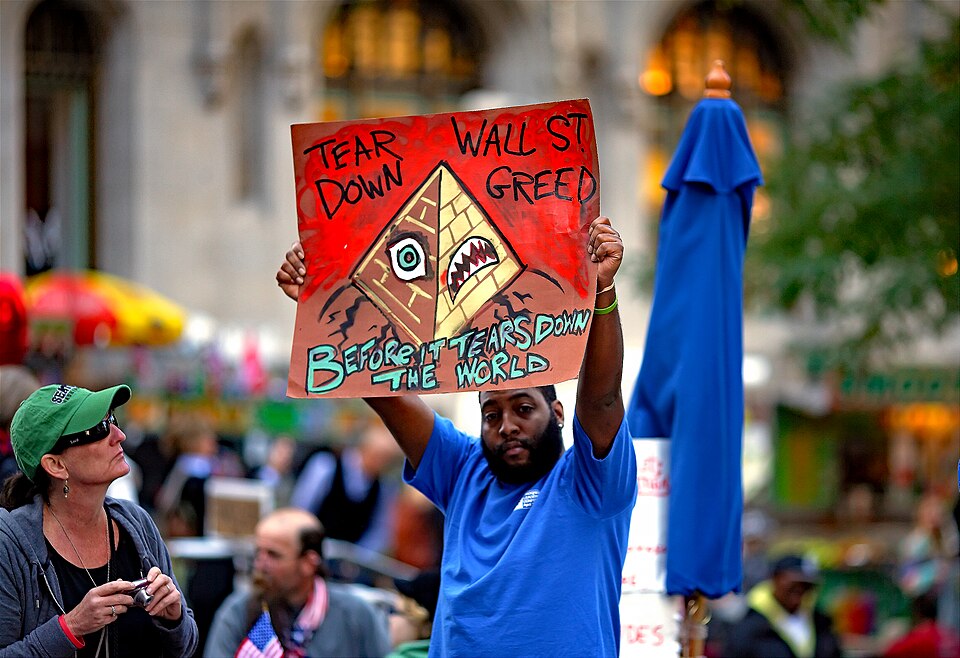
A recent Wall Street Journal headline screamed “Big Banks’ Profits Surge After a Red-Hot Quarter on Wall Street.” The Big Five of finance – JP Morgan, Chase, Goldman-Sachs, Bank of America, and Wells Fargo – earned $49 billion in the first quarter of 2026. JP Morgan’s CEO Jamie Dimon was happy. He declared this is about “as good as it gets.” Behind this nearly $50 billion are the credit card interest and fees that you and I pay. With real wages stagnating and prices of basic goods climbing, millions of Americans borrow money just to pay for basic necessities. Workers are exploited at both ends of the economy – as producer and consumers. Low wages force them to use credit cards to make ends meet. Employers get higher profits which allows banks to reach further into workers’ pockets by charging high interest rates. So, while wages stagnated, corporate profits reached an all-time high of $4.39 trillion for the first quarter of 2026. The economy may be booming for banks and corporations, but for most American families “as good as it gets” stinks.
To make matters worse, while real wages dropped, labor productivity increased by over 2%. Workers toil harder, get paid less and corporate profits go up. Business profits grow but the weight falls on the backs of their employees. The Bureau of Labor Statistics (BLS) reports that real hourly earnings decreased by 0.1% over the 12-month period ending in June 2026. This calculation is based on the BLS 2020 definition of inflation of about 3.5%. Using the pre 2020 inflation formula, which places a greater emphasis on the cost of goods over services, the inflation rate for June 2026 was up to 5.7%. In other words, wage hikes are swallowed by the rising costs of living; it’s just a question of how much.
Several current factors underlying inflation benefit the corporate sector while reducing the buying power of working families. Consider the effects of Trump’s tariffs. According to the Federal Reserve, these tariffs drove up the cost of core goods by 3.1%. Initially, most companies swallowed part of the costs of tariffs but passed the rest on to consumers. But when the Supreme Court declared the tariffs illegal, these large companies, not consumers, are getting back these billions of tariff dollars. Corporate price gouging also adds to inflation. A Department of Justice study found that the likelihood of price gouging increases with the level of economic concentration. Most American industries ranging from breakfast cereals to fossil fuels to e-commerce are heavily concentrated, resulting in unwarranted price increases and corporate profits. Americans are also paying more and more for less and less as shrinkflation becomes the norm in packaged products, especially groceries.
Speaking of groceries, many Americans today are forced to choose between food, rent, gasoline, health care or other essentials and to use credit cards in place of the cash they lack. This gives financial institutions the opportunity to squeeze more dollars from struggling working families, generating that $24.6 billion in profits from credit card fees and interest in the first quarter of 2026. A recent U.S. News and World Report survey found that 57% of all consumers now carry a balance on their credit cards and pay a monthly interest charge. According to Forbes, the average annual interest charge in July 2026 is in the Cosa Nostra neighborhood of 25.16%. Since about 29% of all credit card holders, or around 75 million people, pay interest on balances greater than $10,000, it’s easy to see why banks and corporations are prospering. It’s one big happy partnership of exploiters who can gouge ordinary people at ends of the economic pipeline. According to the Wall Street Journal, by the end of the first quarter of 2026 the outstanding balance on credit cards amounted to $1.25 trillion. A nightmare for consumers but a bonanza for big finance.
If you are among the 10% of households (which includes many pensioners) that own about 90% of all stock and equities, you’re doing pretty well. If you’re in the top 1% subset that holds 50%, you are doing very, very well. Certainly, it doesn’t get much better for President Trump. He reaped a walloping $2 billion from the cryptocurrency business that he regulates. No wonder he calls high grocery prices a Democratic hoax.
Corporations are prospering by underpaying workers and then financial institutions are charging them interest in what amounts to a tax on their survival. About all this the President and Congress are doing nothing. But when this crush is viewed in the context of major cuts to subsidies for the Affordable Care Act that forced 5 million people to drop their health insurance, and Gilded Age style crypto-corruption in Washington, D.C., it’s little wonder that polls show a vast majority of Americans want significant changes to both the economy and our political institutions. The Big Squeeze helps explain the recent success of Democratic Socialists of America (DSA) candidates. But the real question is whether the midterm election will offer us politicians who will bring the business giants to heel or just take their money
ZNetwork is funded solely through the generosity of its readers.
Donate





1 Comment
Do you really think liberal democracy is going to provide a solution to all of this?