

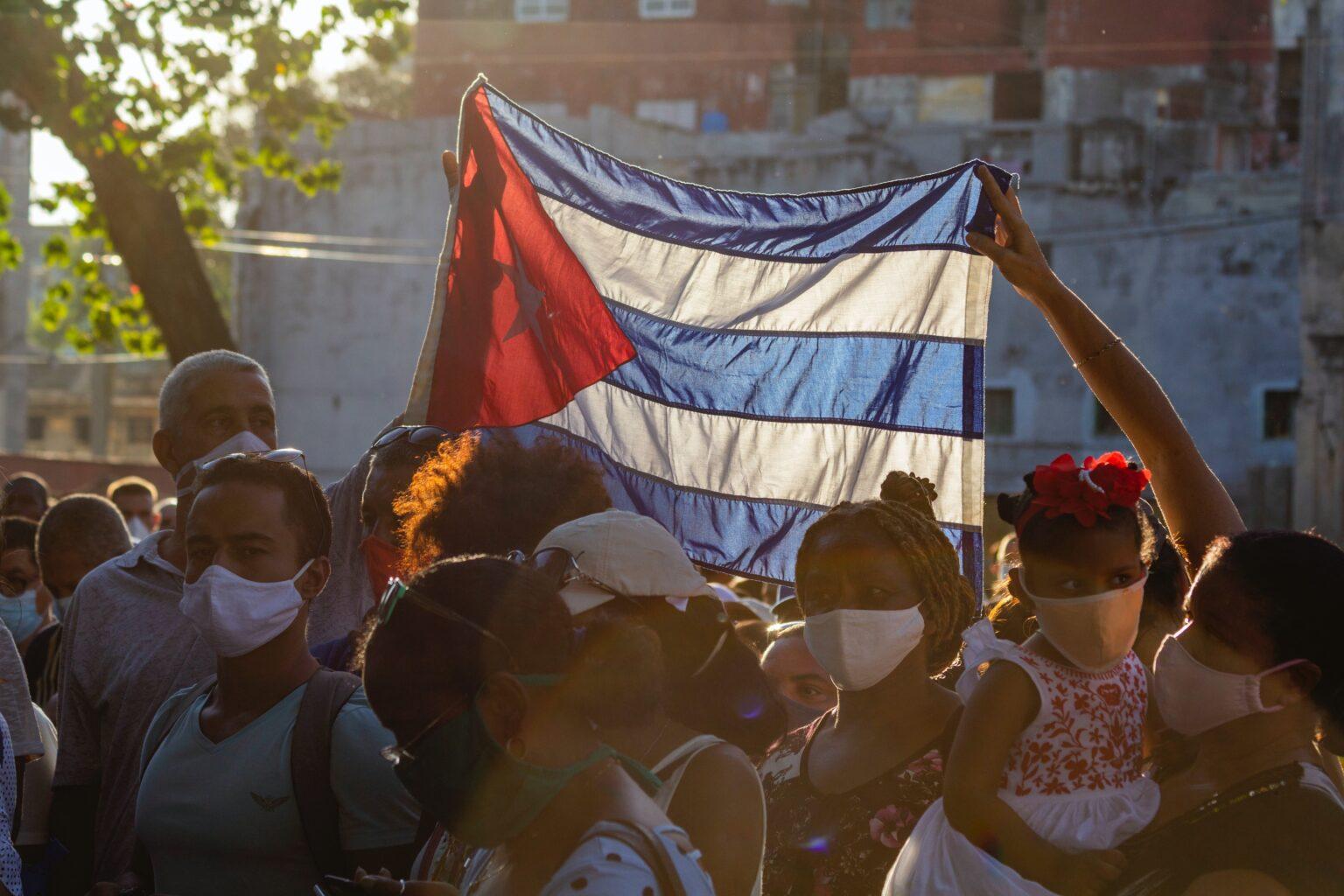
Friends of socialist Cuba like good news about that country. Now bad news has its use. Grief and hardship currently are such that, clearly, the U.S. economic blockade of Cuba must end at once. The harsh details, appearing below, testify to potential destabilization in Cuba, danger to Cuba’s socialist project, and the nefarious role of the blockade. A major mobilization against the blockade is due. The need for action is obvious.
The blockade, a 60-year-old relic of history, places few heavy demands on the U.S. public. No governmental funding is required. The Treasury Department issues fines and presidents make ritualistic declarations. People dodge travel restrictions. It’s a slow-motion affair. Distracted pro-Cuba activists may lose track of harassment details. Here they get a refresher course, for motivation toward action. It emphasizes blockade effects on people’s lives.
In the Beginning
Cuba’s vulnerability is the result mainly of U.S. policies directed at “denying money and supplies to Cuba … to bring about hunger, desperation, and overthrow of government.” The words are those of a State Department memorandum of April 6, 1960.
The flow of money to Cuba – international loans and export income –has long been feeble. International banks, financial institutions, and corporations handling dollars on Cuba’s behalf risk big U.S. Treasury Department fines. U.S. legislation blocks Cuba from importing the products of multi-national companies with branches in the United States – even food and medical supplies. For almost 30 years third-country ships docking in Cuba have been prohibited from entering a U.S. port for the following six months. Since 2019 the U.S. government has sanctioned Venezuelan ships carrying oil to Cuba.
The U.S. government harasses Cuba’s tourism industry, the source of most of Cuba’s foreign currency. Restrictions, variably regulated, operate against U.S citizens’ travel to the island. Why? They would spend money there. To discourage potential investors, U.S. legislation enables the heirs of properties nationalized in Cuba to take legal action in U.S. courts against investors who make use of such properties.
Cuba’s commerce with the United States has been nil for 60 years, except for heavily regulated Cuban agricultural exports. The northern neighbor used to be and still could be Cuba’s most convenient trading partner.
People are hurting
The U.S. blockade constitutes the main impediment to Cuba’s industrial production and overall economic development. Soviet Bloc nations formerly provided relief. Since then, strictures placed on imports have caused shortages of raw materials, replacement parts, consumer goods, new tools and machines, and reagents for drug and vaccine manufacture.
The blockade recently has complicated lives already beleaguered by the Covid-19 pandemic and an 11 percent economic recession resulting from the pandemic.
An Associated Press report of June 22 highlights a lack of new housing and impediments to repairing houses. In 2019, 44,000 homes were built, in 2000, 32,000 homes, and in 2021,18,000. Building materials are in short supply. Hurricanes and the pandemic aggravated the situation.
Elderly Cubans experienced isolation and lack of supplies during the pandemic. For two years they’ve experienced weakened cultural and support services and reduced housing options. Fuel shortages in late 2021 led to fewer bus-runs in Havana. Wait-times were even longer. Pharmacies in 2020 had available only 35 percent of their normal stock.
In recent times, infant death rates in Cuba matched the favorable rates of well-resourced countries, and were lower than U.S. rates. Astoundingly, Cuba’s infant mortality rate in 2021 was 7.6 infant deaths per 1000 births, up from 4.9 in 2000 and 5.0 in 2019. Cuba’s 2021 rate of mothers dying from pregnancy and childbirth difficulties was 176.6 – out of 100,000 mothers giving birth – up from 40.0 mothers in 2000 and 37.4 in 2019.
The increases stem from Covid-19 infection mortality added to deaths in non-Covid times. Experts say the deaths of children and mothers can reflect social factors – mothers’ low educational levels, reduced access to healthcare and other services, and poor nutrition. Therefore, the U.S. blockade, which does affect social well-being, may have taken a toll in this area too.
Cuba’s food supply is unstable what with reduced food production, inefficient distribution, marketing based on income levels, and quality variations. At an annual cost of $2 billion, Cuba’s government still must import 60-70 percent of the food consumed in Cuba.
Production levels remain low despite reforms introduced after 2008, among them: land distribution, allowances for farmers’ permanent use of land, marketing reforms, governmental assistance to individual farmers and agricultural cooperatives, new distribution systems, local decision-making on assistance and policies, and ecologically sustainable methods.
The U.S. economic blockade is not responsible for soil deficiencies, officials’ inaction, drought conditions, overgrowth of invasive plants, and the appeal of urban life for rural youth. Blockade effects do show up in farmers’ reduced access to credit and lack of funds for fertilizer, seeds, breeding stock, spare parts, new equipment, and fuel.
Inflation holds sway in Cuba now. Prices, rising for two years, are up now by 70 percent and more. Access to essential goods is impaired. Frustration at high prices and shortages helped trigger island-wide protests on July 11, 2021 and has contributed to record emigration.
The U.S. blockade set the stage for inflation. After losing its commercial partnership with the Soviet Bloc, which disappeared in 1991, Cuba was in trouble. The blockade blocked access to international loans and interfered with income derived from exports, the latter effect stemming from export restrictions. Consequently, funds have been short for importing essential products and for developing the economy.
Cuba desperately needed foreign currency and therefore brought tourists to the island to spend money that would end up with the government. From 1993 on, their money was captured via a new currency called the Cuban convertible peso (CUC). Tourists surrendered their own currencies in exchange for the CUCs.
Cubans, not all of them, acquired CUCs and were able to buy goods and dollars unavailable to Cubans without CUCs. Inequalities emerged. Responding, the government gradually withdrew CUCs from circulation, beginning in January 2021. Anticipating hardships, it raised salaries and pensions payable in Cuba’s “national peso.”
New money in circulation stimulates inflation, especially when goods for sale are in short supply, as in Cuba. The national currency lost value. Tourists, excluded during the pandemic, returned in late 2021. Their money, circulating, added to inflationary pressures. CUCs with a prominent role in Cuba’s informal economy, and still circulating, did likewise. The role of CUCs suggests the blockade’s indirect contribution to inflation.
Persevering
Those defenders of Cuba worried about diminished Cuban-government commitment to bettering people’s lives may need reassurance. Of note:
* Cuban president Miguel Díaz-Canel Bermúdez on June 21 addressed a meeting which elevated the role of social work. Discussion centered on mothers living in cities in “situations of vulnerability.”
* Support programs are in place for elderly Cubans experiencing isolation, for example, the “Accompany Me (Acompáñame) project of telephone assistance and the National Program for Comprehensive Attention to Elders.
* As of 2021, 423 so-called Projects of Local Development promoted food production, small workplaces, and tourism along with socio-cultural, environmental, and research programs.
* The government promotes its program known as “micro, small, and medium [size] businesses.” These mostly privately owned enterprises, numbering 1,188 last year, produce food products, building materials, furniture, textile products, footwear, cleaning supplies, computer accessories, recycling serves, and more.
* The government in April 2021 approved 43 measures directed at increased agricultural production and food availability. Results are far from ideal, an observer notes.
* Prime Minister Manuel Marrero Cruz, on June 24 visited a district in Cardenas to assess progress toward “improvements of roads, water supply, housing construction and social work.”
What to do
Resistance to the U.S. blockade within the United States has been constant for decades, but to no avail. Thanks to the Helms-Burton Law of 1996, the hurdle now is forcing the Congress to act. For that to happen, masses of people must stand up together and weigh in.
But that won’t happen, it seems, as long as activists continue to view the blockade as an isolated issue. What’s needed is collective action on many issues toward changing the direction of the U.S. government itself. The common ground would be justice and decent lives for all people everywhere, Cubans among them.
Also required would be new understanding that U.S. assault on Cuba happens as part of the larger U.S. project of capitalism worldwide and imperialist domination. The big mobilization to end the blockade would be part of a larger mission to take apart that U.S. project. Oppressed and plundered nations would be rescued, Cuba among them.
One adjustment: U.S. progressives ought to reject that old dictum that “Politics stops at the water’s edge.” It sends the message that solidarity with and struggle for oppressed peoples overseas doesn’t matter. That’s not so.
By no means will these suggestions bear fruit in time to end the blockade soon. Hope and struggle will remain. U.S. public opinion favors ending the blockade. People in the United States now fighting the blockade are experienced and want to enlarge the movement. Maybe chaos attending capitalism’s failures, new wars, and international divisions will distract the U.S. government from bothering with Cuba. Maybe international solidarity with Cuba will continue growing. Revolutionary Cuba, with unity and effective leadership, is known for overcoming challenges.
ZNetwork is funded solely through the generosity of its readers.
Donate




