


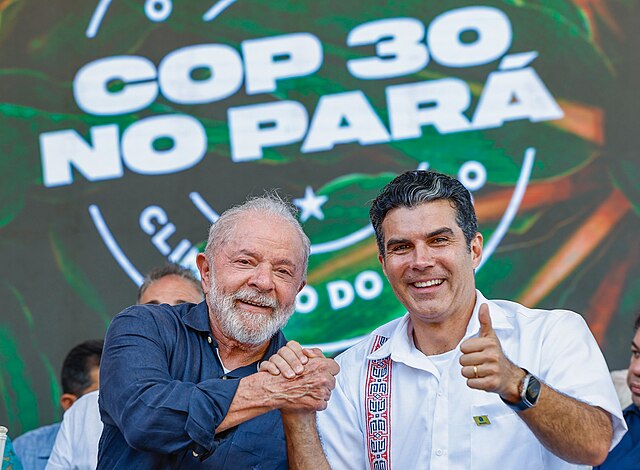
COP 30 is the official name of the UN conference on climate change taking place in Belém, Brazil, from November 10 to 21. But indigenous peoples around the world have for years given it another number that better reflects their historical experience of the issues under discussion. The date is that of the arrival of European colonizers in their territories. In the case of Brazil, 1500. The problem of climate change began with colonialism and capitalism and continues to this day. It will not be solved as long as colonialism and capitalism dominate our lives. The ecological crisis is the other side of the social and political crisis. It is not worth giving numbers because numbers are a way of neutralizing revolt, whether they are numbers on deforestation, the weight of plastics in the oceans, the genocide in Gaza, or the regular killings of the impoverished populations of the favelas of Rio de Janeiro. Numbers are abstract entities introduced for the purpose of counting. The objects we count (dead people, felled trees) are not numbers, they are unique beings that we reduce to a number so that we can accommodate them in a conception of reality that does not change whatever the number. Just as prisoners are not numbers, even if they have a number. We have become accustomed to designating horror by quantity in order to live with it more easily, that is, without having to change the political, economic, and cultural conceptions that produce it systematically. Those who do the math are not counted.
Depending on the circumstances, COP 30 will be either an orgy or a war of present and future numbers. In the end, there will be winning numbers and losing numbers so that everything remains the same. Numbers are only useful for small changes that do not alter the essentials. And even in this area, pessimism about COP 30 is justified. Donald Trump’s environmental denialism has produced an incalculable civilizational setback by forcing all countries rich in natural resources (and impoverished in health, education, human security, etc.) to proclaim their sovereignty over them and prove it through more intense exploitation. The reaction to Trump has had the perverse result of further weakening the international cooperation that would be necessary to face the imminent ecological collapse.
What is at stake at COP 30, as it was at previous conferences and will be at future ones, is the lack of political will to face this simple truth, which is easy to formulate but very difficult to put into practice: nature does not belong to us; we belong to nature. The difficulty is also simple to identify, but very difficult to address: capitalism and colonialism, which have dominated the global economy and society since the 16th century, have become incompatible with the survival of human life and life in general on planet Earth. The incompatibility is also simple to formulate: for Eurocentric modernity, constituted primarily by capitalism and colonialism, nature belongs to us and as such we can dispose of it freely. Disposing of it implies the power to destroy it.
For capitalism and colonialism, there is a radical separation between humanity and nature. The Cartesian philosophy that presides over this duality establishes an absolute separation and hierarchy between human beings and nature, just as it separates the mind from the body. While human beings are a res cogitans, a thinking substance, nature is a res extensa, an extensive and impenetrable substance. As God is human thought about the infinite, human beings are immensely closer to God than nature. Human beings are truly worthy of the dignity that God has granted them to the extent that they denaturalize themselves. Herein lies the root of the abysmal line that characterizes modern domination, the possibility of absolute dualisms and, with that, the impossibility of holistic thinking. Nature is subjected to an abysmal exclusion from society, and the same occurs, logically, with all entities considered closest to nature. Historically, women, indigenous peoples, Black people, and, in general, all races considered inferior have been examples of these entities. All the main mechanisms of exclusion and discrimination existing in modern societies, whether based on class, race, or gender, are ultimately founded on the radical dualisms of humanity/nature, mind/body, spirituality/materiality. The ways in which modern society deals with inferiority are modeled on the ways in which it deals with nature. If abysmal exclusion means domination through appropriation/violence, nature—including the land, rivers, and forests, as well as the people and ways of being and living whose humanity has been denied precisely because they are part of nature—has been the preferred target of this domination, and therefore of appropriation and violence, since the 17th century.
Environmental destruction and the ecological crisis are the other side of the social and political crises we are facing and which conventional policies are increasingly unable to resolve. Different schools of thought have attempted to account for the double link between the ecological crisis and the social crisis. Most point to the urgent need for a paradigm shift, which in itself indicates both the severity of the crisis we are going through and the magnitude of what is at stake. They agree with the idea that the paradigm shift consists of replacing the humanity/nature dualism with a holistic conception centered on a new understanding of nature and society and the relationships between them.
A paradigm is a specific type of social metabolism, a set of material and energy flows controlled by humans that occur between society and nature and which, together and in an integrated manner, sustain the self-reproduction and evolution of the biophysical structures of human society. From the 16th century onwards—following European colonial expansion and, in particular, after the first industrial revolution in the Western world (1830s)—the social metabolism characteristic of the capitalist and colonialist paradigm generated a growing imbalance in the flows between society and nature, producing a metabolic rupture. It is now accepted that this rupture, by creating a systemic imbalance between human activity and nature, marked the beginning of a new age in the life of planet Earth, the Anthropocene. This imbalance has worsened to such an extent that we are now facing an imminent ecological catastrophe, a situation which, when it becomes irreversible, will put human life on Earth at great risk. It is imperative to set in motion, as quickly as possible, a process of transition to a different type of social metabolism, based on a different type of relationship between society and nature. This is what the necessary paradigm shift is all about.
The paradigm shift presupposes the need for a philosophy to underpin it and a strong social mobilization to put it into practice. The transition is a historical process, which means that it is urgent to begin it, but it is impossible to predict its pace and timing. We have more reasons to be optimistic about the philosophy than about social mobilization.
The philosophy has long been available; it is the set of philosophies of the peoples who have been most sacrificed by capitalism and colonialism, the peoples who have often been exterminated, whose territories have been invaded, whose so-called natural resources have been stolen, a historical process that began in the 16th century and continues in our time. I am referring to the philosophies of indigenous or native peoples. Fortunately, these philosophies have reached us thanks to the resistance and struggles of these peoples against oppression, exploitation, and annihilation. These philosophies are one of the main dimensions of what I call the epistemologies of the South.
Although these philosophies are very diverse, they converge on one point. What we refer to as nature is conceived by these philosophies as Pachamama, or Mother Earth. If nature is mother, it is the source of life, it is care, deserving of the same respect as our mothers who gave us life. In short, nature does not belong to us; we belong to nature. This radical belonging contradicts any idea of dualism between human beings and nature. The divine entity, regardless of how it is conceived, is an entity of this world and can manifest itself in a river, a mountain, or a particular territory. The divine is the spiritual dimension of the material, and both belong to the same immanent world.
These philosophies will be present at the People’s Summit, COP 525. They will be excluded from the main rooms of COP 30, where those responsible for the problem will incessantly disguise themselves as promoters of the solution. And if indigenous peoples are occasionally allowed to speak, at that moment the official delegates and their physical or mental ties will take the opportunity to go to the bathroom, check their cell phones, and respond to urgent messages. From time to time, they will raise their heads to see if the indigenous people have finished. Then everything returns to the somnambulistic normality of the joyful journey to the final disaster.
All this shows that we have the philosophies that would allow us to rescue human and non-human life, but we do not have the social mobilization to carry them forward and the paradigm shift they presuppose. In fact, the current period seems much more hostile to the idea of a paradigm shift than previous periods. The maximum hostility stems from the threat of global war hanging over the world and the growing polarization between “us” and “them” that fuels the politics of hatred. A new world war will certainly be more destructive than previous ones, and the destruction will not only be of human life, but also of what remains of the ecosystems that sustain life in general. In turn, social polarization and tribalism, which are growing in its wake, fueled by the promoters of hatred and identitarianism, make it impossible for humanity to talk to each other and to all non-human beings with whom they share planet Earth. The struggle for paradigm shift begins today with the struggle against war and against social polarization fueled by tribalism, identitarianism, and the politics of hatred.


Boaventura de Sousa Santos is the emeritus professor of sociology at the University of Coimbra in Portugal. His most recent book is Decolonizing the University: The Challenge of Deep Cognitive Justice.
ZNetwork is funded solely through the generosity of its readers.
Donate





1 Comment
Thank you for clearing the smog of Trump’s colonial ambitions from the impoverishment of US citizens and Cop-Out 30. In order to avoid a future of extractive nefariousness and private empires where the majority of the population are surplus to requirement, we need to see the big picture in all dimensions so we can replace it with something surviveable for all of us.