


A tank capable of firing depleted uranium shells has been destroyed in Ukraine, sparking health concerns.
One of 14 tanks Britain sent to Ukraine has been destroyed in a battle with Russian forces.
The smouldering wreck was filmed near Robotyne, a war-torn village in Zaporizhzhia Oblast.
It’s the first time a Challenger 2 tank has ever been lost in combat since Britain began building the vehicles in the late 1980s.
Ukraine believes the tanks, each worth £5m, could be of decisive advantage due to their armour-piercing rounds made from depleted uranium (DU).
Rishi Sunak’s decision to supply the ammunition earlier this year caused international outcry as DU is an ultra-dense metal made from nuclear waste.
Although its radioactivity is low, it can cause cancer and birth defects when exposed to humans in certain circumstances.
British courts have found in favour of at least two Gulf War veterans who suffered ill health from contact with DU.
A tribunal in Edinburgh upheld a war pension appeal by Kenny Duncan. His three children were born with deformities after he had helped salvage tanks destroyed by DU shells.
And an inquest in the Midlands found it was “more likely than not” that exposure to DU caused cancers which killed Stuart Dyson, an ex-soldier who cleaned British tanks in Iraq.
Toxic aerosol
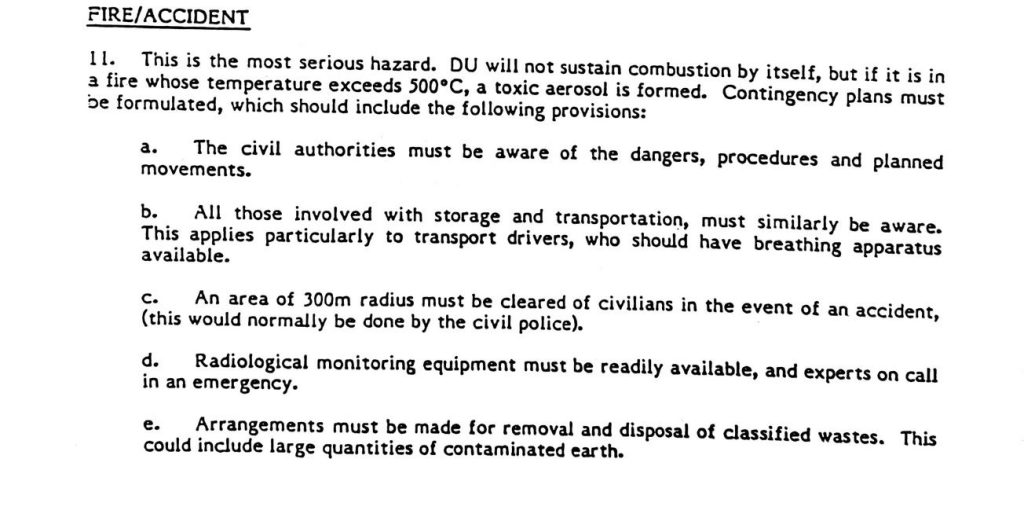
UK military safety studies from 1986-88, found by Declassified, show that an accident in which DU rounds caught fire was regarded as “the most serious hazard”.
A DU round could combust “if it is in a fire whose temperature exceeds 500 degrees celsius”, forming a “toxic aerosol”.
Another document states that “ignition arising from petrol or propellant will produce an aerosol smoke containing radioactive particles. There is danger from breathing this smoke.”

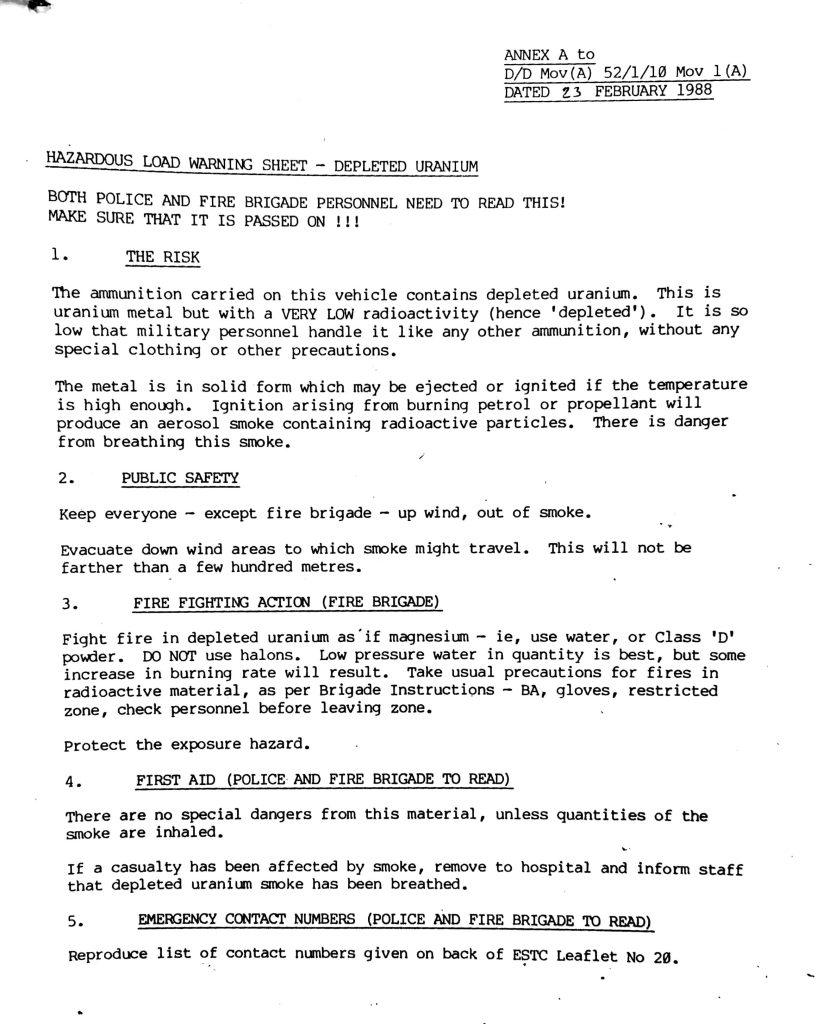
Contingency plans specified that “breathing apparatus” would be needed to tackle the fire, and “an area of 300m radius must be cleared of civilians”.
It further warned people to “evacuate down wind areas to which smoke might travel…[and] if a casualty has been affected by smoke, remove [them] to hospital and inform staff that depleted uranium smoke has been breathed.”
Internal military advice stressed that “radiological monitoring equipment must be readily available” and disposing of the wreckage could “include large quantities of contaminated earth”.
This advice does not seem to have been followed in Ukraine. The destroyed tank was seen billowing with black smoke as Ukrainians filmed from a car with a cracked windscreen while driving downwind.

Toxic ammo
Britain sent Ukraine “thousands of rounds of Challenger 2 ammunition including depleted uranium armour-piercing rounds”, armed forces minister James Heappey has told parliament.
They are being operated by Ukraine’s 82nd Air Assault Brigade, which was trying to keep them in reserve until the counter-offensive gathered pace.
Doug Weir, from the Conflict and Environment Observatory, told Declassified: “It is believed that Challenger 2’s can carry up to 52 rounds of ammunition, in this case a proportion of this is likely to have been CHARM3 DU munitions.
“Past cases of fires affecting vehicles suggest that should the fire be sufficiently intense, pyrophoric DU can ignite and burn.
“Vehicles suspected to be contaminated by DU oxide need to be marked and managed so as to avoid further dispersal to the environment, or the exposure of people coming into contact with them. Contamination may also be present in the vicinity of the vehicle.”
While the UK was the first to supply Ukraine with depleted uranium, the US has since announced the ammunition will be available with Abrams tanks it is sending to Kyiv.
Weapons containing DU have previously been fired by UK and US forces in conflicts such as Iraq, Syria and the former Yugoslavia.
An investigation by Declassified this summer in Kosovo found that civilians living near areas where DU was fired reported high levels of rare cancers.
The UK Ministry of Defence was asked to comment.


Phil Miller is Declassified UK's chief reporter. He is the author of Keenie Meenie: The British Mercenaries Who Got Away With War Crimes. Follow him on Twitter at @pmillerinfo
ZNetwork is funded solely through the generosity of its readers.
Donate




