


Identity is fluid, because concepts such as culture, history and collective self-perceptions are never fixed. They are in a constant state of flux and revision.
For hundreds of years, the map of the Roman Empire seemed more Mediterranean and, ultimately, Middle Eastern than European – per the geographic, or even geopolitical demarcation of today’s Europe.
Hundreds of years of conflicts, wars and invasions redefined the Roman identity, splitting it, by the end of the fourth century, between West and East. But, even then, the political lines constantly changed, maps were repeatedly redrawn and identities fittingly redefined.
This applies to most of human history. True, war and conflict have served as drivers of change of maps – and of our collective relationship with these maps – but culture is also shaped and remodeled by other factors.
The permeation of the English language, for example, as a main tool of communication in the post-Cold War era, resulted in an invasion by US, and to a lesser extent, British entertainment – films, music, sports, etc. – of many parts of the world. This incursion has disrupted the natural cultural development of many societies, widening the generational gap and redefining social conceptions, values and priorities.
Such a sudden change in cultural flow is hardly conducive to the health of a nation, whose sense of self is the outcome of hundreds, if not thousands of years of social conflicts, struggles and, often, growth.
Thus, identity, as a permanent political signifier, cannot be trusted, since this vague concept is in a constant state of motion and because of the unprecedented connectivity among peoples all over the world. While such connectivity can lead to slow ethnocide, which is difficult to detect, let alone avoid, it can also help beleaguered, oppressed nations fight back.
Once upon a time, such self-serving theories as that of an impending ‘clash of civilizations’, was all the rage among many US-western academics.
Samuel Huntington’s division of the world into “major civilizations” whose relationships will be defined by conflict was a convenient addition to a history of such racist tropes, going as far as the early phases of western colonialism.
Such thinking was propelled forward by political expediency, not rational thought, as it was marketed heavily following the collapse of the Soviet order, the first Iraq war and the emboldened western militarism across Asia, the Middle East and the rest of the Global South.
Linking violent endeavors with such lofty words as civilizations – some driven by universal values, while others, supposedly by extremism – was a mere reintroduction of old mantras as Europe’s ‘mission civilisatrice’ and the American ‘manifest destiny’.
All of it failed, anyway, or, more accurately, could not produce the desired outcome of keeping the world hostage to the west’s definition of civilization, identities and human relations, thus the supposedly inevitable ‘clash’.
Currently, there are signs of a new world that is emerging. It is not one that is shaped by civilizational quests or impulses, but by the same old historical paradigm: those who are seeking power that can widen and protect their economic interests, and those fighting back, seeking freedom, justice, equality, rule of law and the like.
Those pursuing power can, and are uniting beyond their supposed civilization inclinations, religious values, racial orientations and geography.
Even prior to the Russia-Ukraine war, a new cold war was already emerging, between a declining empire, the US, and a rising one, China.
Both countries, according to Huntington, would serve as textbook examples of ‘western civilization’ vs. the ‘Sinic civilization’ – lumped with others under the ‘Eastern world’.
Yet, neither the refined approach of Barack Obama nor the populist style of Donald Trump succeeded in deepening this presumed civilizational clash. The rest of the world’s relations with China continue to be governed by economic interests.
Even Washington’s European allies, who rely heavily on Chinese trade and technological advancements, are not entirely persuaded in joining the trade war on Beijing in the name of common western values and other such rhetoric.
As for those fighting back, the war on Gaza was an unexpected rallying cry for unity. Indeed, the war has resulted in a whole new formation of international relations that hardly existed prior to October 7.
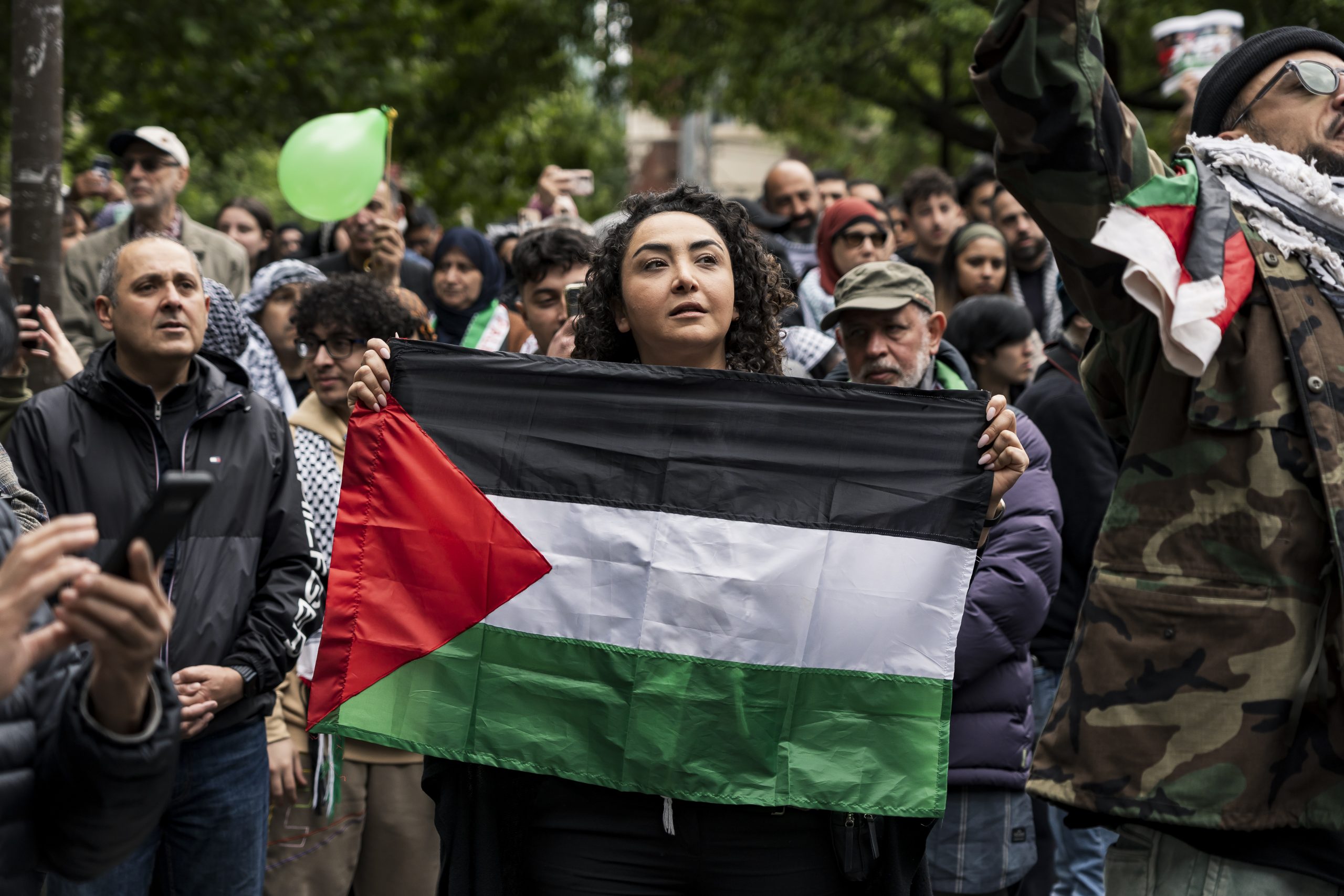
Those speaking out for the Palestinians are neither governed by religious, racial, geographic or even cultural boundaries. From Namibia to South Africa, from Brazil and Colombia to Nicaragua, and from China, to Russia to the Middle East, solidarity with Gaza is hardly defined from a narrow ‘civilizational’ perspective.
This includes the mass protests across the world, including throughout Europe and North America, where people from every color, race, age group, gender, religion and more are united in a single chant: ceasefire now.
Of course, there will always be those invested in dividing us, around whatever lines that may serve their political agendas, which are almost always linked to economic interests and military might.
Yet, the global resistance to such delusional academics and chauvinistic politicians is stronger than ever before. Gaza has proven to be the ultimate unifier, as it has drawn a line that bonds all of Huntington’s civilizational groups, not around imminent conflict, but global justice.


Ramzy Baroud is a US-Palestinian journalist, media consultant, an author, internationally-syndicated columnist, Editor of Palestine Chronicle (1999-present), former Managing Editor of London-based Middle East Eye, former Editor-in-Chief of The Brunei Times and former Deputy Managing Editor of Al Jazeera online. Baroud’s work has been published in hundreds of newspapers and journals worldwide, and is the author of six books and a contributor to many others. Baroud is also a regular guest on many television and radio programs including RT, Al Jazeera, CNN International, BBC, ABC Australia, National Public Radio, Press TV, TRT, and many other stations. Baroud was inducted as an Honorary Member into the Pi Sigma Alpha National Political Science Honor Society, NU OMEGA Chapter of Oakland University, Feb 18, 2020.
ZNetwork is funded solely through the generosity of its readers.
Donate




