It is unfortunate that with such serious issues to attend to, Christopher Hitchens insists on wasting time on irrelevant and fanciful diatribes against assorted enemies, the latest being his REJOINDER TO NOAM CHOMSKY. He begins by placing his question “before the house”: “Can the attacks of September 11 be compared to an earlier outrage committed by Americans? And should they be so compared?” NB: HIS question. If he wants to consider that question, fine, but I didn’t raise it or discuss it, nor will I now. Recall that his series of denunciations takes off from a single sentence in a composite response to journalists in which I said, accurately, that the toll of the “horrendous atrocities” of Sept. 11 might be comparable to the toll of the destruction of half the pharmaceutical supplies of the Sudan. The rest is the product of his imagination.

Hitchens fulminates about my failure to refer to his publications on the bombing of the plant — or, he might have added, to the many articles in the mainstream press that considered the validity of the justifications offered for the bombing. The reasons are straightforward, and were stated clearly and explicitly. I kept to prominent articles from credible sources in the mainstream press, which were therefore widely available; and to the topic with which I was concerned, namely, consequences.

Hitchens claims that I accused him of “propensity for racist contempt.” I explicitly and unambiguously said the opposite.

Hitchens condemns the claim of `facile “moral equivalence” between the two crimes.’ Fair enough, but since he fabricated the claim out of thin air, I feel no need to comment.

Hitchens is also outraged at my statement that we should condemn Milosevic for the crimes that are “plausibly attributed” to him. According to Hitchens, then, we must also charge him with those that are not plausibly attributed to him, and it is, furthermore, utterly outrageous to suggest otherwise. Of course, he does not mean what he is saying, once again. Having carried irrationality to new limits, he then seeks to evade the accurate argument that he quotes. Perhaps he does not like the way its conclusion applies to him. If so, that’s his problem. The argument remains valid, and elementary, nonetheless.

I will not sink to Hitchens’s level of referring to personal correspondence, which — it is now no surprise — he utterly distorts. The remainder has not even a remote connection to what I wrote, and I will therefore ignore it. And furthermore wish to waste no more time on these shameful meanderings.

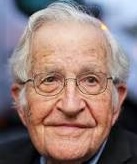
Noam Chomsky (born on December 7, 1928, in Philadelphia, Pennsylvania) is an American linguist, philosopher, cognitive scientist, historical essayist, social critic, and political activist. Sometimes called "the father of modern linguistics", Chomsky is also a major figure in analytic philosophy and one of the founders of the field of cognitive science. He is a Laureate Professor of Linguistics at the University of Arizona and an Institute Professor Emeritus at the Massachusetts Institute of Technology (MIT), and is the author of more than 150 books. He has written and lectured widely on linguistics, philosophy, intellectual history, contemporary issues, and particularly international affairs and U.S. foreign policy. Chomsky has been a writer for Z projects since their earliest inception, and is a tireless supporter of our operations.


ZNetwork is funded solely through the generosity of its readers.

Donate
Donate
Leave A Reply

Subscribe

All the latest from Z, directly to your inbox.

Institute for Social and Cultural Communications, Inc. is a 501(c)3 non-profit.

Our EIN# is #22-2959506. Your donation is tax-deductible to the extent allowable by law.

We do not accept funding from advertising or corporate sponsors.  We rely on donors like you to do our work.

ZNetwork: Left News, Analysis, Vision & Strategy

Subscribe

All the latest from Z, directly to your inbox.

THE WIND CRIES FREEDOM

The Wind Cries Freedom, the new book from Z co-founder Michael Albert, is a sweeping oral history of a future American revolution.

Through thirty interconnected chapters, it draws out the strategies, failures, turning points, and hard-won wisdom of a movement that called itself the Revolutionary Participatory Society. These are not the polished memoirs of politicians: they are the unfiltered accounts of people who organized in neighborhoods, hospitals, universities, stadiums, courthouses, and places of worship, and kept a shared vision alive through cynicism and exhaustion.

The result is speculative political fiction that reads like history: messy, human, and quietly hopeful in the way that only real experience and long thought can produce.

Get your copy and peruse more features on the book’s website below.

“Read it, argue with it, but don’t look away. The future it recalls is one we must still fight to deserve.”

Yanis Varoufakis

“The most unusual and intriguing combination of prophecy, manifesto, and movement building manual that I have ever encountered.”

Bill Fletcher Junior

“This work fills a huge gap in our social movement literature.”

Cynthia Peters

You've just read your article on Z this month.

DOES Z'S SURVIVAL MATTER?

You keep coming back for a reason: serious political analysis, movement reporting, and debate beyond the priorities of corporate media. Today, Z is in a precarious financial position. If Z is part of how you understand the world, help keep it going. The readers who give monthly are the reason this work survives between fundraisers.

Z is in a precarious financial position. If it’s part of how you understand the world, help keep it going.

Number of donors708
Our goal1,000

Sustainers at $9/month or more receive the digital Z Magazine.

Already a sustainer? Click here and we won’t ask again. Thank you!

Your reading count is stored only in your browser and is never sent to us.

Sound is muted by default.  Tap 🔊 for the full experience

CRITICAL ACTION

Critical Action is a longtime friend of Z and a music and storytelling project grounded in liberation, solidarity, and resistance to authoritarian power. Through music, narrative, and multimedia, the project engages the same political realities and movement traditions that guide and motivate Z’s work.

If this project resonates with you, you can learn more about it and find ways to support the work using the link below.

Z is in the most precarious financial position in its history.

Z is a place to think beyond the limits of the present.

For decades, Z has brought together political analysis, movement reporting, debate, and visions of a different future from writers and activists around the world. That work is more than journalism. It is movement infrastructure: movements need places to develop ideas, test arguments, learn from experience, and imagine what comes next.

In the first two days of this fundraiser, 19 donors and 8 new monthly sustainers stepped up. Help us reach 1,000 donors who keep Z independent, for everyone.

For decades, Z has published the analysis, debate, and visions movements need, free of paywalls, ads, and billionaire owners. If that work should continue, Z needs your support now.

Number of donors708
Our goal1,000

Sustainers at $9/month or more receive the digital Z Magazine.

Subscribe

Join the Z Community – receive event invites, announcements, a Weekly Digest, and opportunities to engage.

Exit mobile version

