


Note: This debate occurred in 2001. Christopher Hitchens wrote an essay in the Nation, and a subsequent comment on the Nation web site…and among those he attacked in his fulminations, was Noam Chomsky. Here, Chomsky replies…
I have been asked to respond to recent articles by Christopher Hitchens (webpage, Sept. 24; _Nation_, Oct. 8), and after refusing several times, will do so, though only partially, and reluctantly. The reason for the reluctance is that Hitchens cannot mean what he is saying. For that reason alone — there are others that should be obvious — this is no proper context for addressing serious issues relating to the Sept. 11 atrocities.
That Hitchens cannot mean what he writes is clear, in the first place, from his reference to the bombing of the Sudan. He must be unaware that he is expressing such racist contempt for African victims of a terrorist crime, and cannot intend what his words imply. This single atrocity destroyed half the pharmaceutical supplies of a poor African country and the facilities for replenishing them, with an enormous human toll. Hitchens is outraged that I compared this atrocity to what I called “the wickedness and awesome cruelty” of the terrorist attacks of Sept. 11 (quoting Robert Fisk), adding that the actual toll in the Sudan case can only be surmised, because the US blocked any UN inquiry and few were interested enough to pursue the matter. That the toll is dreadful is hardly in doubt.
Hitchens is apparently referring to a response I wrote to several journalists on Sept. 15, composite because inquiries were coming too fast for individual response. This was apparently posted several times on the web, as were other much more detailed subsequent responses. Assuming so, in the brief message Hitchens may have seen, I did not elaborate, assuming — correctly, judging by subsequent interchange — that it was unnecessary: the recipients would understand why the comparison is quite appropriate. I also took for granted that they would understand a virtual truism: When we estimate the human toll of a crime, we count not only those who were literally murdered on the spot but those who died as a result, the course we adopt reflexively, and properly, when we consider the crimes of official enemies — Stalin, Hitler, and Mao, to mention the most extreme cases. If we are even pretending to be serious, we apply the same standards to ourselves: in the case of the Sudan, we count the number who died as a direct consequence of the crime, not just those killed by cruise missiles. Again, a truism.
Since there is one person who does not appear to understand, I will add a few quotes from the mainstream press, to clarify.
A year after the attack, “without the lifesaving medicine [the destroyed facilities] produced, Sudan‘s death toll from the bombing has continued, quietly, to rise… Thus, tens of thousands of people — many of them children — have suffered and died from malaria, tuberculosis, and other treatable diseases… [The factory] provided affordable medicine for humans and all the locally available veterinary medicine in Sudan. It produced 90 percent of Sudan‘s major pharmaceutical products… Sanctions against Sudan make it impossible to import adequate amounts of medicines required to cover the serious gap left by the plant’s destruction…. [T]he action taken by Washington on Aug. 20, 1998, continues to deprive the people of Sudan of needed medicine. Millions must wonder how the International Court of Justice in The Hague will celebrate this anniversary” (Jonathan Belke, _Boston Globe_, Aug. 22, 1999).
“[T]he loss of this factory is a tragedy for the rural communities who need these medicines” (Tom Carnaffin, technical manager with “intimate knowledge” of the destroyed plant, Ed Vulliamy et al., London _Observer_, 23 Aug. 1998).
The plant “provided 50 percent of Sudan’s medicines, and its destruction has left the country with no supplies of choloroquine, the standard treatment for malaria,” but months later, the British Labour government refused requests “to resupply chloroquine in emergency relief until such time as the Sudanese can rebuild their pharmaceutical production” (Patrick Wintour, _Observer_, 20 Dec. 1998).
And much more.
Proportional to population, this is as if the bin Laden network, in a single attack on the US, caused “hundreds of thousands of people — many of them children — to suffer and die from easily treatable diseases,” though the analogy is unfair because a rich country, not under sanctions and denied aid, can easily replenish its stocks and respond appropriately to such an atrocity — which, I presume, would not have passed so lightly. To regard the comparison to Sept. 11 as outrageous is to express extraordinary racist contempt for African victims of a shocking crime, which, to make it worse, is one for which we are responsible: as taxpayers, for failing to provide massive reparations, for granting refuge and immunity to the perpetrators, and for allowing the terrible facts to be sunk so deep in the memory hole that some, at least, seem unaware of them.
This only scratches the surface. The US bombing “appears to have shattered the slowly evolving move towards compromise between Sudan‘s warring sides” and terminated promising steps towards a peace agreement to end the civil war that had left 1.5 million dead since 1981, which might have also led to “peace in Uganda and the entire Nile Basin.” The attack apparently “shattered…the expected benefits of a political shift at the heart of Sudan‘s Islamist government” towards a “pragmatic engagement with the outside world,” along with efforts to address Sudan‘s domestic crises,” to end support for terrorism, and to reduce the influence of radical Islamists (Mark Huband, _Financial Times_, Sept. 8, 1998).
In this respect, we may compare the crime in the Sudan to the assassination of Lumumba, which helped plunge the Congo into decades of slaughter, still continuing; or the overthrow of the democratic government of Guatemala in 1954, which led to 40 years of hideous atrocities; and all too many others like it.
One can scarcely try to estimate the colossal toll of the Sudan bombing, even apart from the probable tens of thousands of immediate Sudanese victims. The complete toll is attributable to the single act of terror — at least, if we have the honesty to adopt the standards we properly apply to official enemies.
Evidently, Hitchens cannot mean what he said about this topic. We can therefore disregard it.
To take another example, Hitchens writes that “I referred to the “the whole business [of the 1999 war] as a bullying persecution of – the Serbs!” As he knows, this is sheer fabrication. The reasons for the war that I suggested were quoted from the highest level US official justifications for it, including National Security Adviser Sandy Berger and the final summary presented to Congress by Secretary of Defense William Cohen. We can therefore also disregard what Hitchens has to say about this topic.
As a final illustration, consider Hitchens’s fury over the “masochistic e-mail…circulating from the Chomsky-Zinn-Finkelstein quarter,” who joined such radical rags as the _Wall Street Journal_ in what he calls “rationalizing” terror — that is, considering the grievances expressed by people of the Middle East region, rich to poor, secular to Islamist, the course that would be followed by anyone who hopes to reduce the likelihood of further atrocities rather than simply to escalate the cycle of violence, in the familiar dynamics, leading to even greater catastrophes here and elsewhere. This is an outrage, Hitchens explains, because “I know already” about these concerns — a comment that makes sense on precisely one assumption: that the communications were addressed solely to Hitchens. Without further comment, we can disregard his fulminations on these topics.
In one charge, Hitchens is correct. He writes that “The crime [in the Sudan] was directly and sordidly linked to the effort by a crooked President to avoid impeachment (a conclusion sedulously avoided by the Chomskys and Husseinis of the time).” It’s true that I have sedulously avoided this speculation, and will continue to do so until some meaningful evidence is provided; and have also sedulously avoided the entire obsession with Clinton‘s sex life.
>From the rest, it may be possible to disentangle some intended line of argument, but I’m not going to make the effort, and fail to see why others should. Since Hitchens evidently does not take what he is writing seriously, there is no reason for anyone else to do so. The fair and sensible reaction is to treat all of this as some aberration, and to await the return of the author to the important work that he has often done in the past.
In the background are issues worth addressing. But in some serious context, not this one.

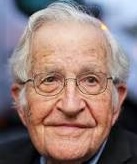
Noam Chomsky (born on December 7, 1928, in Philadelphia, Pennsylvania) is an American linguist, philosopher, cognitive scientist, historical essayist, social critic, and political activist. Sometimes called "the father of modern linguistics", Chomsky is also a major figure in analytic philosophy and one of the founders of the field of cognitive science. He is a Laureate Professor of Linguistics at the University of Arizona and an Institute Professor Emeritus at the Massachusetts Institute of Technology (MIT), and is the author of more than 150 books. He has written and lectured widely on linguistics, philosophy, intellectual history, contemporary issues, and particularly international affairs and U.S. foreign policy. Chomsky has been a writer for Z projects since their earliest inception, and is a tireless supporter of our operations.
ZNetwork is funded solely through the generosity of its readers.
Donate




