


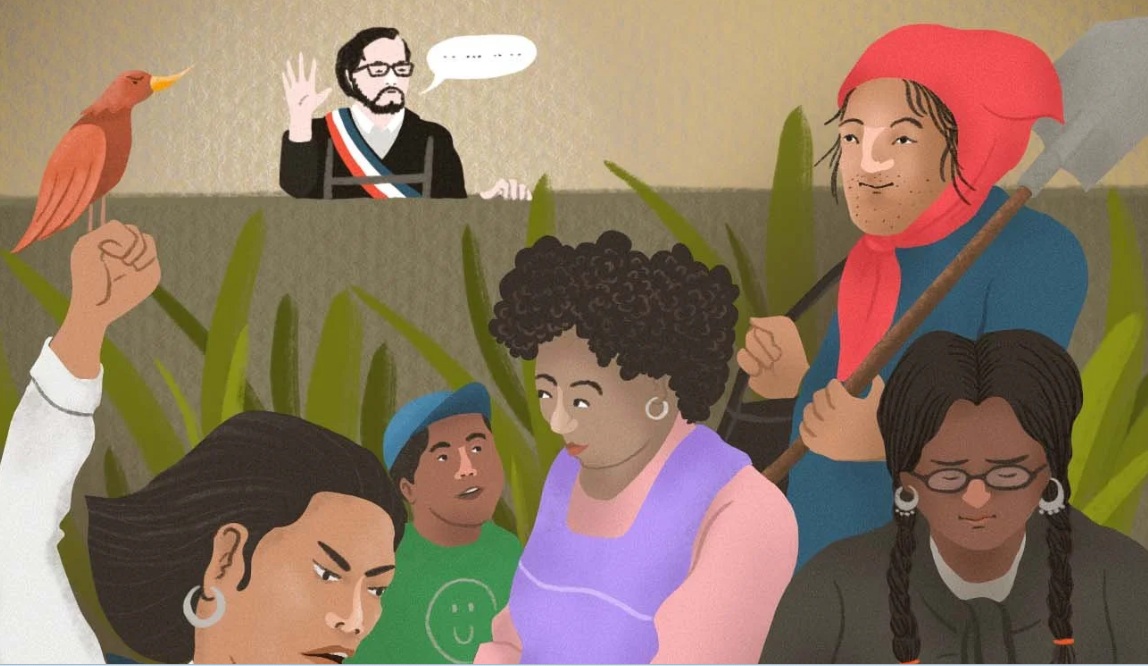
Chile’s transfeminist movement faces an uncertain future after a decade of achievements, breakthroughs, and creative political strategies. We are living in a time that demands deep reflection in order to avoid caving to the opacity of the present.
Feminist fervor erupted in Chile during what became known as “Feminist May” in 2018. That uprising, led by thousands of university students, grew to include the occupation of over 20 universities across the country and mass demonstrations to publicly condemn the violence and sexual harassment we experience at the hands of authorities, professors, and our male peers.
Since then, feminists have undergone intense processes of politicization and mass mobilization in the context of a broad, creative, and diverse movement. We have forged new paths to reorganize the struggle in the face of the “top-down” shutdown of the 2019 uprising and the double standards of Chilean progressivism.
Today, we are taking stock and talking amongst one another. We come from different organizing experiences in Chile but share common ground rooted in feminist and anti-patriarchal practice.
What follows is our contribution to the transfeminist debates initiated by Verónica Gago from Argentina, Raquel Gutiérrez from Mexico, and Susana Draper from the United States, in a bid to understand and fight the patriarchal counteroffensive.
Beyond ‘Feminist May’
Our first hypothesis is that feminist reorganization requires a deep, context-specific, transnational examination of the last cycle of protests, recognizing the genealogies of different currents of struggle and the ways in which emotional, political, and cross-country coordination was carried out.
Although 2018 appears as the high point of politicization and the popularity of the feminist movement, it can only be understood by remembering our history of organizing and recognizing the convergence of forms of resistance that built an autonomous, grassroots, territorial, anti-authoritarian, and anti-neoliberal feminism.
This accumulated experience is possible because of a century of feminist struggles. There are the anarchist, communist, and socialist workers who organized in the saltpeter mines. The feminists of the Pro-Emancipation Movement of Chilean Women, founded in 1935, who fought for full liberation for women. There are those who resisted the dictatorship of Augusto Pinochet in the 1980s, and those who, after the Latin American and Caribbean Feminist Gathering held in 1996, broke with the mainstream institutionalization taking place at that time to promote an independent feminist agenda.
Chile’s feminist movement also draws strength from student struggles of the 2000s, which gave rise to mass marches, including the ¡Cuidado! El machismo mata (2006-2009) (Look out! Machismo kills) campaign led by the Chilean Network Against Violence Against Women, and the fight for access to the morning-after pill (2008).
The experiences of land defenders have also been central. Their conceptual and organizational contributions to the struggle have brought patriarchal-colonial and neoliberal violence to light. We can look to women in sacrifice zones and the leadership of Mapuche women like Nicolasa and Berta Quintreman, who fought against the construction of the Ralco Hydroelectric Plant for over two decades.
A keystone of current transfeminist endeavors lies in reconstructing genealogies. Retracing the intellectual contributions of women and dissidents, Indigenous peoples, people of African descent, and migrants involved in cycles of struggle—past and present—sheds light on these confusing and turbulent times.
What we learned in the fire
Our second hypothesis emerges out of debates we’ve been having against the established narrative—including in progressive circles—that seeks to dismiss the 2019 social uprising as an isolated event. This narrative seeks to erase the established organizing structures that led up to the uprising, rendering them invisible. It is designed to nullify the power of the movement, as well as its networked communication and the feminist, territorialized nature of the struggle.
This fragmentary analysis is not neutral: it’s a deliberate attempt to uproot experiences of everyday insurgency. To cast doubt on the transformative power of feminisms and mass movements.
Three lessons stand out from this cycle of expansion and retreat.
First, although many of the demands made during the social uprising came from the feminist movement—as did much of the toolkit for actions—the presence of women and dissidents has been systematically erased.
We have had to work to make ourselves visible again, forcing recognition of our collective experiences, while also making clear that the uprising inherited a great deal from other organizational processes that have been similarly ignored. Our power lay precisely at the convergence of these diverse paths of struggle, most of which are excluded from the dominant narrative.
Second, it was feminist perseverance, tenacity, and creativity—adamantly sustaining the position that “we will not be sent backwards again”—that allowed us to hold a central role in the uprising. Although we put our bodies on the line yesterday and today, our place in history is still being contested.
And third, that one way to address this moment of retreat is to educate around collective memory, which serves as archive and resistance against the erasure of the uprising and the role feminism played within it.
This erasure has gone hand in hand with a broader exercise in patriarchal restoration, especially in the wake of the defeat of the first Constitutional Convention process in 2022, which was blamed on women, dissidents, Afro-descendants, and Indigenous peoples.
Conservative sectors established an unfounded but effective narrative in which they presented opposition to the new constitution as a rejection of “pro-abortion,” “pro-gender,” and “pro-Indigenous” rights, accusing proponents of engaging in so-called “identity delusion.”
The punishment was electoral, but it was also symbolic, emotional, and cultural. In response, we must insist on defending what we have built and what we dream of achieving.
A feminist government?
In the current moment, there are increased tensions between institutional and autonomous feminists. Similar to what is taking place in Mexico under Claudia Sheinbaum, the self-proclaimed “feminism” of Gabriel Boric’s government has raised problems that are worth paying attention to as we consider how progressivism conceals its drive to uphold the patriarchal order.
Appealing to feminism was instrumental in the consolidation of Boric’s support base. Many of those who voted for him in 2021 did so to prevent the far right from gaining ground. Although the government’s official narrative tends to downplay this, it took power in large part thanks to the sustained and coordinated efforts of feminist movements.
One the one hand, the government has responded to some of the movement’s demands, including the comprehensive law to end gender-based violence, the creation of a national care system, and a national registry of child support debtors (“Ley Papito Corazón”).
But on the other hand, the government has stepped up extractivism, proceeded apace with the militarization of Wallmapu for over three years, pushed through a package of repressive laws—unprecedented since the return of democracy—and criminalized migration.
In other words, the so-called “feminist” government is forcing an agenda that threatens people’s lives, especially those of Mapuche women, migrants, women of African descent, and women of color, who are fighting to keep their communities intact.
That is why we, too, have witnessed the emergence of state-led anti-feminism in Chile, which, like elsewhere, seeks to restore the patriarchal order shaken by the recent cycle of feminist protests.
One of the tasks at hand is to rearticulate feminist struggles beyond the state, in a manner suited for our times.
Some demands—such as the decriminalization of abortion—require institutional debate and legal frameworks. We are not advocating for the full-scale abandonment of those structures, but rather that to avoid allowing our political energy to get bogged down on that front.
Our murky present
We must ask ourselves how to rebuild strength after these defeats, and how to rekindle organizing and political imagination in a context that pushes us toward nihilism and isolation.
Today, countering the far right is imperative, but so is resisting authoritarianism, essentialism, and the closing of the horizon of deep social transformation, including within feminism. In Chile, anti-rights, transphobic, and anti-sex work movements have been held back, but their containment is not definitive.
Our response to the fascistization of life must come from all fronts. In carrying it out, we cannot shy away from the ideological battle we are facing.
It is time to weave the threads of collective action, while also acknowledging the tensions and doubts that we all feel.
As Audre Lorde signalled: “It is not difference that immobilizes us, but silence.” Breaking the silence and overcoming stasis is essential.


Born in Santiago de Chile, with Mapuche roots and a weichafe heart. Currently an activist researcher interested in anti-patriarchal struggles based in Puebla, México.

Andrea was born on a Sunday in the year of the earthquake in Chile. She;ss a feminist and member of the collective "Sur Territoria" and participates in the Internationalist Committee of the CF8M. She is a student in the Doctorate of Law program at the Universidad Austral de Chile and is currently in Mexico researching and exploring the field of relational dissidence.
ZNetwork is funded solely through the generosity of its readers.
Donate




