Source: Declassified UK

British officials feared Nelson Mandela would nationalise South Africa’s economy and lobbied him to protect British commercial interests as soon as he gained freedom.

The UK’s Foreign Office set out to “educate” the African leader with “sensible” economic policies and to counter “the absurdity of nationalisation”, declassified files show.

British fears were sparked one month before Mandela’s release from jail.

On 15 January 1990 Mandela issued a statement saying nationalising “the mines, banks and monopoly industries” was the policy of the African National Congress (ANC) – of which he was then deputy president – and that a change in this view was “inconceivable”.

He added that “Black economic empowerment is a goal we fully support and encourage, but in our situation state control of certain sectors of the economy is unavoidable.”

At the time, British firms in South Africa accounted for no less than half of all foreign investment in the country. Prominent among the UK companies were the banks NatWest, Barclays and Standard Chartered, which were all subject to lawsuits for complicity in apartheid after the regime fell. 

British mining companies Anglo American and De Beers also faced legal claims for exploiting black workers.

Britain had maintained and profited from these investments under decades of apartheid, with Margaret Thatcher’s government famously opposing sanctions, and had no desire to see them disappear with an ANC-led government.

‘The absurdity of nationalisation’

Britain’s ambassador in Pretoria, Robin Renwick, wrote in June 1990 that the South African state already held large holdings in many companies but that “the idea that nationalising the banks, mines and ‘monopoly industry’ can help to redistribute wealth has proved a short cut to disaster wherever it has been tried”.

Ahead of Mandela’s first visit to the UK in July 1990, just five months after his release, the Foreign Office prepared a brief stating that a key UK objective was to “encourage recognition” of “sensible economic policies which encourage investment”.

“There are some signs that economic realities are beginning to impinge” on Mandela, “with less talk of wholesale nationalisation but the process of education will take time”, Stephen Wall, private secretary to foreign secretary Douglas Hurd, wrote.

“Nationalisation is not the answer”, Wall added in his brief. South Africa needed “economic policies to foster growth and attract investment”.

When Hurd met Mandela on 3 July he asked the South African if his economic policies “included nationalisation”. Mandela replied that state ownership in his country was “nothing new” and that “the problem was an unfair distribution of resources”.

Ahead of Thatcher’s meeting with Mandela, Charles Powell, the prime minister’s private secretary, was even starker in his brief for his boss. “The absurdity of nationalisation” was one of the main issues he advised Thatcher to raise.

‘Troubled’

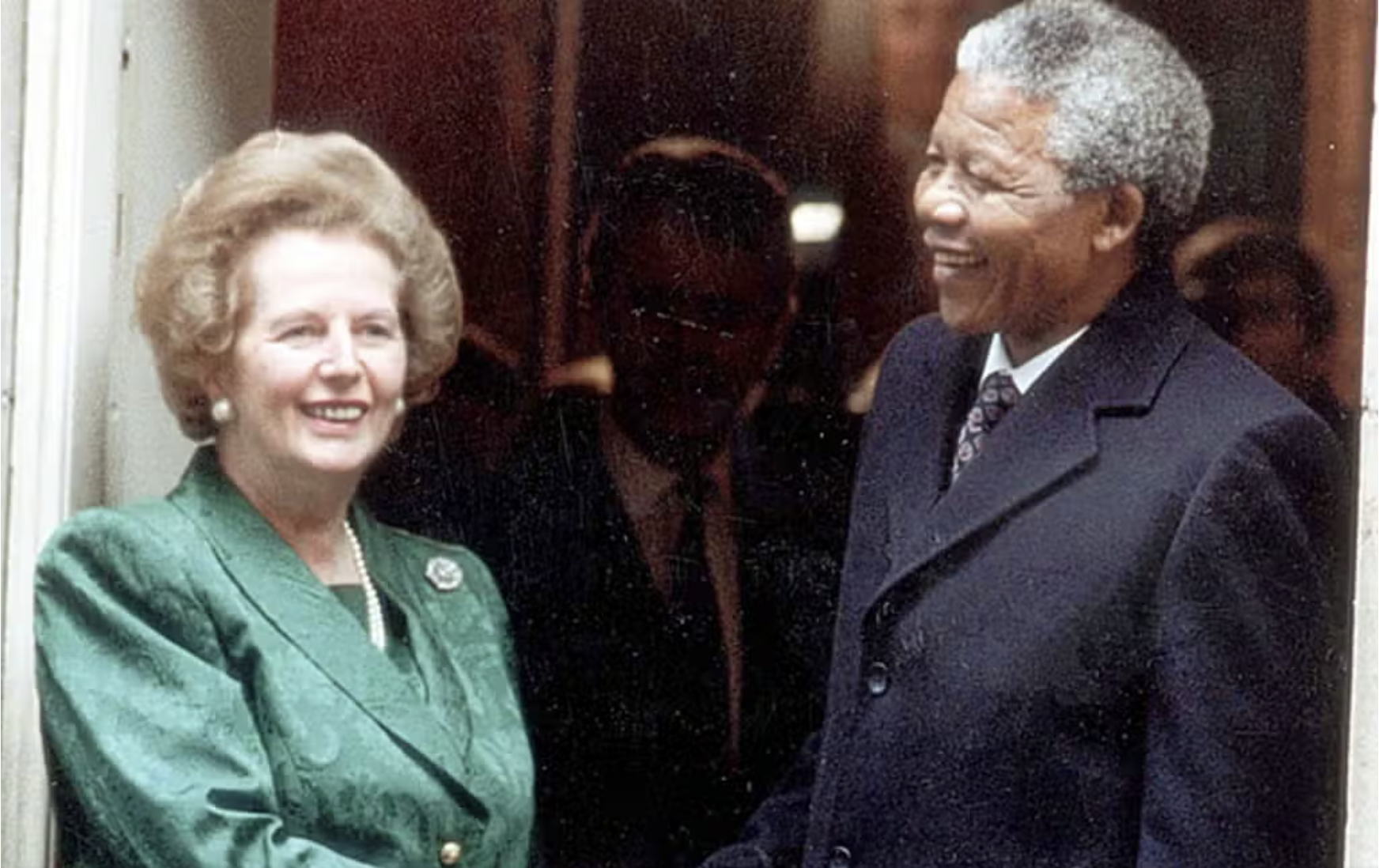
Thatcher met Mandela for the first time in person in Downing Street on 4 July 1990.

According to the British notes of the meeting: “The prime minister said that she was troubled by the emphasis given in Mandela’s remarks since his release to negative aspects such as sanctions, armed struggle and nationalisation”. 

Thatcher “stressed the importance of an open economy, in order to attract investment and create growth”.

Mandela told her that “state participation in industry was an option, but only one.” “He wanted to stress that the ANC had not decided on nationalisation: they hoped that viable alternatives could be found”.

But he also told Thatcher that “virtually all the resources of South Africa were owned by a tiny minority of the white minority”. “The great mass of black people were experiencing poverty, hunger, illiteracy and unemployment”, he added. 

“Unless this inequitable distribution could be rectified, it would not be possible to get democracy to function”.

Redistribution

The day before Thatcher met Mandela, the Foreign Office had told her that nationalisation “was clearly receding as an issue” and that Mandela was rather concerned with “the unfair distribution of resources”.

This was also what ambassador Robin Renwick had told London after meeting Mandela the previous month.

He said the ANC would not nationalise “anything” when in power and that all the major utilities were already in the public sector. The “key issue” for Mandela, Renwick wrote, “was not nationalisation but the distribution of wealth”.

“South Africa could not go on with a situation in which whites owned 87% of the land”, Renwick wrote, expressing Mandela’s view.

After Thatcher resigned in November 1990, Mandela held his first meeting with new prime minister John Major in London in April 1991.

The notes of the meeting, held in Downing Street, record that Mandela “favoured a mixed economy with public and private ownership and cooperatives”.

Officials were still not entirely reassured, however. 

Stephen Wall, who was by now Major’s private secretary, wrote that Mandela “has a remarkable lack of bitterness but his view of the world is coloured by the fact that when he went to prison Britain was still a colonial power and intervention economics were fashionable”.

The Foreign Office noted at the time that the South African economy was in recession the previous year, that unemployment was on a “massive scale” – and at over 50% in the townships – and that 84% of the rural population lived below the poverty line.

It added that there was “uncertainty about ANC economic policies” and that “they have moved a long way from calls for nationalisation but still hanker after a command economy”.

Change of stance

As debates on nationalisation in the ANC continued, Mandela’s unequivocal change of stance on the issue has been pinpointed to January 1992 during a trip to Davos, Switzerland, for the annual meeting of the World Economic Forum.

Mandela said of his conversations there with other world leaders: “They changed my views altogether. I came home to say: ‘Chaps, we have to choose. We either keep nationalisation and get no investment, or we modify our own attitude and get investment’.”

By May 1993, Mandela visited Major again in London “to encourage foreign investment”, the notes of that meeting state.

He reassured British officials that “the ANC’s economic policies had been modified, particularly regarding nationalisation, and now offered an inviting climate for foreign investment”.

Major reiterated: “He wished to see investment in South Africa: there was substantial interest on the part of UK companies in returning”.

Five months later, in October 1993 Mandela gave a speech at the Confederation of British Industry in London “calling for British companies to invest in a climate of sound economic policies”, the Foreign Office noted.

There were by now other advantages to South Africa’s economic openness. The Foreign Office wrote that “there are now no restrictions on defence sales to South Africa” and that “prospects are good for BAE’s Hawk and for naval frigates from Swan Hunter”.

“We are already the biggest foreign investor in South Africa; we hope to build on this position”, the Foreign Office said in another memo.

The UK remains a major investor in South Africa, amounting to over £20bn worth. South Africa’s mineral riches still lie substantially in the hands of British companies, with huge investments in its gold, platinum, diamonds and coal. 

‘Too democratic’

The files also contain some of the British officials’ views on Mandela. Renwick wrote in June 1990 that he “has a natural dignity and authority” but “is not as intelligent as [Zimbabwean leader Robert] Mugabe, but a great deal nicer”.

A UK brief on Mandela the following year described him as “rather old-fashioned and rather wooden in manner and a poor public speaker who nevertheless picks his words skilfully.” 

He was also “on the nationalist/Africanist wing of the ANC – loyal to, but much more moderate than, overtly socialist/SACP [South African Communist Party] elements”.

Stephen Wall wrote in April 1991 that “Mandela has enormous dignity and has borne considerable hardship with great resilience. His mind is not closed to fresh ideas but he can be obstinate and… his organisation is if anything too democratic”.


This article was originally published by Declassified UK; please consider supporting the original publication, and read the original version at the link above.

Mark Curtis is the director of Declassified UK, and the author of five books and many articles on UK foreign policy.


ZNetwork is funded solely through the generosity of its readers.

Donate
Donate
Leave A Reply

Subscribe

All the latest from Z, directly to your inbox.

Institute for Social and Cultural Communications, Inc. is a 501(c)3 non-profit.

Our EIN# is #22-2959506. Your donation is tax-deductible to the extent allowable by law.

We do not accept funding from advertising or corporate sponsors.  We rely on donors like you to do our work.

ZNetwork: Left News, Analysis, Vision & Strategy

Subscribe

All the latest from Z, directly to your inbox.

THE WIND CRIES FREEDOM

The Wind Cries Freedom, the new book from Z co-founder Michael Albert, is a sweeping oral history of a future American revolution.

Through thirty interconnected chapters, it draws out the strategies, failures, turning points, and hard-won wisdom of a movement that called itself the Revolutionary Participatory Society. These are not the polished memoirs of politicians: they are the unfiltered accounts of people who organized in neighborhoods, hospitals, universities, stadiums, courthouses, and places of worship, and kept a shared vision alive through cynicism and exhaustion.

The result is speculative political fiction that reads like history: messy, human, and quietly hopeful in the way that only real experience and long thought can produce.

Get your copy and peruse more features on the book’s website below.

“Read it, argue with it, but don’t look away. The future it recalls is one we must still fight to deserve.”

Yanis Varoufakis

“The most unusual and intriguing combination of prophecy, manifesto, and movement building manual that I have ever encountered.”

Bill Fletcher Junior

“This work fills a huge gap in our social movement literature.”

Cynthia Peters

You've just read your article on Z this month.

DOES Z'S SURVIVAL MATTER?

You keep coming back for a reason: serious political analysis, movement reporting, and debate beyond the priorities of corporate media. Today, Z is in a precarious financial position. If Z is part of how you understand the world, help keep it going. The readers who give monthly are the reason this work survives between fundraisers.

Z is in a precarious financial position. If it’s part of how you understand the world, help keep it going.

Number of donors707
Our goal1,000

Sustainers at $9/month or more receive the digital Z Magazine.

Already a sustainer? Click here and we won’t ask again. Thank you!

Your reading count is stored only in your browser and is never sent to us.

Sound is muted by default.  Tap 🔊 for the full experience

CRITICAL ACTION

Critical Action is a longtime friend of Z and a music and storytelling project grounded in liberation, solidarity, and resistance to authoritarian power. Through music, narrative, and multimedia, the project engages the same political realities and movement traditions that guide and motivate Z’s work.

If this project resonates with you, you can learn more about it and find ways to support the work using the link below.

Z is in the most precarious financial position in its history.

Z is a place to think beyond the limits of the present.

For decades, Z has brought together political analysis, movement reporting, debate, and visions of a different future from writers and activists around the world. That work is more than journalism. It is movement infrastructure: movements need places to develop ideas, test arguments, learn from experience, and imagine what comes next.

In the first two days of this fundraiser, 19 donors and 8 new monthly sustainers stepped up. Help us reach 1,000 donors who keep Z independent, for everyone.

For decades, Z has published the analysis, debate, and visions movements need, free of paywalls, ads, and billionaire owners. If that work should continue, Z needs your support now.

Number of donors707
Our goal1,000

Sustainers at $9/month or more receive the digital Z Magazine.

Subscribe

Join the Z Community – receive event invites, announcements, a Weekly Digest, and opportunities to engage.

Exit mobile version

