New York City cops are fuming.
On Tuesday, union officials gathered to publicly denounce “police haters” and defend the conduct of police officers involved in the apprehension of Eric Garner, a Staten Island man who was killed while being placed under arrest for allegedly selling untaxed cigarettes. Last week, the state medical examiner’s office said Garner died as a result of being put in a chokehold — a tactic banned by the New York Police Department.
But the problem, as union officials see it, is that the video of the arrest heightened anti-cop hysteria, and Mayor Bill de Blasio, who was elected with progressive support and ordered an investigation of the incident, acquiesced to this irrational outcry.
While this telling may satisfy conservatives convinced de Blasio is a radical leftist, the reality is much different.
To his credit, the use of stop-and-frisk has decreased under de Blasio. But even after Garner’s killing, the mayor has continued defending “broken windows” policing, the idea that cops should crack down on small crimes, such as selling loose cigarettes, before they grow into bigger problems. De Blasio also appointed Rudy Giuliani’s police commissioner, Bill Bratton, to helm the department.
Eight months in, it’s not working well.
Just last month, police violently apprehended a fare-beater with a chokehold similar to the one that killed Garner; assaulted a mentally ill person that emergency medical responders then defended; and burst into a Brooklyn apartment, dragging a naked, asthmatic woman into the hallway and allegedly pepper spraying a 4-year-old.
De Blasio has justifiably won liberal support for things like universal pre-K. So what explains his comparably conservative law enforcement policy? In short, he’s scared of his right flank.
Alex Vitale, a Brooklyn College sociologist who focuses on policing and criminal justice, told me in an interview that it’s easy for de Blasio to see the political forces in play. For example, he has to avoid upsetting upset rank-and-file cops, even though they scoffed at Garner’s death on online bulletin boards, because police unions hold considerable sway in municipal organized labor.
“They’re a part of the broader right-wing politics of the city,” Vitale said. “That includes certain white ethnic neighborhoods who basically are concerned with maintaining their social position, which is often at the expense of minorities.”
In this fight, conservatives check their typical anti-union animus and defer to the cops. There wasn’t a peep from the Right when sergeants’ union President Edward Mullins suggested that his members might delay response times — a work slowdown that would potentially violate state labor code. Imagine the cover of the Daily News if, say, the transit workers union had threatened an analogous action.
The mayor has also had to fend off recent charges that reducing the use of stop-and-frisk has caused an uptick in shootings. (While it is true that the number is higher than last year, the administration points out that shootings are still low by historic standards.) Virtually any mayor would defend police performance, but de Blasio’s trepidation is particularly apparent. A crime spike would be grist for a conservative opponent in the future.
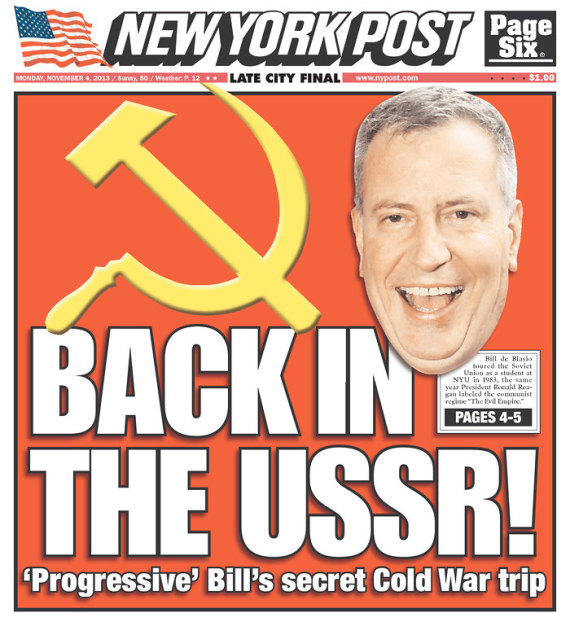
This political fear makes liberals like de Blasio rush to the center in an attempt to mollify the Right. Similar to how conservative talk show hosts deride Barack Obama as a conciliatory president while his administration ravages the Muslim world with drone strikes, so too was de Blasio painted as a bleeding heart liberal who then appointed a law-and-order police commissioner.
There’s center-left precedent for this. Vitale notes that the last Democratic mayor, David Dinkins, was known for proposing a tax increase not for more social programs like universal pre-K, but to put more cops on the street.
In addition, progressives tend to have a hard time coming up with a liberal model of policing. Vitale thinks the reason is clear: There isn’t one. We often hear about community policing alternatives but few ever concretely explain what such a thing means in practice.
The Left response, in contrast, is to address problems through social policy instead of with streets cops. Ending the drug war ends organized drug gangs. Mental health programs provide services for those who need them. Reducing inequality brings homeless people out of homelessness, rather than just throwing them in the slammer.
De Blasio is making progress in some of these areas, but his continuation of “broken windows” undercuts these modest advances. For example, even though rookie Brooklyn District Attorney Ken Thompson has stated that he will not prosecute people nabbed for small amounts of marijuana, Brattonsaid that won’t stop cops from making pot arrests in the borough anyway.
In the wake of Eric Garner’s murder, de Blasio has an opportunity to jettison Bratton and choose a more progressive alternative. Instead, cowed by the Right, he’s stubbornly doubled down on “broken windows.” Sustained movement pressure offers the only hope to stop this rightward drift.


Ari Paul has reported for the Nation, the Guardian, the Forward, the Brooklyn Rail, Vice News, In These Times, Jacobin and many other outlets.
ZNetwork is funded solely through the generosity of its readers.
Donate