

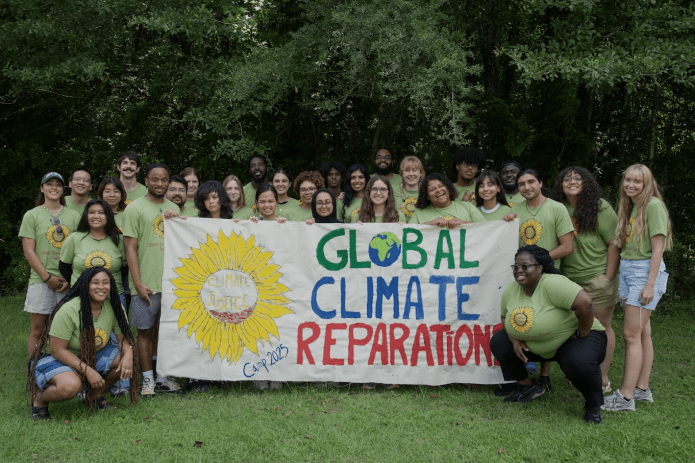
In early August, I landed in New Orleans not knowing what to expect for the next few days at Climate Reparations Camp, but I was ready for it.
August 2025 marked twenty years since Hurricane Katrina, and I felt such a weight to be in the city that experienced the disasters of the historic hurricane made worse by bad policies and bad decisions. Hurricane Katrina resulted from major flooding due to the city’s levees failing that submerged 80% of the city. Twenty years later, these levees are still sinking.
I learned quickly just how much the hurricane still impacts people here when our New Orleans-based shuttle driver told us that a regular question to ask other residents is, “What flood zone are you in?” And he said to the campers that we’re needed here, since New Orleanians are still reeling from the aftermath and non-changes of Katrina, twenty years later – and our commitment to climate justice can help them.
When we got to the campsite, the Rivers Retreat, it was beautiful. I wondered about the details of the site’s history – its irrefutable origins as Indigenous land that belongs to the Tchefuncte people and then its conversion to an Army base. Now, a gathering space for camps and wedding events.

.png)
As I met the other campers, I could tell right away the rich array of experiences and backgrounds there. We were young people from all over the country doing immigrant justice work, studying in college, and organizing in our respective communities and at the United Nations level. I was there to represent the military spending & demilitarization space, to bring in the fact that we spend so much on the military and not enough on the climate investments we need.
We were all united under the banner of climate justice and the main question that drew us here: “What is global climate reparations?” Well, the answer is not so black and white, but emergent and many-sided. In two-and-a-half days, we explored what global climate reparations look like.

.png)
Photo Credit: Action Aid USA / Brandon Wu
Brandon Wu from Action Aid USA set the scene of the world that we’re dealing with: how the Green New Deal missed a prescription for a world that favored a green transition for everyone, everywhere. We talked about the increasing militarism and kidnappings in our streets, how the Big Ugly Bill increases Pentagon funding by $150 billion and mass deportations and detentions by $170 billion for the next few years. This is not an easy hand we’re being dealt in trying to advance climate justice. We need to center the immediate protection needed of our neighbors and loved ones, but we must see the long-term vision in order to see this mess out.
Kelly Stone, also from Action Aid USA, brought the facts on climate policy and spending at the U.S. and international level. She talked about the history of the Paris Agreements, with the countries’ combined goal of reducing global heating to 1.5 degree celsius. She explained that what makes something fair is everyone doing their part even if it looks different, and it looks colossal for the United States with its large wealth capacity and large historical emissions. The U.S. climate fair share – what the U.S. owes to the rest of the world for their contribution to the climate crisis – would amount to $446 billion per year by 2035.
On that first full day of camp, we also got to hear from two compelling speakers based in New Orleans.
Sharon Lavigne, founder of RISE St. James and frontline organizer against petrochemicals in “Cancer Alley,” taught us that there is no justice without environmental justice, and that climate reparations for them looks like taking care of the St. James parrish’s immediate and long-term needs: from monitoring pollutants and getting water filters, to lasting policy changes and legal services that bring justice to the decades-long damage brought on by Formosa Plastics.
.png)
Photo Credit: Action Aid USA / Brandon Wu
Colette Pinchon Battle, founder of Taproot Earth, talked about the five elements of reparations: cessation and guarantee of non-repetition, restitution, compensation, rehabilitation, and satisfaction. Taproot Earth organized a convening in Nairobi, Kenya to come to a consensus agreement on what defines global climate reparations. Reparations look like healthy and balanced relationships, Black and Indigenous liberation, and reparative action from oppressors – to name a few.
Michel Legendre grounded us in historical examples of reparations, such as in the Indian Removal Act, the GI Bill, and even Haitians reclaiming their country but having to pay France for it – even though it was France who colonized them.
Analyah Schlaeger dos Santos led dynamic exercises on storytelling, teaching us that the story of who we are must always be known. A powerful story includes appealing and thought-provoking points, values to share and connect with an audience, and pieces of our authentic selves.
Narratives, Strategies, and Organizing
We didn’t get all that training for nothing – we made sure to apply it in multiple exercises and conversations. The campers spoke about the challenges and opportunities our communities are facing. We also “went around the world” with a world cafe exercise from the National Partnership for New Americans, applying a global climate reparations lens to the climate crises going on in different regions: Africa, Asia, South America, the Pacific Islands, and the very region of the U.S. we were in.
Community-Building
Weaved into the week were campers and our leaders connecting with one another. One night, we went to New Orleans to hear about the African-American history of the city and dined in a Creole restaurant. We shared laughs and stories and questions, and enjoyed time under the sun. We dipped into the pool and kayaked along the creek. We relished in the togetherness of camp.

.png)
Photo Credit: Action Aid USA / Brandon Wu
Takeaways
I left camp re-committed and reenergized to continue climate justice work in the peace and demilitarization movement, and vice versa.
My takeaways are these:
- We have two responsibilities right now in the climate justice movement:
- Fight fascists and protect communities.
- Build solidarity and a vision for a better world with our power.
- The money is there to move from harm towards reparations. We can look at the trillion-dollar Pentagon budget, for example.
- We must constantly ask ourselves what reparations look like locally, nationally, and globally. Does it include immediate material needs? Does it include dismantling violent systems? Does it include change in our decision-making bodies? We have to tackle the work with different faces through different fronts.
Thank you to everyone who made this experience possible, including the New Orleans land and residents and all who were part of camp.
ZNetwork is funded solely through the generosity of its readers.
Donate




