

On Sunday 30 August, US missiles struck Iranian positions on Larak Island, in the Strait of Hormuz, killing three people. The assault ended a brief lull in US’s kinetic attacks, suggesting that the strategy of economic strangulation — “economic D-day” — was not bearing fruit.
US Central Command claimed an “imminent threat” — that Iran was preparing to launch rockets carrying sea mines into the strait. Tehran rejected the claim. Since the 7 April truce, Larak has been a central point of contention in the Gulf. Along with neighboring islands Qeshm and Hormuz, Larak sits at the narrowest point in the passage between the Persian Gulf and Gulf of Oman and holds the key to controlling waters that once moved a fifth of the world’s oil.
Iran responded quickly, with volleys of missiles and drones against US bases in the region. On Tuesday 1 September, the US struck again with what Donald Trump called a “very heavy” attack, hitting targets around the country, including a wedding ceremony in southern Iran. He said that the Islamabad Memorandum — the framework he signed with Iran in June — “isn’t worth the paper it’s written on.” Trump threatened a further attack that could leave “very little” of the Islamic Republic. Iran has since changed its doctrine to pre-emptively target US threats in the region.
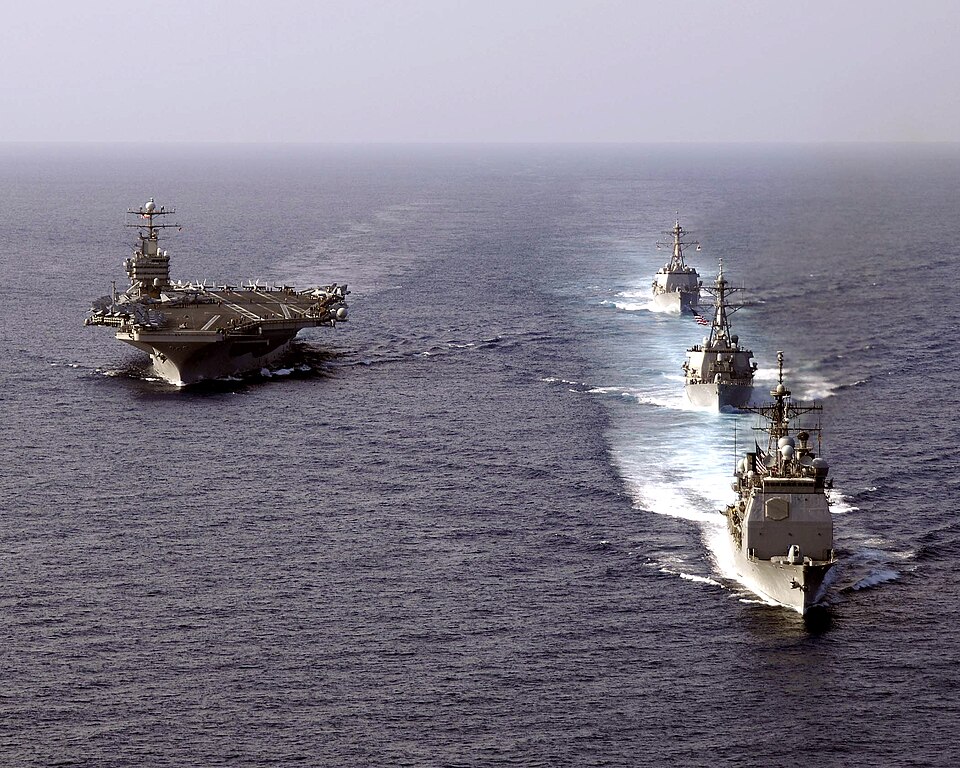
Washington’s ambitions are clear. “We took over Venezuela,” Trump said last week as the strikes continued, “and we essentially took over Iran.” But the US fleet tells another story. In a pair of investigations this month, the New York Timesdocumented the devastating effects of Iran’s retaliation on US forces. Iranian missiles and drones destroyed much of Naval Support Activity Bahrain — the headquarters of the Fifth Fleet and the Navy’s principal logistics hub in the Gulf. Fujairah, the only other regional port where carriers take on supplies and crews take leave, sits well within range of Iranian missiles. The fleet has since sustained itself from Diego Garcia, an atoll 3,500 kilometers from the carrier operating areas in the Gulf of Oman — a base built on an island that Britain had emptied of its people to host it. The only alternative is 6,000 kilometers away in Singapore.
The logistics are placing an enormous strain on US forces. According to the Times, roughly twenty US warships and some 20,000 sailors and Marines consume more than 420,000 meals and around 30 million litres of fuel every week. All these resources are now shuttled across the Indian Ocean in a handful of ships that are slow and exposed. The Chief of Naval Operations, Admiral Daryl Caudle, conceded that his personnel “aren’t getting back” to Bahrain anytime soon.
Then there is the human cost. The USS Abraham Lincoln left San Diego on 21 November 2025 for a planned seven-month deployment. It is only now returning — after 266 days at sea, 200 of them in combat, with more than 10,000 sorties flown and 1.5 million pounds of ordnance dropped. Sailors and their families described food shortages, rationed hygiene supplies, mail lost for months, toilets overflowing into sewage-soaked washrooms. The ship has since landed in Thailand’s Pattaya — a former fishing village that US forces turned into a hub of sexual exploitation during their invasion of Vietnam — coated in rust. To relieve the Lincoln, the Navy is steaming the USS George Washington from Japan — stripping the Pacific theatre of its only carrier.
In 2020, the US strategist A. Wess Mitchell prepared a study for the Pentagon’s Office of Net Assessment on how the United States might avoid a multi-front war it could no longer fight. His Marathon Initiative developed the notion further in 2024. Washington faces “a growing risk of multi-front war against Russia, China and Iran,” it said, and must therefore take its adversaries in sequence — a world war waged in pieces. This reality is increasingly acknowledged across the West. The Italian State Attorney General’s Office has recently said that “a fragmented and hybrid world war is currently underway, involving, among others, Italy…”
But Iran’s effective and enduring response has thrown a spanner into the works. The US assault on Iran was meant to be the short war — decapitate the leadership, foment unrest, and seize the oil flows. The war is now in its eighth month and Iran is emerging with a powerful strategic advantage. The blockade has not broken Iran’s hold on Hormuz; the fleet enforcing the blockade cannot feed itself; the Pacific has lost its carrier to keep the first front supplied; and difficult or impossible-to-replace military technology, including advanced radars and high-altitude interceptors, has been destroyed and exhausted at unprecedented rates.
The defeats in this multi-front war’s opening chapters may very well prevent the US from escalating further afield. But this outcome is by no means guaranteed. The countries of the West are embarking on the largest armament spree in history, putting their economies on war footing. Washington strategists envisage a succession of wars that destroy the emergent centers of sovereignty and submit the entire global economy to the permanent rule of empire. Our task is to stop the wars we see today from becoming the springboards to the next.
ZNetwork is funded solely through the generosity of its readers.
Donate




