

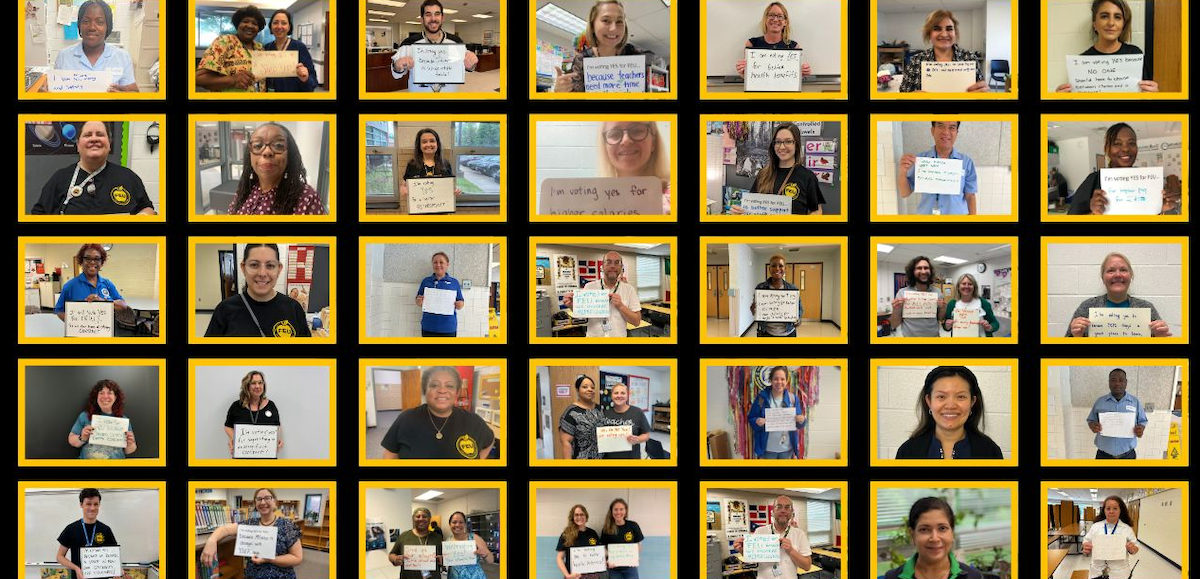
Education unions just won a massive victory in the fight to bring collective bargaining rights to Virginia’s public sector. Workers at the Fairfax County Public Schools voted this week to unionize, creating a wall-to-wall union of 27,500 teachers, custodians, teaching assistants, bus drivers, and more.
The new bargaining unit is one of the largest K-12 unions on the East Coast, according to the National Education Association.
Fairfax County is in Northern Virginia, near Washington, D.C., and the Fairfax County school district is by far the largest in the state.
But many teachers, especially newer ones, live outside Fairfax County because housing there is too expensive. And “a lot of custodians do two or three jobs just to provide for their families,” said Ernesto Escalante, a building supervisor at Crestwood Elementary and an activist in the union drive.
OUTLAWED FOR DECADES
Public sector collective bargaining has been outlawed in Virginia for decades. Unions were not illegal, but they had no bargaining rights, and had to rely on persuading school boards and legislators.
But in 2021, a new state law lifted the ban. The law, a compromise measure negotiated among not-very-labor-friendly Democratic legislators, didn’t mandate public sector bargaining rights, but instead established a mechanism for counties and municipalities to choose to enable collective bargaining.
Local governments can reject collective bargaining altogether, or pick and choose which workers they will bargain with. They can also decide what they will bargain over.
So far, the Firefighters (IAFF) have won five contracts, as well as Prince William County teachers and support staff with a National Education Association (NEA) affiliate. Richmond schools workers have also organized, as have others. But in Virginia Beach, where some city workers started organizing with the United Electrical Workers before the law was passed, the city council recently rejected an IAFF petition for collective bargaining.
The union behind this week’s big win, Fairfax Education Unions, is a coalition of the local affiliates of the two national teacher unions, the NEA and the AFT. Rather than compete to represent the workforce, the two unions banded together.
After the school board unanimously passed a collective bargaining ordinance, the union launched a petition to demonstrate support for a union drive. Activists and organizers then spent the spring signing up members on union authorization cards, submitting them on May Day.
The election was held at the beginning of June. Eighty percent of the “operational” workers and 96 percent of the “instructional” unit voted yes.
RELUCTANT AT FIRST
How did they win? “On-the-ground organizing got us there,” says Fran Lewandoski, a school social worker with 20 years in. “Person-to-person organizing, recruiting interested people, getting leaders in buildings, providing them with guidance.”
Escalante said that while many custodians knew that their conditions weren’t great, at first they were reluctant to talk about changing them. He experienced a breakthrough when they dug into an issue specific to their work: air conditioning.
The school district turns off the conditioning during the summers—but the custodial staff is still working to clean, paint, and do bigger maintenance on the buildings. By focusing on an issue that workers really cared about, he could get the message across: “If we work together, we can change our working conditions.”
Many people had little knowledge about what it would mean to have a union, or what it would take to get there. For activists like Escalante and Lewandoski, a big part of their organizing work was sharing information about the process and fielding questions.
The union’s petition was a “vehicle for having conversations,” according to Lewandoski, and an opportunity to talk people through the many questions they had.
WHAT’S NEXT?
After a short celebration, activists are getting to work to prepare for bargaining. Lewandoski and other social workers and school psychologists are meeting next week to discuss priorities for their titles. The union also plans to distribute a bargaining survey.
Escalante says he is excited to advocate for custodian issues at the bargaining table, while working alongside other workers in the school system: “It feels good to work with the teachers—to know they have our backs.”
Lewandoski believes there’s a chance here for real change in people’s work lives. The union drive “elevates the voice of the rank-and-file employees, and that’s a really exciting opportunity,” she said. “It means a lot when people have a say in how their work is structured and carried out.”
ZNetwork is funded solely through the generosity of its readers.
Donate
