




‘Barbie stages in Barbieland the equivalent of the Protestant Reformation’
I finally got what director Greta Gerwig was up to in her movie Barbie, which features Margot Robbie as the adult doll Barbie. She’s out to give a lesson in Marxism, the candy-coated kind that she thinks is palatable to Gen Z. At one level, Barbie is a film targeted at the coming-of-age demographic, works out their “existential crises,” and resolves this with a stereotypical Hollywood ending. But there’s another, deeper level, and this is aimed at Gen Z’s subconscious. For the most part, the two levels proceed in a congenial, parallel fashion, until the end — but let’s leave that for later.
To fully appreciate what Gerwig is trying to do, you have to use a companion text, Marx’s Theses on Feuerbach, the seminal text where Marx critiqued the thought of the philosopher Ludwig Feuerbach who had weaned him away from G.W. Hegel’s idealism, which saw empirical reality as a pale reflection of the “Spirit,” a philosophical tradition that goes way, way back to Plato.
Let’s start with Thesis Four. Marx wrote: Feuerbach starts out from the fact of religious self-alienation, of the duplication of the world into a religious world and a secular one. His work consists in resolving the religious world into its secular basis. But that secular basis detaches itself from itself and establishes itself as an independent realm in the clouds [that] can only be explained by the cleavages and self-contradictions within this secular basis. The latter must, therefore, in itself be both understood in contradiction and revolutionized in practice.
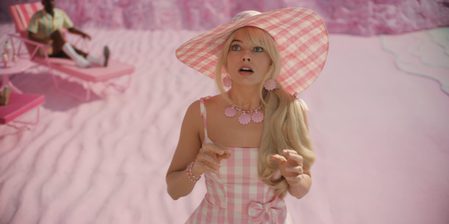
Barbieland is the religious world that Marx talks about, the “independent realm in the clouds” where all the contradictions that exist in reality magically vanish. It is the human subject’s projection of the real world that leaves the conflicts, contradictions, and crises of the latter behind.
Let’s move on to Thesis Eight, where Marx asserts: All social life is essentially practical. All mysteries which lead theory to mysticism find their rational solution in human practice and in the comprehension of this practice.
Even though it’s an ideal world, Barbieland is not seamlessly constructed. There’s a crack in Barbie’s world — she wakes up and finds out she has cellulite and flat feet — and she is forced to come down to earth to be “fixed” and discovers that the world is full of contradictions and conflicts that the elite, the black-suited directors of Mattel, don’t want people to grapple with and solve collectively, by focusing their attention instead on the ideal relationships of Barbieland. Barbie’s unexpected appearance threatens the long-standing equilibrium between the ideal and the real.

In Thesis Eleven, Marx’s most quoted text, he says: The philosophers have only interpreted the world, in various ways. The point is to change it.
Barbie’s trip to the real world enlightens her, and she returns to the ideal world in order to fix the world of ideas to reflect the real world. She stages in Barbieland the equivalent of the Protestant Reformation. She wins, but she’s no longer interested in just being Martin Luther, in simply winning the theological battle. She decides to return to the real world to change it. She wants to be Martin Luther King. This is where the two levels of the movie come into conflict.
The movie ends with Barbie returning to earth to see a gynecologist. Huh? There’s something wrong here. But it’s not Barbie. It’s Greta. This is, after all, still Hollywood, and Gerwig can’t resist the temptation of a Hollywood ending that will rake in all those dollars — and beat Oppenheimer at the box office as well. But by this time Gen Z does not need Gerwig to follow Barbie to the logical conclusion of her political development. They actually know she will use the visit to the obgyn as a decoy, leave by a side-door, walk over to the HQ of Mattel, the capitalist behemoth that created Barbie and her ideal world, her jaw clenched to convey her determination to carry out her mission as she disappears in a slow fade-out.
ZNetwork is funded solely through the generosity of its readers.
Donate

