


The late Israeli commentator, Uri Avnery, wrote, “I am increasingly worried that the Israeli-Palestinian struggle … is assuming a more and more religious character.”
At first glance, the statement may seem baffling. If Israel is a ‘Jewish State’ that serves as a ‘homeland’ for all Jewish people, everywhere, does it not follow that the ‘struggle’, at least from an Israeli viewpoint, is essentially a religious one?
If only it was that simple.
Israel’s dichotomy is that it was founded by an ideology, Zionism, which purposely conflated between religion and nationality.
“The Zionist movement was non-religious from the start,” Avnery wrote, “if not anti-religious.” He went on to cite a famous quote by the founder of Zionism, Theodor Herzl, that “we shall know how to keep (our clergymen) in their temples.”
Clearly, Herzl’s descendants could not keep the “clergymen in their temples”. The once marginal impact of Israel’s religious Zionists has long exceeded the margins allocated to them by their liberal brethren.
It is the likes of Itamar Ben-Gvir and Bezalel Smotrich, Israel’s far-right ministers of national security and finance, respectively, who are the new kings of the hill.
The days of Chaim Weismann, David Ben-Gurion, Levi Eshkol and even Shimon Perez are long gone, and most likely irreversibly so.
The irony and the source of confusion is that all past and current leadership of Israel – liberal, conservative or religious – are proud Zionists who saw Judaism as a centerpiece in the Israeli identity.
But how can one then understand the current layers of religious, class, ethnic and, ultimately, ideological conflicts at work in Israel?
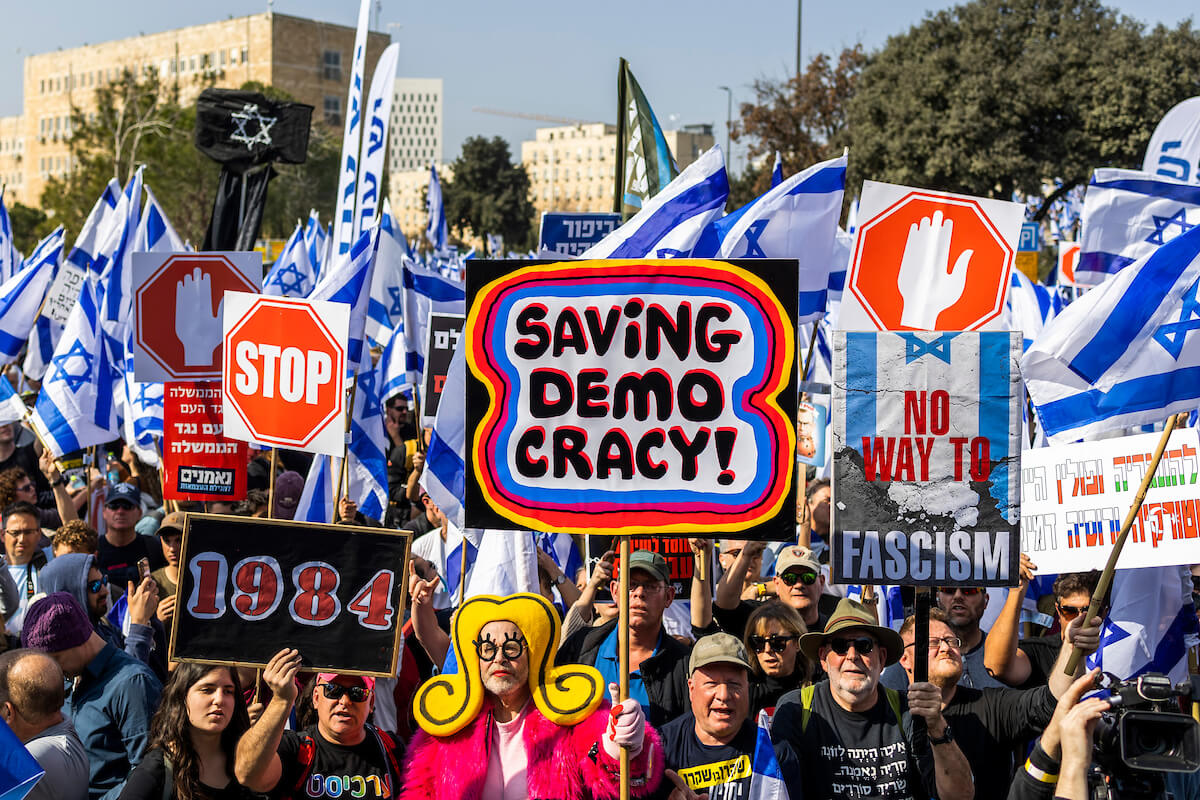
The simple explanation of Israel’s ongoing protests is that nearly half of the Israeli population objects to judicial reforms championed by an extremist rightwing government under the leadership of Benjamin Netanyahu.
Protesters say that the mass mobilization aims at saving Israeli democracy from the likes of Ben-Gvir and others.
Yet, there was no such mobilization when Israel passed its Nation-State Law in 2018, defining Israel as the “national home of the Jewish people, in which it fulfills its natural, cultural, religious and historical right to self-determination.”
The truth is that most Israeli Jews have no qualms with a law that exists to discriminate against the Palestinian Arab citizens of the country. This should hardly be a surprise as Israel is a settler-colonial state whose very existence was made possible by the expulsion of most of the native Palestinian population.
The phrasing of the Nation-State Law, however, did not only exist to cancel the rights of the Palestinians, but to ensure some kind of balance between the competing Israeli-Jewish groups.
Writing in Haaretz in June 2017, Shlomo Sand asserted that Zionism was a national movement that “rebelled against historical Judaism” and that it “was mainly atheistic”.
In this context, atheism did not simply translate to the denial of God’s existence, but also to the rejection of all religious myths, notions and beliefs affiliated with traditional Judaism.
It was no wonder that religious Jewish organizations and communities in Europe had initially rejected Zionism and perceived early Zionist leaders as heretics.
Yet such terms as ‘Jews’ and the ‘Jewish people’ remained essential to atheistic Zionists because such references were not only strategic and functional, but critical to the very survival of the ideology.
“For the atheistic Zionists, God was dead and, therefore, the Holy Land became the homeland,” Sand argued, describing how Zionists converted Judaism from a religion to a national movement.
This is why the language of the Nation-State law was phrased in such a way. When the terms ‘natural’, ‘cultural’, ‘religious’ and ‘historical’ are combined, they produce a relatively modern definition of nationhood – though an exclusivist and racist one.
The way that liberal Zionists redefined religion according to nationalistic lines, religious Zionists are now redefining nationality according to religious beliefs.
Armed with a legally binding definition of Israel as an exclusively Jewish state, many Israelis would like to see the religious component of the state become the dominant one, thus challenging the liberal Zionists’ peculiar definition of ‘democracy’.
For that to happen, the country’s political, educational, judicial and military systems would have to be entirely revamped to adhere to a religious, messianic code and priorities.
Now that Israel’s most rightwing government in history has a comfortable majority, the next step is to remove the main obstacle out of the way: the judicial system and, particularly, the Supreme Court – the only entity capable of blocking or reversing the government’s decisions.
The media presentation of Israel’s mass protest as a fight for democracy is misleading, at best, as it fails to address the historical, ideological and, ultimately, class divides in Israeli society.
When the state of Israel was finally established on the ruins of historic Palestine in May 1948, it was liberal and atheistic Zionists who declared its independence, invented its founding myths and labored to give it international legitimacy.
References to Jews, Judaism and the Jewish people were enough to give it a religious façade and appeal, but not enough to hand the keys over to religious Zionists.
The latter group proved critical to liberal Zionists, as they became the backbone of Israel’s colonial enterprises in the Occupied Palestinian Territories following the 1967 war.
Not until the late 1970s did right-wing, revisionist Zionism become more relevant, and not until recently did religious Zionists become the power brokers, dominating the Israeli government and some of the most critical political institutions.
It seems that the balancing act of liberal Zionists of being both Jewish and democratic has failed. This strange equation has served Israel well among its Western allies, who not only believed in this perplexing reasoning, but defended it as well.
Thus without “Jewish and democratic” together in the same sentence, the idea of Israel will become even more indefensible in the future.
Ideological shifts do not appear and disappear overnight. Regardless of the outcome of Israel’s protests, the ideological shifts in Israel are seismic and long-lasting.
For now, liberal Zionists and their Western allies must accept the historical truth that Herzl’s “clergymen” have escaped the “temples” and are now running the country.


Ramzy Baroud is a US-Palestinian journalist, media consultant, an author, internationally-syndicated columnist, Editor of Palestine Chronicle (1999-present), former Managing Editor of London-based Middle East Eye, former Editor-in-Chief of The Brunei Times and former Deputy Managing Editor of Al Jazeera online. Baroud’s work has been published in hundreds of newspapers and journals worldwide, and is the author of six books and a contributor to many others. Baroud is also a regular guest on many television and radio programs including RT, Al Jazeera, CNN International, BBC, ABC Australia, National Public Radio, Press TV, TRT, and many other stations. Baroud was inducted as an Honorary Member into the Pi Sigma Alpha National Political Science Honor Society, NU OMEGA Chapter of Oakland University, Feb 18, 2020.
ZNetwork is funded solely through the generosity of its readers.
Donate




