

The clock is ticking toward September 14 at midnight, when the United Auto Workers’ (UAW) contracts with the Big Three automakers expire. The new leaders of the UAW have come out swinging, and in quickly growing numbers, members are stepping up to prepare for a strike.
The agreements cover close to 150,000 workers at Ford, General Motors (GM), and Stellantis.
In early August UAW president Shawn Fain presented a list of “the Members’ Demands” to the companies, calling them “the most audacious and ambitious list of proposals they’ve seen in decades.” These bargaining goals are aimed at undoing concessions extracted by the companies from previous union administrations since before the Great Recession. A major goal is to ensure that the transition to electric vehicles is not used to further undermine auto workers’ standards.
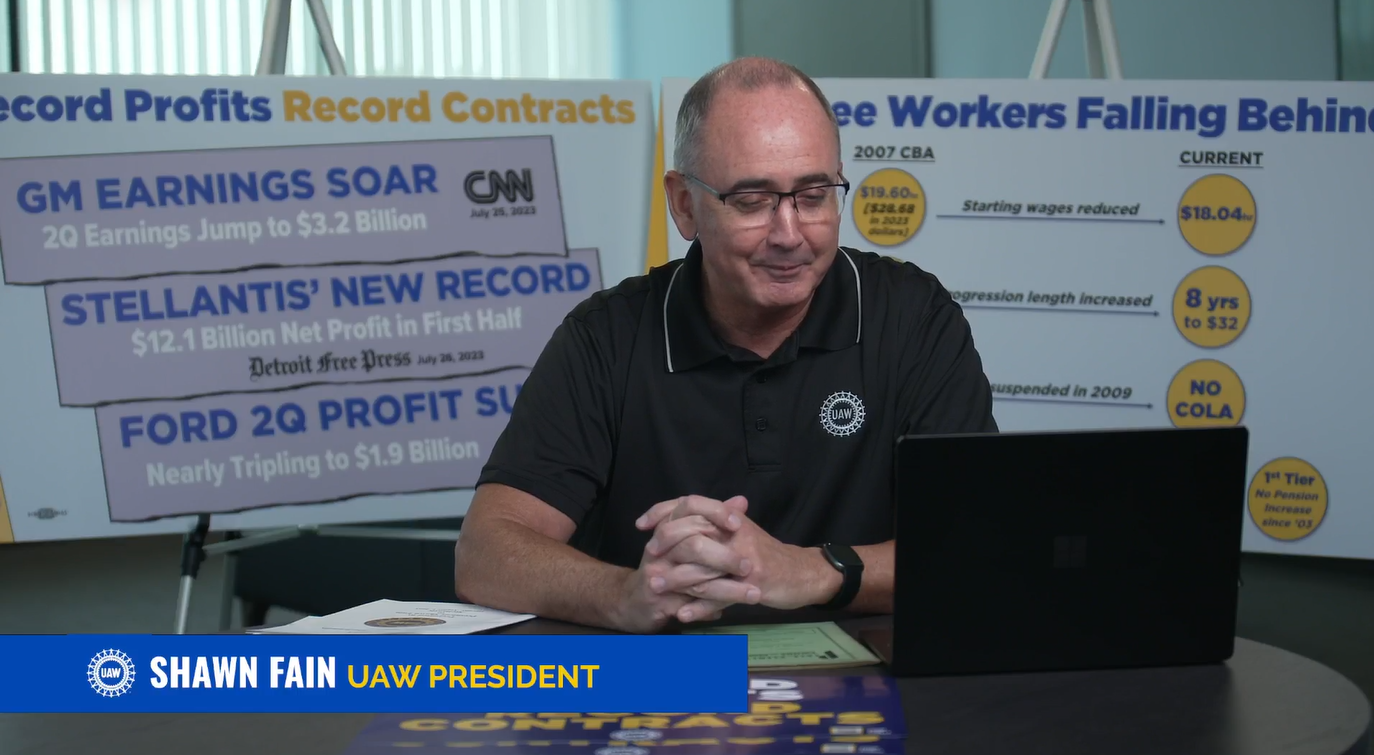
Entering this round of bargaining, the Big Three have reported a combined $21 billion in profits in the first half of 2023. This comes on top of profits of $250 billion over the last ten years. “Our message going into bargaining is clear: record profits mean record contracts,” Fain told UAW members on Facebook Live on August 1.
Instead of the UAW’s past tradition of targeting just one auto company in bargaining, then basing contracts for the others off that model, Fain warned all three companies to consider themselves targets, keeping them guessing about which one may ultimately be struck — or whether union members might walk out at all three. In 2019, forty-nine thousand UAW members struck GM for six weeks.
Among the demands Fain presented are:
- Eliminating tiers on wages and benefits, plus double-digit raises for all
- Restoring cost-of-living adjustments, which were suspended during the Great Recession
- Restoring the defined-benefit pension and retiree health care for all; workers hired since 2007 have neither
- Increasing pensions for current retirees; there’s been no increase since 2003
- The right to strike over plant closures
- A “working family protection program.” If the companies shut down a plant, they would have to pay laid-off workers to do community service work.
- Making all current temps permanent employees, with strict limits on the future use of temps
- Increasing paid time off
Protecting Electric Vehicle Workers
The union is simultaneously pushing to improve conditions for electrical vehicle (EV) battery workers employed at joint ventures between the Big Three and South Korean firms. A letter signed by twenty-eight Senators urged the companies to fold these battery workers into their master agreements with the UAW. “These are highly skilled, technical, and strenuous jobs,” read the letter. “It is unacceptable and a national disgrace that the starting wage at any current American joint venture EV battery facility is $16 an hour.”
The companies say that these proposals are too expensive and threaten their competitiveness, especially when they are ramping up investment to convert to EVs. Fain says that this argument ignores recent history: “When the Big Three say the future is uncertain and the EV transition is expensive, remember that they’ve made a quarter of a trillion in North American profits over the last decade and have poured billions of it into special dividends, stock buybacks, and supersized executive compensation.”
Pay for the Big Three CEOs rose by an average of 40 percent since 2019, with GM CEO Mary Barra alone raking in $29 million in compensation in 2022. “We know our members are worth the same and more,” said Fain.
More Transparency
Fain was elected in March on a slate backed by the reform movement Unite All Workers for Democracy (UAWD), on a platform of “No corruption, no concessions, no tiers,” ending seventy years of one-party rule in the UAW. He is not only pushing a more militant approach in bargaining but also promising more transparency with the members.
“Bargaining’s not a one-person show,” Fain said. “Those days are gone, and gone with those days is the false belief that union contracts are solely won by the president.”
This time around, Fain has had particularly harsh words for Stellantis, the parent company of Jeep, Ram Trucks, and Chrysler formed in 2021 through a merger of Fiat Chrysler and Peugeot. “I have been shocked to see how one company in particular is trying to lowball and undercut us,” he said on Facebook Live on August 8.
Fain said that concession demands included removing a cap on temps and cutting vacation for new hires — and then he dumped Stellantis’s proposal in the trash.
Past UAW leaders bargained behind closed doors, never organizing members to pressure the Big Three and declining even to reveal specific bargaining goals. Leaders sometimes called major strikes last minute to soften members up to accept lousy offers.
Nonetheless, UAW members kept alive a wall-to-wall culture of honoring picket lines.
Members in Motion
This year, some old-guard regional directors and local officers are refusing to promote the contract campaign — calling it a UAWD plot. But Fain’s assertive and open approach has encouraged members — and some skeptical officers — to jump into the fight
.
On Facebook Live on August 15, he said, “I’m asking rank-and-file activists all around the country to do everything you can do to get organized in your plant. . . . Our national organizing department is putting together weekly virtual trainings that will walk you through how to organize actions at your workplace.”
Fain specified getting out a big strike vote, putting signs in car windows, and — taking a page from the Teamsters’ book — staging parking lot rallies and practice pickets. Besides strike votes, none of these tactics has been used by the UAW for many decades.
In addition, UAWD is encouraging members to spread information and spirit through “10-minute meetings,” in-person meetings at work with a group of coworkers.
At Ford’s big Chicago plant, five hundred members of Local 551 attended two-hour strike training classes in early August, organized by members and local officers. Nearly one hundred volunteered as strike captains.
Before the class got started, some members showed each other videos of Fain’s demands on their phones: “Forty-six percent raise by the end of the contract? That’s right on.” Members cheered when local officers repeated the threat to strike all three companies at once, if needed.
The training raised ideas for escalating pressure on Ford before expiration, with inspiration from a video of “practice picketing” by UPS Teamsters. One of the biggest applause lines came from a facilitator’s suggestion to “do no favors for managers!”
Members’ fighting spirit came out fast in questions. Assembly worker Wayne Davis asked, “How do we get others ready to endure as long as it takes?”
ZNetwork is funded solely through the generosity of its readers.
Donate




