

On 4 March 2026, a US military vessel torpedoed and sunk the unarmed Iranian frigate IRIS Dena off the southern coast of Sri Lanka. The illegal strike killed over 80 and injured over 30 Iranian sailors, who were returning home after participating in the Indian Navy’s flagship biennial multilateral naval drill, Exercise MILAN, and the International Fleet Review, in Visakhapatnam.
The Sri Lankan authorities mobilised to rescue the sailors and grant them safe passage. The sinking of the IRIS Dena by a torpedo strike is the first such incident since World Anti-Fascist War (World War II), and a significant escalation of the New Cold War in Asia.
Ironically, the attack coincided with the 55th anniversary of the UN declaration of the Indian Ocean as a Zone of Peace – a proposal championed by Sri Lanka and Tanzania in the heyday of the Non-Aligned Movement.
Centre of Gravity
Asia today sits at the heart of a New Cold War being imposed by the US on the region. With the People Republic of China as its principal engine, the centre of gravity of the world economy has shifted to Asia. Asia is home to approximately 60 percent of the world population. Between 2015 and 2025, the region contributed to 70 percent of global economic growth. Much of this growth has been driven by production – over 57 percent of world manufacturing value added come from Asia.
While industrial success has brought significant gains in social indicators, it has also been uneven, often failing to transcend peripheralisation. In 2022, Sri Lanka became the first country in Asia to default on its sovereign debt in the 21st century – Sri Lanka is now undergoing its 17th IMG programme. According to the World Bank, nine countries in Asia are in debt distress, and 6 are undergoing IMF programmes. Despite its economic weight, Asia remains dependent on the dollar and lacks regional alternatives to the Bretton Woods institutions.
Flood and Fury
Today, West Asia has become home to one of the most acute humanitarian crises of the 21st century – the ongoing genocide of Palestinians in Gaza, which is perpetrated by the state of Israel with the backing of the United States and Europe. Over 70,000 Palestinians have been killed by Israeli strikes since 7 October 2023. The life expectancy in Gaza has nearly halved from 75 to 40 years.
The war on Gaza has escalated into a regional war, intensified by the fall of the Baathist government in Syria and the rise of US-backed government of Ahmed al-Sharaa. Israeli strikes have expanded to southern Lebanon and, with US backing, to Iran, in total violation of international law. The assassination of Hezbollah leader Hassan Nasrallah in September 202 and Iranian leader Ayatollah Khamenei in February 2026 marked significant escalations of imperialist aggression in the region. Yet the resistance of the Iranian people reveals the desperation of imperialism which struggles to achieve its political goals despite use of arms.
The Double Bind
Asia is enmeshed in a garland of over 270 US military bases. These bases stretch from the Persian Gulf states in the west, to Diego Garcia in the Indian Ocean, to the chain of bases along Philippines, South Korea, Japan, Guam, and the Marshall Islands in the east. These bases are supplemented by a complex network of partnerships and military agreements such as the Quadrilateral Security Dialogue or Quad (2017), AUKUS (2021), the Pacific Deterrence Initiative (2021), and the US-Japan-South Korea Trilateral Agreement (2023).
This military architecture is part of the US ‘strategy of denial’ designed to encircle China and constrain its development. The contradiction at the heart of the strategy is that the hosts of US bases and partners of these agreements themselves have a strong measure of economic interdependency with China. The US drive towards militarisation therefore creates tensions rather than resolving them and diverts precious resources into the pockets of military contractors rather than investment in education, healthcare, infrastructure and production. Peace and development in Asia require a strategy of regionalism and multilateralism, led by the peoples of the region.
The ‘Gen Z’ Question
Amid war in West Asia and militarisation in the East Asia, the political and economic crises in South Asia have been multiplying. The crisis of neoliberalism has led to uprisings toppling governments in Sri Lanka (2022), Bangladesh (2024), and Nepal (2025). These uprisings have been attributed to the amorphous category of ‘Gen Z’, which masks more than it reveals. Slogans about corruption, nepotism, and authoritarianism reveal deep discontent, but stop short of identifying the principal contradiction of imperialism and its economic structures.
In reality, the countries of South Asia are witnessing social discontent driven by youth unemployment, rural-agrarian crises, climate change, and migration. The resulting social embers pose opportunities for social transformation or imperialist co-option. In Nepal and Bangladesh, these uprisings have led to a drift towards the right. In Sri Lanka, the left eventually came to political power but has been unable to advance an alternative economic agenda.
Hands off Asia!
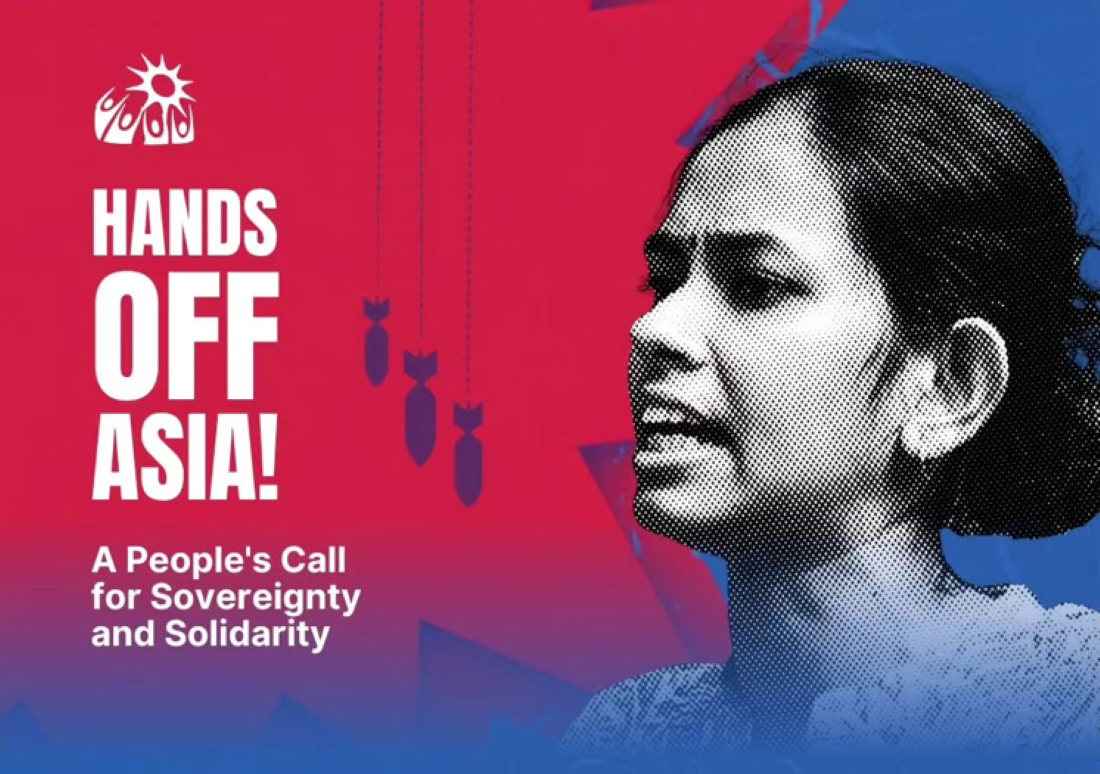
It is in this context that the International People’s Assembly, with the support of Tricontinental: Institute for Social Research, hosts the “Hands off Asia! A People’s Call for Sovereignty and Solidarity” in Colombo on 16, 17, and 18 July. The conference brings together, movement leaders, scholars, and diplomats from seventeen countries across the region in a dialogue about the pressing issues of the current conjuncture.
The conference aims to: 1. Build a shared understanding of the imperial attack on Asia; 2. Create a space where movements, parties, people’s organisations, and thinkers can share their experiences of struggle and build lasting working relationships, 3. Develop a shared programme of demands; 4. Deepen the political understanding of Asian organisations by connecting everyday struggles to the bigger picture of imperial domination; and 5. Produce a more nuanced and cohesive understanding that can guide the next stage of united anti-imperialist work across the continent.
The people of Asia know the cost of imperialism and remember the many historic struggles and revolutions across Asia – from the Arab Revolt (1917–1918), to the Chinese Revolution (1949), to Vietnam’s Resistance War Against the US (1955–1975). The same fight against imperialism is being waged today on many fronts, from Gaza to Colombo to Okinawa. Hands off Asia!
ZNetwork is funded solely through the generosity of its readers.
Donate




