


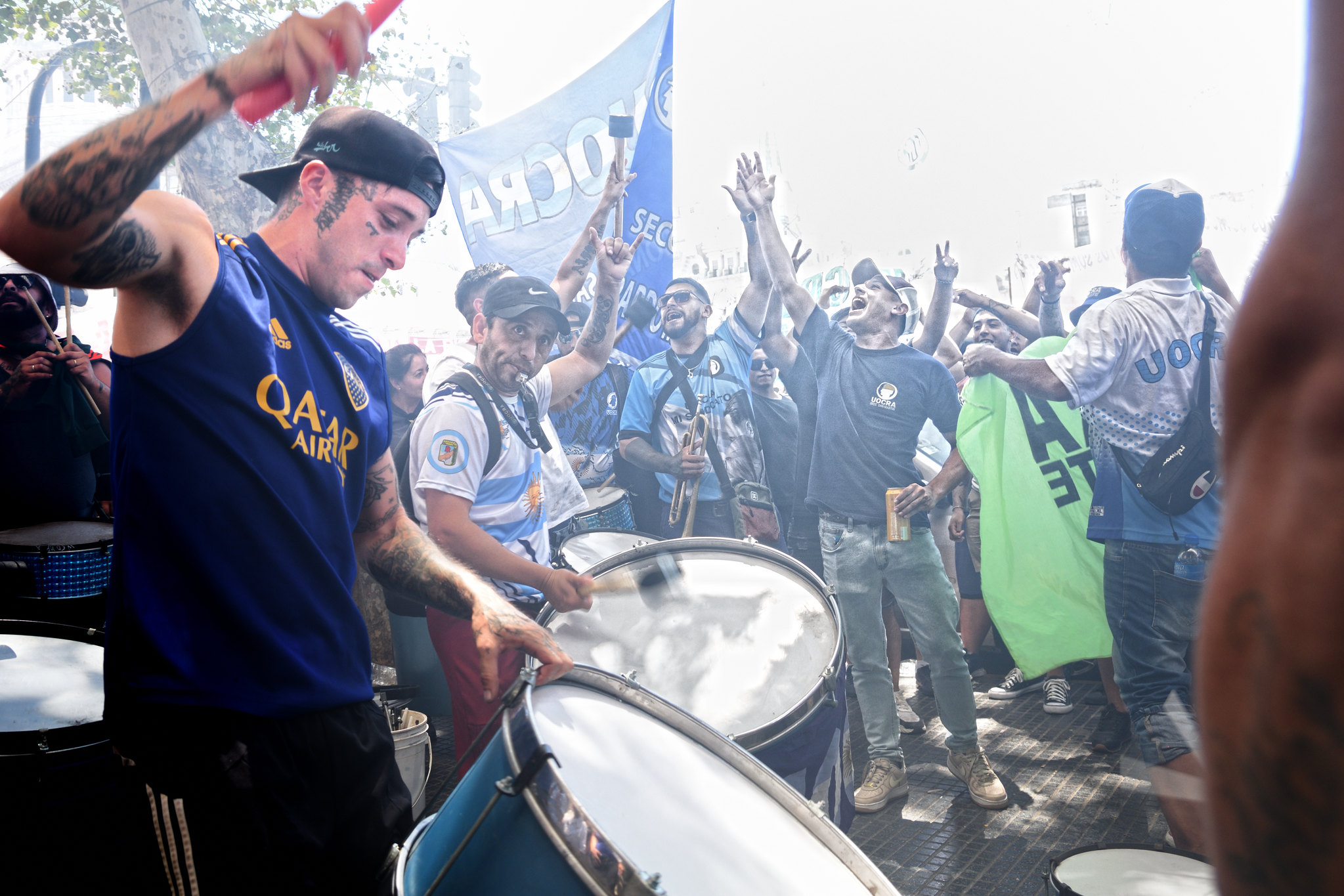
Argentina’s primary trade union federation on Thursday held another nationwide general strike, the second called since President Javier Milei, a far-right economist, took office in December and began pursuing sweeping austerity and deregulation.
The South American nation’s unions organized the strike “in defense of democracy, labor rights, and the living wage,” according to a statement from the General Confederation of Labor (CGT), the Argentine Workers’ Central Union (CTA), and the Autonomous CTA.
“It is a day of resistance and demand,” the groups said, blasting the Milei government’s “brutal” attacks on labor rights, social security, public health, education, science, and “our cultural identity.” The policies of austerity, say opponents, have disproportionately impacted working people and retirees.
The labor groups called out the government for promoting “dangerous policies for the privatization of public enterprises” and pushing for “a phenomenal transfer of resources to the most concentrated and privileged sectors of the economy.”
CGT celebrated the 24-hour strike’s success on Friday, declaring that “Argentina stopped,” and sharing photos of sparsely populated roads, transit hubs, and other public spaces.

As the Buenos Aires Times reported:
In the nation’s capital, streets were mostly empty, with very little public transport. Many schools and banks closed their doors while most shops were shuttered. Garbage was left uncollected.
Rail and port terminals were closed, while the industrial action forced the cancellation of hundreds of flights, leaving airports semi-deserted. Some buses—from firms that did not take part in the strike—were running in the morning, although with few passengers. Cars were circulating, but traffic levels were similar to that seen on weekends.
The port of Rosario, which exports 80% of the nation’s agro-industrial production, was all but paralysed in the midst of its busiest season.
A spokesperson for Milei, Manuel Adorni, claimed the nationwide action was “an attack on the pocket and against the will of the people” by those “who have curtailed the progress of Argentines over the last 25 years,” the newspaper noted.
Meanwhile, union leaders stressed that the strike was the result of “a government that only benefits the rich at the expense of the people, gives away natural resources, and seeks to eliminate workers’ rights,” as CTA Secretary General Hugo Yasky put it.
As the action wound down Thursday, Yasky described it as a “display of dignity of the Argentine people” that sent “a strong message” to Milei’s government as well as the International Monetary Fund “that intends to govern us” and the country’s senators.
Argentina’s Senate is now debating an “omnibus” bill that contains some of Milei’s neoliberal economic policies—including making privatization easier—after the package was approved last week by the Chamber of Deputies, the lower congressional body.
Rubén Sobrero, general secretary of the Railway Union, signaled that more strikes could come if lawmakers continue to advance the president’s policies, tellingThe Associated Press that “if there is no response within these 24 hours, we’ll do another 36.”
Solidarity with our union siblings in #Argentina on their general strike focused on the need for improved working conditions, social justice, democracy and equality. #ParoGeneral https://t.co/ptuSdibECk
— AFL-CIO Global (@AFLCIOGlobal) May 9, 2024
From Europe to North America, trade groups around the world expressed solidarity with Thursday’s strike.
“Milei’s policies have not tackled the decadence of the elites that he decries, instead he has delivered daily misery for millions of working people. Plummeting living standards, contracting production, and the collapse of purchasing power means some people cannot even afford to eat,” said International Trade Union Confederation general secretary Luc Triangle in a statement.
Triangle noted that “the government is targeting the rights of the most vulnerable sectors of the population and key trade union rights, such as collective bargaining, that support greater fairness and equality in society, while threatening those who protest with police repression and criminalization.”
“In this context, the work of the trade unions in Argentina is extraordinary. They have emerged as the main opposition to the government’s dystopian agenda, uniting resistance and building a coalition in defense of workers’ rights and broader democratic principles,” he added. “The demands of the trade unions in Argentina for social justice, democracy, and equality are the demands of working people across the world. Their fight is our fight and that is why the global trade union movement stands with them.”


Jessica Corbett is a senior editor and staff writer for Common Dreams.
ZNetwork is funded solely through the generosity of its readers.
Donate




