


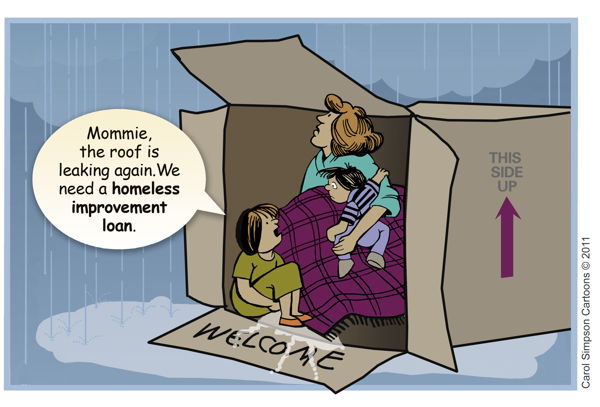

It’s been a cool breezy summer here in Oak Park IL. Not so good for the beach, but delighful for long walks and bike rides. The overpriced condos are popping up like toadstools after a gentle rain and the homeless can beg for money in relative comfort.
I had just returned from a bike ride to our local bank when I went downstairs to pick up the mail. Amongst the bills, appeals for donations and the carry-out menus was one of those Official Letters. You know the ones. They have the Internal Revenue Service, a collection agency or a lawyer’s office as a return address—- the kind of mail that freezes the blood even as it races the heart.
Mine was from the Cook County Assessor’s Office. My day was ruined as I trudged slowly up the stairs.
But wait! There’s more!
I opened the letter and read it. The estimated value of our vintage 1892 frame 2-flat house had declined by over $30,000 since 2010. If I had the feet and grace of Bill “Bojangles” Robinson I would have tap danced all the way to the kitchen to give my partner Estelle the wonderful news.
What wonderful news you ask, your eyes wide as you lean back from your computer screen in horror; well, the wonderful news that admidst the sky-high real estate taxes in my community, ours might actually be going down. Whoa Nelly, this calls for a celebration!
You see, I’m an old fashioned kinda guy. When we purchased our house with the generous help from Estelle’s parents, we actually bought it to live in, not to hire a crew to “fix it up” and flip it in that “red hot housing market” of the 1980′s and 1990′s. Sure our home doubled in price over the years, but that is less impressive to me because I plan to live in it until I’m pushing daisies. Yes, I know the advantages of rising property values. We can sell the place, move to somewhere cheaper and more scenic or even apply it to the cost of a nursing home if that becomes necessary.
But why should those options only be available to those with family and social capital? My partner and I were the beneficiaries of progressive legislation that working class people can only dream of today.Plus we’re white, so we came from families that began with modest incomes, but who could take advantage of hard work PLUS racial privilege.
All of that made it possible for us to buy the place with a loan from Estelle’s parents, have them live on the first floor as tenants AND provide babysitting. Such a deal. With all of that going for us, I hardly noticed the real estate boom except when the tax bills came around.
Besides, my personal experience with the red hot real estate market was just a little too literal. When we were living in the pleasant blue collar Chicago neighborhood of Lakeview in the 1970′s, a wave of arson fires swept across the community one summer. It was domestic terrorism for profit, a scheme by shadowy financial interests who hired gangbangers to deposit molotov cocktails on peoples’ back porches and gangways. This Dresden by the Lake was wildly successful and today Lakeview is trendy, hip and pricey. Red hot real estate markets don’t always destroy neighborhoods in quite so dramatic a fashion, but destroy them they do.
Right after World War II, working class home ownership was within reach of many young families, especially if they were white. Even if they weren’t white, restrictive covenants were being knocked down and the civil rights movement was opening up new opportunities. There were low cost government housing loans that spurred the growth of working class suburban subdivisions. Union density was the highest in US history and wages were pretty decent after the misery of the Great Depression.
But then the working class got whacked by the neo-liberal economics that began in the 1970′s. Industry moved away. Unions were busted. Wages fell or remained stagnant. Unemployment and under-employment grew. Into this sinking working class economy came the bankers with their exotic credit schemes. High wages were replaced by sleazy loan deals to finance home ownership. So when the housing bubble burst, working class families found that their dream house investment was facing foreclosure. Whole neighborhoods sunk into depair. Empty houses stood while homeless people walked the streets. The world of “Welcome Back Kotter” had become the the world of “The Wire.”
Back here in Oak Park, the red hot real estate market put some serious money into the hands of developers and pushed lower income people out. Now we have condos and apartments standing empty and whole development projects have ground to a halt.
Oak Park is a relatively affluent community so when a small low income housing program did come before our Village council, there were heated meetings at Village Hall and a flood of letters in the local paper. It was human values vrs property values. Oak Park is a generally liberal community, so some residents were all for the idea. Other Oak Parkers only welcome low-income people into our community as long as they are cutting the grass, fixing peoples’ roofs, mopping up at the local hospitals and washing dishes in restuarants. But if you are low income, you better get out of town after your chores are done. Yesiree!
I welcomed the low income housing which will be about 4 blocks from where I live. I only hope that the animosity from some of my neighbors will not impact on the residents. Maybe some of our homeless might even find a place there. The victims of the red hot real estate market deserve better than than a couch in someone’s crowded apartment or an old sleeping bag in a dicey part of town.
So rising home prices are not always good and declining prices are not always bad. There are working class communities where a sustainable rise in home values would be beneficial. But many of our neighborhoods are way overpriced, causing serious distortions in our weak and battered economy.
I prefer the term working class, but most Americans prefer the term middle class, so I’ll use that one now. Having spent most of my life in the lower middle class, I think we really only need one social class. My model would be our present lower, middle and upper middle class. Heck, I would gladly pay people way more than I make if they could lead our communities in an efficient and humane way, putting people first and profits last.
And yeah, in case you are wondering, I’ve been a socialist most of my life, although these days I’m not even sure what that means anymore. I do know one thing though, “red hot real estate markets” leave a lot of hard working people burned by the so-called wisdom of the marketplace. That’s not even good for sustaining capitalism, much less for creating something better.
ZNetwork is funded solely through the generosity of its readers.
Donate

