


Major American media organizations diligently parrot what US officials want the public to know about global affairs, historian Noam Chomsky told RT. To US leaders, any news outlet that “does not repeat the US propaganda system is intolerable,” he said.
The culpability of the West – namely the United States – for world affairs, such as the Ukrainian conflict or tensions with Iran, is another idea that is not permissible in leading American media, Chomsky said, adding that world opinion does not matter when that opinion counters US strategy.
“The West means the United States and everyone else that goes along,” he said. “What’s called the international community in the United States is the United States and anyone who happens to be going along with it. Take, say, for example, the question of Iran’s right to carry out its current nuclear policies, whatever they are. The standard line is that the international community objects to this. Who is the international community? What the United States determines it to be.”
He added that, “any reader of [George] Orwell would be perfectly familiar with this. But it continues virtually without comment.”
Chomsky’s remarks came this week just before a congressional hearing that was officially titled ‘Confronting Russia’s Weaponization of Information.’ Of the meeting, House Foreign Affairs Committee chair Ed Royce said, “The Russian media is now dividing societies abroad and, in fact, weaponizing information.”
The social philosopher and MIT professor said, “if there were any imaginable possibility of honesty,” Rep. Royce could be talking about the American media. He pointed to a recent New York Times story that discussed reasons not to trust Iran amid the tentative agreement between Tehran and Washington, along with other major global powers, over the former’s nuclear ambitions.
“The most interesting one is the charge that Iran is destabilizing the Middle East because it’s supporting militias which have killed American soldiers in Iraq,” Chomsky told RT’s Alexey Yaroshevsky.
“That’s kind of as if, in 1943, the Nazi press had criticized England because it was destabilizing Europe for supporting partisans who were killing German soldiers. In other words, the assumption is, when the United States invades, it kills a couple hundred thousand people, destroys the country, elicits sectarian conflicts that are now tearing Iraq and the region apart, that’s stabilization. If someone resists that tact, that’s destabilization.”
Chomsky also related American media propaganda to recent moves by US President Barack Obama to reach out to Cuba, which the US has long considered a state sponsor of terror while instituting a harsh embargo regime. Chomsky said top American media outlets go to great lengths to pit Cuba — and not the US — as the isolated party in the Western Hemisphere.
“The facts are very clear. This is a free and open society, so we have access to internal documents at an extraordinary level. You can’t claim you don’t know. It’s not like a totalitarian state where there are no records. We know what happened. The Kennedy administration launched a very serious terrorist war against Cuba. It was one of the factors that led to the missile crisis. It was a war that was planned to lead to an invasion in October 1962, which Cuba and Russia presumably knew about. It’s now assumed by scholarship that that’s one of the reasons for the placement of the missiles. That war went on for years. No mention of it is permissible [in the US]. The only thing you can mention is that there were some attempts to assassinate [Fidel] Castro. And those can be written off as ridiculous CIA shenanigans. But the terrorist war itself was very serious.”
Obama has changed course on Cuban policy not for reasons pursuant to freedom or democracy, as is peddled in the US media, Chomsky said.
“There is no noble gesture, just Obama’s recognition that the United States is practically being thrown out of the hemisphere because of its isolation on this topic,” he added. “But you can’t discuss that [in the US]. It’s all public information, nothing secret, all available in public documents, but undiscussable. Like the idea — and you can’t contemplate the idea — that when the US invades another country and the other resists, it’s not the resistors who are committing the crime, it’s the invaders.”
As for international law, Chomsky said it “can work up to the point where the great powers permit it.” Beyond that, it is meaningless. Thus, is international law an illusion if the US picks and chooses — while exempting itself — from what is enforced?
“To say that [international law is] dead implies it was ever alive. Has it ever been alive?” he said, citing US stonewalling of the world court’s demand in the 1980s that the US halt its war on Nicaragua and provide extensive reparations for damage done.
“International law cannot be enforced against great powers,” he said. “There’s no enforcement mechanism. Take a look at the International Criminal Court, who has investigated and sentenced African leaders who the US doesn’t like. The major crime of this millennium, certainly, is the US invasion of Iraq. Could that be brought to the international court? I mean, it’s beyond inconceivable.”
Chomsky said the so-called American Dream and US democracy are in “very serious decline,” as social mobility is among the worst among the richest nations. He added that, formally, the US retains a democratic veneer, but actual manifestations of democracy are dwindling.
“Basically, most of the population is disenfranchised,” he said, referring to public polling. “Their representatives pay no attention to their opinion. That’s roughly the lowest three-quarters on the bottom of the income scale. Move up the scale, you get a little more influence. At the top, essentially policy is made. That’s plutocracy, not democracy.”

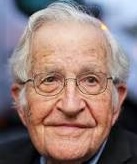
Noam Chomsky (born on December 7, 1928, in Philadelphia, Pennsylvania) is an American linguist, philosopher, cognitive scientist, historical essayist, social critic, and political activist. Sometimes called "the father of modern linguistics", Chomsky is also a major figure in analytic philosophy and one of the founders of the field of cognitive science. He is a Laureate Professor of Linguistics at the University of Arizona and an Institute Professor Emeritus at the Massachusetts Institute of Technology (MIT), and is the author of more than 150 books. He has written and lectured widely on linguistics, philosophy, intellectual history, contemporary issues, and particularly international affairs and U.S. foreign policy. Chomsky has been a writer for Z projects since their earliest inception, and is a tireless supporter of our operations.
ZNetwork is funded solely through the generosity of its readers.
Donate





1 Comment
Imagine the leader of the World Federation of Liberalism, Hans van Baalen, saying that Democracy has its limits, and when a chosen leader doesn`t fulfill his chosen role (from a Western point of view) it`s OK to support a military coup with all terrible consequences. And that`s exactly what he said yesterday on Dutch national television. (Oog in Oog). The most disturbing fact, however, was not his opinion. It is the total lack of criticism regarding his views.