

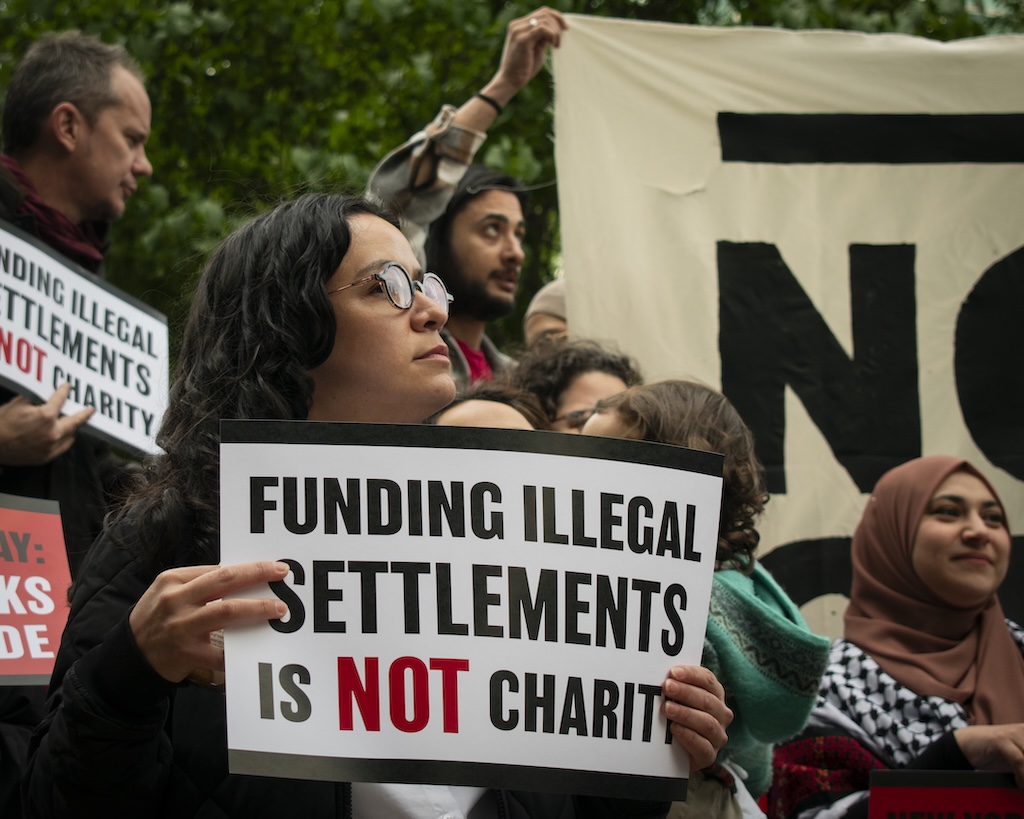
One of Zohran Mamdani’s signature legislative proposals from his time in the New York State Assembly has been reintroduced by his successor and allies. And while the original proposal for the “Not on Our Dime! Ending New York Funding of Israeli Settler Violence” Act was met with open hostility from New York’s Democratic Party, there are reasons to believe this time might be different.
Originally introduced in 2023 by then–Assembly Member Mamdani and Senator Jabari Brisport, “Not on Our Dime” seeks to stop New York charities from financially supporting Israeli war crimes and Palestinian displacement. Diana Moreno, who succeeded Mamdani in the assembly and is one of nine New York City Democratic Socialists of America (NYC-DSA)–endorsed members of the state legislature, reintroduced it this session.
“I am proud to reintroduce the ‘Not on Our Dime’ act in the State Assembly to end our state’s complicity with war crimes, apartheid, and genocide,” said Assembly Member Moreno, “Too often, New York State supports organizations and military units responsible for the violent displacement and atrocities against Palestinian people by allowing them to operate as charities in violation of international law. I join Palestinian and human rights organizations, labor unions, and my colleagues in the state legislature to finally stop our state from subsidizing these atrocities.”
According to the website for the coalition behind the bill, it would clarify “that funding Israeli settlement activity and any violations of the Geneva Conventions of 1949 and Rome Statute of the International Criminal Court by NYS charities is illegal . . . prohibit[ing] NY-based organizations claiming non-profit status from abusing this status to reinforce and further Israeli war crimes.”
The legislation would also allow the New York attorney general to dissolve the nonprofit status of and fine organizations that knowingly fund settler activity as well as let Palestinians file lawsuits against them.
“As an assembly member, I introduced the ‘Not on Our Dime’ Act because I understood that New Yorkers did not want their government subsidizing war crimes,” said Mayor Zohran Mamdani. “I am grateful that Assembly Member Diana Moreno and Senator Jabari Brisport are carrying this work forward.”
When Mamdani introduced these proposals a few years ago, they received little institutional support in the legislature. “Not on Our Dime” was largely criticized by other state legislators and political leaders, with Assembly Leader Carl Heastie calling it “a non-starter.” A majority of Democratic assembly members signed a public letter denouncing the legislation as “attack[ing] Jewish organizations” and “a ploy to demonize Jewish charities with connections to Israel.”
Today, such a reaction — or at least such a widespread reaction — sounds unrealistic. Zohran’s election and the rise of other pro-Palestine elected officials around the country seem to have proven that opposing support for Israel is no longer a political third rail in New York.
“This is a different world than we were living in when now-Mayor Mamdani and I first introduced this bill almost exactly three years ago; I’m deeply grateful to everyone who’s been in this with us, but also to everyone who’s had the courage to learn, grow, and join this movement,” said Senator Jabari Brisport. “It’s time for New York to stop subsidizing war crimes and invest, instead, in the programs that meet our constituents’ needs and uphold their values.”
That growth can be seen in the names attached to “Not on Our Dime.” The bill’s reintroduction will have more initial cosponsors — with larger platforms — than before. Several, like Assembly Members Claire Valdez and Jessica González-Rojas, are running for higher office.
Three years into its genocide in Gaza, Israel is increasingly unpopular in New York. A September 2025 New York Times/Siena poll of likely New York City voters found that 44 percent sympathized with Palestinians more than Israelis, while only 26 percent said the reverse.
Meanwhile, crackdowns on campus protests, increasing exposure of Israel’s actions in Gaza, and Trump’s war on Iran have also polarized voters, especially Democratic voters, away from Israel. Democrats, both nationally and in New York, are increasingly critical of material support to Israel.
Mamdani’s election victory also played a role. Some legislators who signed the 2023 letter may be more reluctant to oppose the bill again, now that doing so could be seen as picking a fight with the popular mayor of New York City. Of the sixty-six assembly members who signed, more than half had portions of New York City in their districts — including areas in Queens and Brooklyn where Mamdani did very well in last year’s mayoral election.
One race in particular captures how much the landscape around the proposal has changed. Aber Kawas, one of the activists who helped write the original bill, is now running for New York State Senate with the backing of both Mamdani and NYC-DSA. Her opponent, Assembly Member Steven Raga, did not back “Not on Our Dime” in 2023 but has signed on as a cosponsor this time. Both candidates attended a Friday press conference announcing the reintroduction of “Not on Our Dime.”
“As a member of the coalition that worked to develop the bill from day one I am proud and pleased about the reintroduction of ‘Not on Our Dime’ and the fight to get it passed, which is being led by a new socialist in office,” Kawas said. “Mayor Mamdani’s victory signaled that standing up for Palestinian human rights is a winning strategy and is what voters in New York want. We hope this encourages more elected officials to sign on.”
In a 2023 interview with the Nation about “Not on Our Dime,” Mamdani said that “it would take a fundamental shift in how New York state politicians understand this issue” for the bill to pass. This year’s reintroduction may test if such a shift has happened.
ZNetwork is funded solely through the generosity of its readers.
Donate





1 Comment
Yet since being inaugurated, NYC’s democratic socialist mayor has apparently not pushed NYC-based universities like Columbia University and NYU to endorse the BDS campaign’s divestment demands and to end their institutional partnerships with Tel Aviv University???
“The connection between academia and the training of the future generation of ground-forces commanders produces a seed that we are planting today and we will reap its fruits in the future.”
(Senior official at the Israeli Ministry of Defense, quoted in an article on the military-academic Erez programme of the Ministry in co-operation with Tel Aviv University, TheMarker2023.)
“The new students will be integrated into a variety of fields in dual-major tracks in social studies, management, sciences, and high-tech, and we see this as another expression of the university’s contribution to the resilience and development of society and the state.”
Prof. Eyal Zisser, Vice-Rector of Tel Aviv University, ibid.
https://rosalux.org.il/eng/society/militarism-in-the-israeli-academia/