

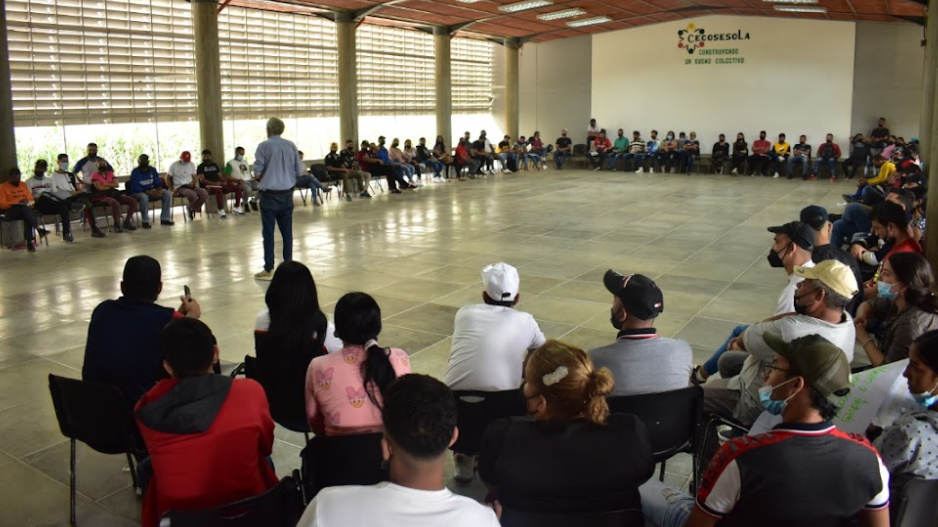
On September 29, 2022, Cecosesola received the Right Livelihood Award, a Swedish prize often known as the “Alternative Nobel Prize.” This award honors people and organizations that encourage social change. According to a statement issued by the Right Livelihood Foundation, the prize was given to Cecosesola for “establishing an equitable and cooperative economic model as a robust alternative to profit-driven economies.”
In what follows, we talk to three of the cooperative’s associates – Lizeth Vargas, Ender Duarte, and Gustavo Salas – about their project which serves hundreds of thousands of people and is a model for non-hierarchical organizational practices.

Can you tell us the story of Cecosesola?
Gustavo Salas: Cecosesola was born in the 1960s when the Centro Gumilla [a Catholic investigation center for social action] promoted the organizing of cooperatives in the most precarious barrios of Barquisimeto [Lara state, center-western Venezuela]. That is when poor, working-class people began to set aside a bit of money every month to build their own cooperatives.
In other countries, co-ops have a middle-class base, but many Venezuelan cooperatives have a working-class one: that is, co-ops here often begin to take shape in the poorest barrios.
The first cooperatives in Barquisimeto were founded by people with a great deal of commitment to social work and community work. They eventually came together in Cecosesola, a co-op center or a co-op of co-ops [the acronym stands for Central Cooperativa de Servicios Sociales de Lara]. The first Cecosesola project was one that addressed an immediate need of the people: funerary services.
Cecosesola was a grassroots construction, but as soon as it was legally registered and established, a directorate was set in place. This broke with the collective character of the organization that evolved in the first years of the cooperative movement, so many of those who had committed themselves to building a cooperative for everyone retreated back to their homes.
What was left was an enterprise with a five-person directorate, an advisory council, a three-person education committee, and the security staff. In other words, Cecosesola was rapidly morphing into a traditional enterprise that had practically nothing to set it apart from a capitalist or state-run enterprise. In fact, the directorate behaved as if they were the owners, except that they would perform an annual, end-of-the-year report in a members’ assembly.
Additionally, only associates could participate in the organization’s ritualistic decision-making process. Cecosesola had become a traditional card-punching employer!
A few years after the foundation of Cecosesola, in 1974, there was a feeling of dissatisfaction brewing among workers and members. Enthusiasm and hopes had vanished, and Cecosesola was now closer to a capitalist enterprise than a social movement or a community-based organization.
As it happens, Cecosesola was immersed in an internal debate. At the time, people of Barquisimeto were on the streets en masse, protesting a hike in bus fares. That is when the Cecosesola bases, those who were pushing to reinstate the original grassroots logic of the organization saw an opportunity to rekindle the cooperative project. Following Cecosesola’s early footsteps and grassroots mission, we built a transportation project that would keep fares down. There were no bosses in this project, which thus reactivated our on-the-ground work. In the end, we ended up assuming many transport routes in Barquisimeto.
Even though the transportation initiative was associated with Cecosesola, it didn’t reproduce the existing hierarchical order. The project became an opportunity to reorganize things and do away with bosses. In fact, the transport initiative would hold massive meetings on a regular basis, and all 300 associated workers would participate in each meeting!
In the beginning, the whole thing was very chaotic: collective decision-making isn’t easy when society is completely based on hierarchies. However, as the transport project became consolidated, it began to leave its imprint on Cecosesola. Eventually, we displaced the conventional top-down model with a system of direct participation that integrates workers and associates alike.
That is how Cecosesola, including its funerary services, was returned to the community, to its origins. Now we have an open administration without intermediation and with direct participation.
Ender Duarte: About our history, I would also like to add that in 2001, Hugo Chávez promoted the law for cooperative associations. Although Cecosesola goes a long way back, that law was important because it coincided with our internal logic and our needs, and it formalized a way of working that does away with the prevailing capitalist logic.
What are the principles behind Cecosesola’s modus operandi?
Ender Duarte: Rather than principles set out on paper, we have a set of ideas or principles that organize and regulate our day-to-day practices.
Our key ideas are mutuality, respect, and transparency, which are all important to building relationships of trust. In other words, mutual care and solidarity are our driving forces.
These practices guide our day-to-day activities, be they funerary services, healthcare, or food production and distribution. If we break away from our fundamentals, we would break the relationships of trust that we have been developing with so much care and love.
As we work, we are doing away with relations based on exploitation and domination. Ours is an organization without bosses. Over the years we have learned that the ever-present shadow of hierarchies can only be abolished with mutual respect and trust.
Of course, these new relations don’t pop up overnight. They are a labor of love: we advance, we take a few steps forward, and then we may have to take a step back to make sure that trust is not broken and guarantee that the project goes on maintaining its on-the-ground, community-based orientation.
What are Cecosesola’s key areas of action presently?
Lizeth Vargas: Currently, our main areas of activity are funerary services, healthcare, savings and loans, community markets, agricultural production, and artisanal or small-scale production. Yet above all, Cecosesola is a school and a community.
Cecosesola’s history and its areas of work all have their roots in very real problems that working-class people face. Early on, we realized that working together would bring solutions. In doing so, we have learned to listen to each other, to see each other, and to think together about how we do things.
Indeed, ours is a beautiful exercise: in the process of getting together, in the permanent act of mutual recognition, we begin to see ourselves reflected in one another. This happens not only in our meetings – and mind you, we meet a lot – but also every day, in our conversations and interactions.
We want to overcome the individualist tendency that society imposes on all of us. We want to overcome the prevailing selfish, competitive drive. We want to build relations based on mutuality and trust with one goal only: collective well-being.
That is why I say that Cecosesola is a school, a space where personal interests become collective objectives. We are not theorizing a new way of living, we are weaving a new way of doing. In doing so, we are showing that another world is possible.

You have emphasized doing away with hierarchies and top-down dynamics. Can you tell us more about the organization’s decision-making processes?
Gustavo Salas: Ours is a process that tries to leave behind competitive and individualistic practices. It’s nearly impossible to push forth a collective logic in private and state enterprises. Why? Because opening up to participation is risky for the bosses. It can also be chaotic at first. However, because a top-down organization is destined to constrain any transformative process and we want change, we are committed to doing away with the culture of bosses.
For change to happen, we must give ourselves the liberty to err and rectify. That is the only real way to change things. It is why an open, flexible, and cooperative organization is important for us.
Going back to the specifics of the decision-making process, our assemblies and our meetings are really important, but our decision-making is not limited to those spaces. In fact, if every decision had to go through a meeting, the whole thing would become stilted and bureaucratized.
We generate the conditions so that each of us can make a decision if needed, but those decisions have to be taken with discernment and, above all, a collective sensibility. For this to occur, we have to be in permanent communication, and we have to talk about our decisions in the meetings. We are in a permanent process of thinking and rethinking our collective practices, which are the true base for our decision-making process.
We have a fluid way of operating: if we need to, each of us can take decisions that will then become collective decisions. In fact, we generally take important decisions with prior consultation or at least with one compañera or compañero by our side.

What happens with the surplus generated by Cecosesola’s economic activities and how do you finance your initiatives?
Ender Duarte: The surplus generated by our economic activities is generally reinvested in the services that we provide. For example, some years ago we built the Integral cooperative Health Center with surplus from our food distribution operations.
In fact, the Health Center is a showcase for self-management: Cecosesola’s surplus supplied the economic foundation for the project, but many of us made direct contributions by selling tizana [a fruit drink], fororo [a cornmeal beverage], clothes, and we even organized trips to the beach.
However, let’s go back to the basics: Cecosesola has several funds, including the Financing Fund. Associated producers, communitary production units, and the co-ops that are part of the food distribution network all contribute to that fund. These resources can be directed to different ends, but the last few years have seen them used for agricultural production, which is a priority right now.
Purchasing seeds and fertilizer is not easy nowadays. The same goes for the purchase of vehicles to transport production. So it is important that Cecosesola can come in to finance the investment in those areas.
Self-financing is part of our principle of mutuality. When we had almost finished creating the Health Center, our accounts went in the red, so we initiated a “collection” of sorts. In response, the organizations associated with Cecosesola extended a collective loan. That is how we were able to finish the Health Center.
Finally, when it comes to the surplus, there is also a fund to cover health expenses for those who work full-time for Cecosesola and for our first-degree family members. The fund covers 75% of all our medical costs. What do we do when the health fund is running low? We compliment it with chicken sales, we sell fororo in the market, and so on.

Cecosesola offers goods and services at well below the market price. How are you able to do this?
Lizeth Vargas: We are not here to get rich. As an organization, our first commitment is to building community. Greed is not part of who we are: we work with passion and mística for a better world. That is why the annual global savings for the community that Cecosesola serves amounts to about 20 million dollars.
We have a commitment to our community. So when there were food shortages in Venezuela, we did all we could to make sure that distribution was as wide as possible, and during the blackout, we “loaned” 100 tons of produce.
Also, during the hyperinflationary period, we found the means to limit its impact on the community: we would set the price of the produce at the beginning of the week and maintain it through the end of the week. Moreover, we made sure that price adjustments in other services were gradual so that people could still go to the doctor or bury their loved ones.
What are the main teachings that Cecosesola can share with people about how to make a better world?
Gustavo Salas: If we want to transform our society, we have to do away with hierarchies. When Cecosesola was born, it generated a great deal of enthusiasm and passion. However, when a conventional, top-down administration emerged, that flower wilted. The hierarchical structure separated people from the organization and they went back home. Why? Even when a boss or leader figure has good intentions, the other vanishes: he or she is erased.
When Cecosesola was re-initiated, we did so by going back to the basics. We rebuilt an organization where everyone has a voice and everyone counts. If we really want to live in a more just society, we have to break away from the prevailing logic, and we have to find new organizational models.
Capitalist enterprises are not a model for us; the same goes for governmental enterprises. At Cecosesola we are exploring a new model based on mutuality. The model works, so now we are working hard to perfect it.
ZNetwork is funded solely through the generosity of its readers.
Donate




