


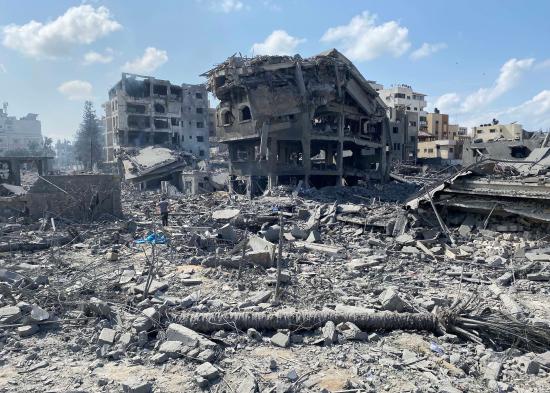
Americans are funding a genocide and no one asked our permission.
We are being dragged, unwillingly, into a war that is decimating a people. We are being forced to become involuntary accomplices to mass slaughter.
Palestinians, on the basis of their legal right against being wiped out, have filed a major lawsuit against President Joe Biden’s administration for funding Israel’s ongoing pogrom in Gaza, one that has killed more than 11,000 people, including 4,700 children. Represented by the Center for Constitutional Rights (CCR), the plaintiffs include Palestinians who have collectively lost at least 116 family members to U.S.-funded Israeli military attacks.
The U.S. has sent Israel a total of about $317 billion in inflation-adjusted tax-payer money, which amounts to more than $4 billion annually. Almost all that funding has gone toward the Israeli military. Israel is the largest recipient of American foreign aid, receiving more money than what we give to far larger, far poorer nations, ones that have a far greater post-colonial claim to Western aid.
Now, the U.S. Congress and the Biden administration want to give even more of our tax dollars to Israel, specifically to continue bankrolling the unfolding genocide. They are quibbling over the political strings attached to the aid but are united in their desire to send the supplemental funds.
But, according to CCR, “The United States has a duty under Article 1 of the Genocide Convention to prevent and punish acts of genocide, an obligation the U.S. Congress made law in 1988.” It’s not just the number of dead Palestinians that ought to result in a withholding of U.S. aid but the fact that Israeli officials have been overt about their genocidal aspirations.
The lawsuit offers evidence of how various Israeli politicians have referred to Palestinians with dehumanizing language such as Defense Minister Yoav Gallant, who promised that the “human animals” in Gaza would suffer the consequences of his order for “a complete siege on the Gaza Strip,” resulting in “no electricity, no food, no fuel.”
Days into Israel’s bombing campaign, United Nations Special Rapporteur Francesca Albanese warned on October 14, 2023, of a grave danger of ethnic cleansing of Palestinians, saying, “The international community has the responsibility to prevent and protect populations from atrocity crimes.” Referring to the first great displacement that Palestinians suffered, Albanese added, “There is a grave danger that what we are witnessing may be a repeat of the 1948 Nakba, and the 1967 Naksa, yet on a larger scale.”
At the time Albanese made the warning, Israel had killed 1,900 Palestinians.
A month later, on November 13, Israel’s Agriculture Minister Avi Dichter described his nation’s bombing campaign with a concise phrase, worthy of an operational name for planned genocide: “Gaza Nakba 2023. That’s how it’ll end.”
By then the official death toll of Palestinians was more than 11,000. United Nations experts warned that “the Palestinian people are at grave risk of genocide,” and, added, “Israel’s allies also bear responsibility and must act now to prevent its disastrous course of action.”
One journalist named Chris McGreal, wrote in The Guardian, “I covered the Rwandan genocide as a reporter. The language spilling out of Israel after the butchery of the Hamas attacks is eerily familiar.” McGreal also correctly called out U.S. elected officials such as Senator Lindsey Graham for picking up the pitchfork and joining the violent mob. “We are in a religious war here. I’m with Israel. Do whatever the hell you have to do to defend yourself. Level the place,” said Graham.
It’s a simple calculus: Israeli officials promise to wipe out people who they view as less than human, with the full blessing and financial might of the U.S. The predictable outcome is a fulfillment of their promises, one that is happening in real-time. Not only are politicians responsible for Palestinian genocide, but so too is the media for uncritically reporting on the explicit goals and desires of genocidal maniacs.
Why shouldn’t we believe leaders when they tell us exactly who they are and what they intend to do? History is replete with naïve denials of stated intentions to violate human decency even as crimes unfold in plain sight. Recall that when Donald Trump told the nation in 2015 that he would launch a white supremacist presidential bid. Media outlets refused to call him a racist until several years later after the damage was done and he was in the White House. Hate crimes surged against Black people, Latinos, Muslims, and Jews. It wasn’t until the summer of 2019 that media outlets finally decided it was okay to label him a racist—that too after much hand-wringing. About a year and a half later, Trump mobilized an attack on the U.S. Capitol in January 2021 in what legal experts describe as an “insurrection” by a majority white mob. Trump told us who he was. Mainstream media outlets refused to believe him until it was too late.
We’re seeing a familiar hand-wringing today. Take the New York Times’s insistence on using euphemisms like “extremist,” “incendiary,” and “inflammatory” to avoid describing Israeli officials’ language and the Israeli military’s actions as genocidal.
This type of discussion dilutes an understanding of Israel’s stated goal by attempting to grapple with the technical definition of genocide. For example, Omer Bartov, a professor of Holocaust and genocide studies at Brown University wrote in a November 10 New York Times op-ed that, “I believe that there is no proof that genocide is currently taking place in Gaza.” Still, Bartov admits that his “greatest concern watching the Israel-Gaza war unfold is that there is genocidal intent, which can easily tip into genocidal action.” (Notice how he doesn’t say “Israel has genocidal intent”—a common use of the passive voice to dilute blame.)
Countering this concern in comments to Vox, Raz Segal, an associate professor of Holocaust and genocide studies at Stockton University asked, “How many Palestinians need to die for these statements [by Israeli officials] to be recognized as what they are?”
It is the job of journalists to warn against abuse, exploitation, and corruption, and to shine a light on power so that an informed citizenry can decide on the course of its government. Many journalists are indeed speaking out against sidestepping the responsibility to report on genocide. More than a thousand have signed on to a letter saying they “hold Western newsrooms accountable for dehumanizing rhetoric that has served to justify ethnic cleansing of Palestinians.”
That ethnic cleansing is in full force. CCR’s lawsuit is seeking an injunction to immediately block U.S. tax dollars from supporting Israel’s war in a concrete effort to block the genocide, or at least wash the stain of Palestinian blood off American hands. Meanwhile, public support for U.S. aid to Israel has dropped, with more Americans now opposed to the military assistance than supporting it according to a Reuters-Ipsos poll. Nearly 70 percent support a ceasefire.International leaders, government offices, and media institutions, often ignore or deny genocides as they are unfolding, express regret after it’s too late, and then make promises of “Never again.” When warning signs of the next genocide arise, the cycle repeats. It’s up to us to stop it and we have that chance right now.
This article was produced by Economy for All, a project of the Independent Media Institute.


Sonali Kolhatkar is an award-winning multimedia journalist. She is the founder, host, and executive producer of “Rising Up With Sonali,” a weekly television and radio show that airs on Free Speech TV and Pacifica stations. Her most recent book is Rising Up: The Power of Narrative in Pursuing Racial Justice (City Lights Books, 2023). She is a writing fellow for the Economy for All project at the Independent Media Institute and the racial justice and civil liberties editor at Yes! Magazine. She serves as the co-director of the nonprofit solidarity organization the Afghan Women’s Mission and is a co-author of Bleeding Afghanistan. She also sits on the board of directors of Justice Action Center, an immigrant rights organization.
ZNetwork is funded solely through the generosity of its readers.
Donate




