


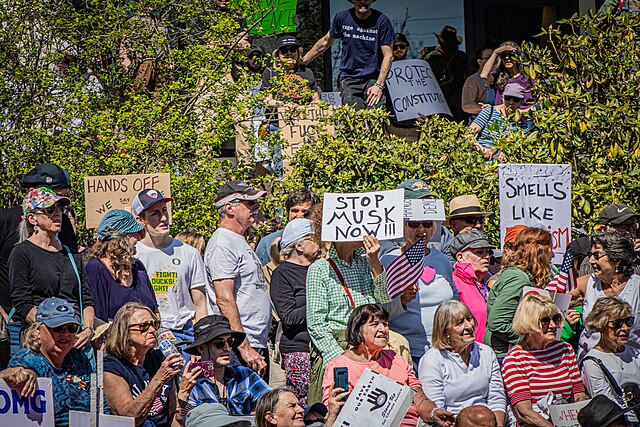
On streets and highway passes, at intersections and in parks, millions of Americans continue to turn out to protest against the Trump administration and its policies. The media spotlight is currently focused on the ongoing protests against ICE raids in Los Angeles, and the Trump administration’s militarized response to them. In our research at the Crowd Counting Consortium, we do not yet have a full picture of the number and range of protests that have occurred in June. However, we do know that protests against ICE raids have been intensifying around the country for months, alongside protests opposing perceived power-grabs by the Trump administration. And we know that the movement’s tactics have been extraordinarily peaceful.
In fact, as we discussed in March, protests in the U.S. have been quite robust since Trump took office the second time. Our ongoing research on protests in the United States reveals that within the first two weeks of the second Trump administration, protest activity surpassed that of 2017. By the end of March 2025, there had been three times as many protests as had taken place in 2017. Protest has been surging since, with large boosts coming from major, multi-location actions in April and May.
Two notable surges of protest came on the nationwide Hands Offs protests on April 5 and No Kings protests on April 19. To date, we have tallied 1,145 protests on April 5, with events occurring in all 50 states and the District of Columbia. Significantly, protest activity occurred throughout the country, including in rural and GOP-leaning towns.
For April 19, we tallied 928 protests also occurring in all 50 states and D.C. And on May 1 and May 3, we tallied over 1,000 anti-Trump May Day protests.
These are significant showings. If we look back to the first Trump administration, in April 2017 the most prominent multi-location protest was the March for Science on April 22, which occurred in 390 locations including most major cities. In 2017, we tallied 80 May Day protests nationwide, compared to over 1,000 this year. Overall, 2017’s numbers pale in comparison to the scale and scope of mobilization in 2025 — a fact often unnoticed in the public discourse about the response to Trump’s actions.


The two days of organized nationwide protests account for most of these numbers. Among the 86 percent of anti-Trump events for which we tallied participation on April 5, we report between 919,000 and 1.5 million participants that day. Although our estimate is below the 5 million figure offered up by some accounts, April 5 clearly involved the most participants nationwide that we have seen during the second Trump administration — and the most we have recorded in a single day since the nationwide uprising following the killings of Ahmaud Arbery, George Floyd, and Breonna Taylor in 2020.
Having identified participant data for 64 percent of anti-Trump events on April 19, we report between 277,324 and 322,384 participants that day. These two events alone account for between 1.2 million and 1.8 million in participants. That number is higher when we account for the hundreds of other protests that occurred throughout the month of April.
Protest spreads
In addition to the size and scale of protest activity, the month of April alone saw a notable level of geographic dispersion. All 50 states and D.C. saw protests in the month of April. This suggests that the anti-Trump mobilization is truly nationwide.

We are often asked how many people have been participating in protests. Because of the size and scope of protest activity, we have not been able to validate participant totals on all events. But even with incomplete data on many events, and fewer reliable numbers of participants available in our May data, we estimate that millions of people participated in protests in April. Dana Fisher’s survey evidence from D.C.-area protests on April 5 suggests that Resistance 2.0 skews older than its 2017 counterpart; however, we do not know how representative this finding is countrywide, across different days, or across different actions.
Anecdotal evidence suggests that some activists are intentionally demonstrating in their local town rather than just traveling to a nearby big city for events. One participant suggested they may do so because it attracts neighbors who are new to protest: “There are people who aren’t going to cities for events like this. They’re dipping their toes in local rallies and activism. We need to meet them where they are.” Another highlighted that it may also make a different impression on passersby than a protest elsewhere: “This is why the protests should /not/ be D.C. or NY focused. When there’s 300 people in front of the local high school, and you go by there Saturday on the way to Walmart, it’s harder to claim it never happened. Or you didn’t see it.”
Notable themes
Throughout early 2025, Elon Musk and Tesla were a major target of protesters. Over 1,500 protests in April and May targeted Musk and Tesla. Such anti-Tesla protests may be connected to the company’s stock price falling significantly, and Musk stepping back from DOGE.
We continue to record considerable protest motivated by foreign affairs, including not only Israel-Palestine but also Russia-Ukraine as the Trump administration has expressed less support for the Ukrainian position on the war. About one in five protests in April were related to foreign affairs, not including immigration or climate change. (Small numbers of counter-protesters have also turned out to defend the president).
But immigration — and aggressive law enforcement responses to immigration-related protests — were key mobilizing issues in April and May. One notable episode in May was the arrest of Ras Baraka, the mayor of Newark, New Jersey, at Delaney Hall, an ICE detention facility. Video of the May 9 arrest has been shared widely, showing ICE and other law enforcement officials pushing through crowds of peaceful protesters to apprehend Baraka outside the facility. Baraka appears to have been allowed into Delaney Hall along with a delegation of federal legislators (from New Jersey) and then afterward asked to leave because he was not a member of Congress. He had already left the facility when law enforcement agents moved to detain him.
In addition to Mayor Baraka’s arrest, a member of the congressional delegation, Rep. LaMonica McIver, was subsequently charged by the U.S. Justice Department with assaulting two of the federal law enforcement officers who detained Baraka. This sparked further protests outside Delaney Hall, including the use of civil disobedience by an inter-faith group of clergy and religious figures, which resulted in two arrests. Protesters also vented their frustration directly at Alina Habba, interim U.S. attorney for New Jersey, who ordered the charges against Rep. McIver. Dozens demonstrated outside her Newark office on May 20.
A nonviolent movement
By and large, in April and May the anti-Trump protest movement relied on protests and demonstrations rather than mass noncooperation, occupations of space or general strikes, though there have been exceptions and some public calls for such actions.
Out of 4,770 anti-Trump protests in April and May, we recorded police injuries at three events (.06 percent) and participant injuries or property damage at only two events (.04 percent). We have recorded arrests of protesters at 20 events, or .42 percent of the total. Roughly the same distribution held for protests related to immigration policies, which constituted a large share of the events.
Overall, in over 99.5 percent of protests in April and May, we recorded no injuries, arrests or property damage — an unprecedentedly tiny fraction for a movement of this size and geographic dispersion. Contrary to officials’ hyperbolic claims of a disorderly movement attempting to sow chaos, at least through April and May, protesters associated with the anti-Trump movement were extraordinarily nonviolent in their tactics.


Erica Chenoweth is a political scientist at Harvard University. They study how people effectively resist authoritarianism and push for systemic democratic change. Chenoweth has written nine books and hundreds of articles, including Civil Resistance: What Everyone Needs to Know (Oxford, 2021). At Harvard, Chenoweth directs the Nonviolent Action Lab.
ZNetwork is funded solely through the generosity of its readers.
Donate




