


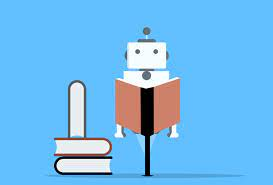
The future tapped me quietly on the shoulder the other day and suggested that I take a moment to learn about the writing bots.
They’re coming!
Excuse me, they’re here. And they struck me as alien invaders, this recent manifestation of artificial intelligence on the Internet, which college students, high school students — anybody–can download, feed a topic and get it to write an essay for them. Is this technology’s next step, after Roomba the robot vacuum cleaner? Humanity is relieved of one more odious task — writing stuff.
“The chatbot,” Kalley Huang pointed out recently in the New York Times, “generates eerily articulate and nuanced text in response to short prompts, with people using it to write love letters, poetry, fan fiction — and their schoolwork.”
Apparently, all you need to do to get the AI bot to produce a piece of prose (or poetry?) is give it a subject and whatever other information is necessary to define the topic you want it to blather about. It can then access the entire Internet for its data and produce whatever — your English paper, your love sonnet. The possibility of student cheating has suddenly become dire enough that college professors are starting to rethink their writing assignments.
I have some advice for them. But before I get to that, I need to calm my own pounding heart. Writing — to me, as a lifelong journalist, essayist, poet, editor, writing teacher — can be difficult as hell, but every hour devoted to a project is a wondrous adventure, a reach into the great unknown, a journey of discovery, of learning, of becoming. I have described the columns I write as “prayers disguised as op-eds,” and it’s that word, prayer, that swelled and started palpitating as I stumbled on the existence of the writing bot. Should we let AI start writing our prayers? Should we shrug and simply stop being our fullest selves?
Life is messy and writing is messy … it has to be. Truth is messy. If we turn the writing process over to the AI bots, my existential fear is that humanity has taken a step toward ending its evolution, ensconcing itself in a prison of conveniences.
“Due to its free nature and ability to write human-like essays on almost any topic, many students have been reaching for this model for their university assignments,” according to the website pcguide, focusing its attention on an AI bot called Chat GPT, which recently proved smart enough to pass a law bar exam. “And if you are a student hoping to use this in the future, you may have concerns about whether your university can detect Chat GPT.”
These words start to get at my primary concern about the whole phenomenon: Critics are missing the point, as they lament that the university’s grading system is under assault. OMG, has cheating gotten easier?
And suddenly it gets clear. When it comes to writing, there’s always been a gaping hole in the American educational system, a mainstream misunderstanding of the nature — the value — of actually learning to write . . . finding your words, finding your wisdom, finding your voice.
Let me repeat: Finding your voice.
That’s where it starts. Without it, what do you have? I fear this is a silent question that plagues way too many students — way too many people of all ages — who were taught, or force-fed, spelling and grammar and the yada yada of thematic construction: opening paragraph, whatever, conclusion.
I quote my mentor and long-time friend, the late Ken Macrorie, one of the teachers who bucked this system oh so many decades ago, when I was an undergraduate at Western Michigan University. He was a professor in the English Department:
“This dehydrated manner of producing writing that is never read is the contribution of the English teacher to the total university,” he wrote in his 1970 book, Uptaught.
He was writing about his own career. He was trapped in a system that disdained most undergrads and their writing and often managed to force the worst out of them, a.k.a., academic writing, such as: “I consider experience to be an important part in the process of learning. For example, in the case of an athlete, experience plays an important role.”
Dead language! May it rest in peace. Artificial intelligence can no doubt do just as well, probably a lot better. Macrorie quoted this oh so typical example in his book — the kind of writing that is devoid of not only meaning but soul. His breakthrough discovery was what he called free writing: He had his students, on a regular basis, sit down and write for 20 minutes or longer without stopping — just let the words flow, let fragments of truth emerge, and share what you have written. Worry later about spelling, grammar and such. First you have to find your voice.
I wound up taking his Advanced Writing class in 1966, two years after he began using free writing as his starting place. Wow. I found my way in . . . into my own soul. I learned that truth is not sheerly an external entity, to be found in some important book. We all have it within us. Doing a “free write” is a means of panning for gold.
And this is the context in which I ponder this recent bit of techno-news: that students don’t have to rely on plagiarism to fake an essay. They can simply prompt a bot and let it do the work.
But that’s not the essence of our social dilemma. As long as the system — let’s call it artificial education — focuses on “teaching to the test” and insists on reducing individual intelligence to a number, and in so many ways ignores and belittles the complex and awakening potential of each student, we have a problem. AI isn’t the cause, but it helps expose it.


Robert Koehler is an award-winning, Chicago-based journalist and nationally syndicated writer. Koehler has been the recipient of multiple awards for writing and journalism from organizations including the National Newspaper Association, Suburban Newspapers of America, and the Chicago Headline Club.
ZNetwork is funded solely through the generosity of its readers.
Donate




