


A colleague, an editor at a widely read outlet that centered Gaza throughout the two-year genocide, recently voiced his frustration that Gaza is no longer a main focus in the news.
He hardly needed to say it. It is evident that Gaza has already been pushed to the margins of coverage — not only by mainstream Western media, long known for its structural bias in Israel’s favor, but also by outlets often described, accurately or not, as ‘pro-Palestine.’
At first glance, this retreat may appear routine. Gaza during the height of the genocide demanded constant attention; Gaza after the genocide, less so.
But this assumption collapses under scrutiny, because the genocide in Gaza has not ended.
According to Gaza’s Health Ministry, nearly 500 Palestinians have been killed and hundreds more wounded since the so-called ceasefire was declared in October 2025, despite repeated claims that large-scale massacres had ceased. These are not isolated incidents or “violations”; they are the continuation of the same lethal policies of the last two years.
Beyond the daily death toll lies devastation on an almost incomprehensible scale. More than 71,000 Palestinians have been killed since October 2023, with entire neighborhoods erased, infrastructure pulverized, and civilian life rendered nearly impossible.
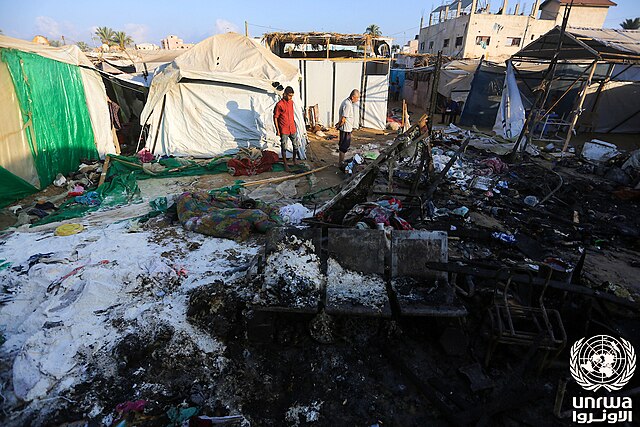
To grasp the depth of Gaza’s crisis, one must confront a brutal reality: well over one million people remain displaced, living in tents and makeshift shelters that collapse under winter storms, floodwaters, or strong winds. Infants have frozen to death. Families are swept from one temporary refuge to another, trapped in a cycle of exposure and fear.
Beneath Gaza’s ruins lie thousands of bodies still buried under rubble, unreachable due to Israel’s destruction of heavy machinery, roads, and emergency services. Thousands more are believed to be buried in mass graves awaiting excavation and dignified burial.
Meanwhile, hundreds of bodies remain scattered in areas east of the so-called Yellow Line, a boundary claimed to separate military zones from Palestinian “safe areas.” Israel never respected this line. It was a fiction from the start, used to manufacture the appearance of restraint while violence continued everywhere.
From Israel’s perspective, the war has never truly stopped. Only Palestinians are expected to honor the ceasefire — compelled by fear that any response, however minimal, will be seized upon as justification for renewed mass killing, fully endorsed by the US administration and its Western allies.
The killing has merely slowed down. On January 15 alone, Israeli attacks killed 16 Palestinians, including women and children, across Gaza, despite the absence of any military confrontation. Yet as long as daily death tolls remain below the psychological threshold of mass slaughter — below 100 bodies a day — Gaza quietly slips from the headlines.
Today, more than two million Palestinians are confined to roughly 45 percent of Gaza’s already tiny 365 square kilometers, with only trickles of aid entering, no reliable access to clean water, and a health system barely functioning. Gaza’s economy is effectively annihilated. Even fishermen are either blocked entirely from the sea or restricted to less than one kilometer offshore, turning a centuries-old livelihood into a daily risk of death.
Education has been reduced to survival. Children study in tents or in partially destroyed buildings, as nearly every school and university in Gaza has been damaged or destroyed by Israeli bombardment.
Nor has Israel abandoned the rhetoric that laid the ideological groundwork for genocide. Senior Israeli officials continue to articulate visions of permanent devastation and ethnic cleansing — language that strips Palestinians of humanity while framing destruction as policy, a strategic necessity.
But why is Israel determined to keep Gaza suspended at the edge of collapse? Why does it obstruct stabilization and delay movement to the second phase of the ceasefire agreement?
The answer is blunt: Israel seeks to preserve the option of ethnic cleansing. Senior officials have openly advocated permanent occupation, demographic engineering, and the denial of Palestinian return to their destroyed areas east of the Yellow Line.
And the media?
For its part, Western media have begun rehabilitatingIsrael’s image, reinserting it into global narratives as if collective extermination never occurred. More troubling still, even parts of the so-called ‘pro-Palestine’ media appear to be moving on — as though genocide were a temporary assignment, rather than an ongoing moral emergency.
One might attempt to justify this neglect by pointing to crises elsewhere — Venezuela, Iran, Yemen, Syria, Greenland. But that argument collapses unless Gaza has truly emerged from catastrophe, though it has not.
Israel has succeeded, to a dangerous degree, in systematically dehumanizing Palestinians through mass killing. Once violence reaches genocidal proportions, lesser — yet still deadly — violence becomes normalized. The slow death of survivors becomes background noise.
This is how Palestinians are killed twice: first through genocide, and then through erasure — through silence, distraction, and the gradual withdrawal of attention from their ongoing collective suffering.
Palestine and its people must remain at the center of moral and political solidarity. This is not an act of charity, nor an expression of ideological alignment. It is the bare minimum owed to a population the world has already failed — and continues to fail — every single day.
Silence now is not neutrality; it is complicity.


Ramzy Baroud is a US-Palestinian journalist, media consultant, an author, internationally-syndicated columnist, Editor of Palestine Chronicle (1999-present), former Managing Editor of London-based Middle East Eye, former Editor-in-Chief of The Brunei Times and former Deputy Managing Editor of Al Jazeera online. Baroud’s work has been published in hundreds of newspapers and journals worldwide, and is the author of six books and a contributor to many others. Baroud is also a regular guest on many television and radio programs including RT, Al Jazeera, CNN International, BBC, ABC Australia, National Public Radio, Press TV, TRT, and many other stations. Baroud was inducted as an Honorary Member into the Pi Sigma Alpha National Political Science Honor Society, NU OMEGA Chapter of Oakland University, Feb 18, 2020.
ZNetwork is funded solely through the generosity of its readers.
Donate




