

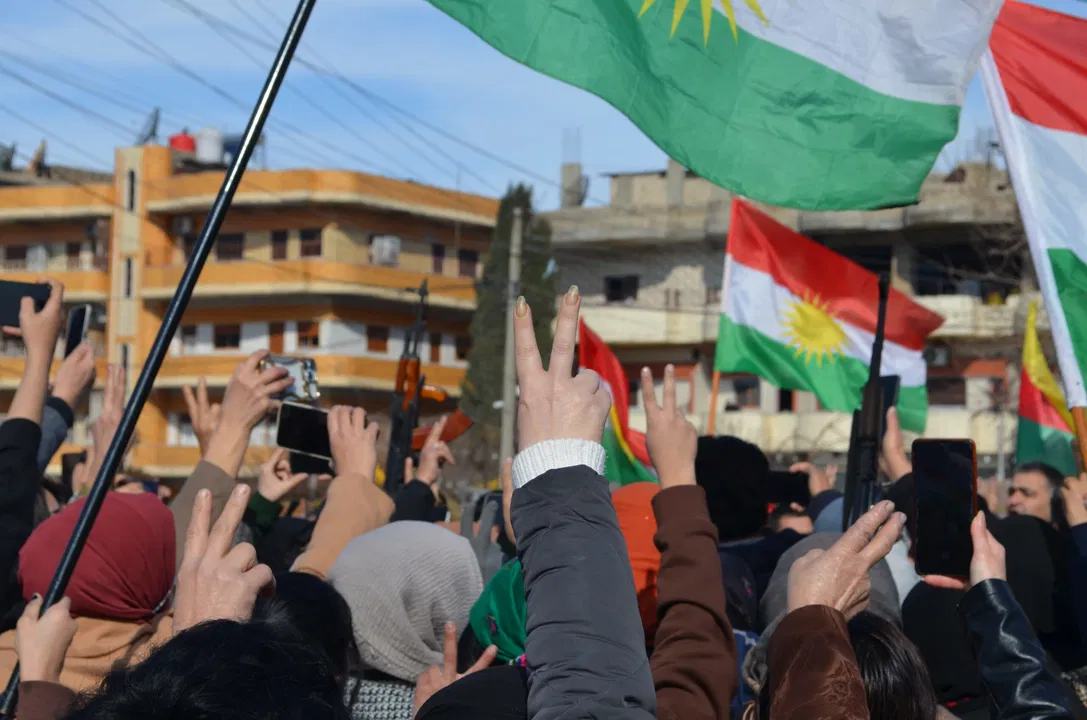
The ceasefire deal agreed between the Syrian government and the Kurdish-led Syrian Democratic Forces (SDF) last week – hailed by the US as a ‘historic milestone in Syria’s journey toward national reconciliation’ – represents a major victory for Damascus. It also spells the end of Rojava as a Kurdish-run autonomous enclave in the country’s northeast. Talks between the al-Sharaa government and SDF leaders to agree the integration of the political and military structures of Rojava into those of the new central state begun soon after Assad’s ouster in December 2024. Yet an agreement was not reached, and after the deadline for finalizing the integration plan elapsed in December 2025, Damascus resolved to impose by force what the diplomatic process had thus far failed to deliver. On 6 January, government troops attacked Kurdish-majority neighbourhoods in Aleppo, an isolated SDF-held pocket in central Syria. The Syrian army also exploited the SDF’s weak position along the Euphrates in Arab-majority areas of Raqqa and Deir-ez-Zor, which led to major Arab breakaways. Last came the full-scale offensive on Rojava, forcing an SDF retreat into the Kurdish-majority heartlands. Further violence was prevented by a temporary ceasefire. Now, under the terms of the truce, the SDF will integrate into the Syrian army in three brigades and Kurdish governing bodies will merge with state institutions. Interior Ministry security forces have reportedly begun to enter the SDF-held cities of Hasakah and Qamishli.
The existence of Rojava as a semi-autonomous space, with global symbolic resonance – for women’s liberation, unprecedented in the region, and for the democratic self-rule of an oppressed people – depended on unique circumstances. The SDF – which at its height controlled over a quarter of the country, including its major oil fields – was a creation of the Syrian civil war, during which military units affiliated with the Kurdistan Workers’ Party (PKK) began to take control in the predominantly Kurdish areas of northern Syria. The SDF proper emerged in 2015, after Kurdish fighters successfully defended the town of Kobane from Islamic State (IS) militants, with the help of a US airlift. This marked the beginning of a decade-long alliance with Washington. Rojava did not join the major opposition forces, which it regarded as jihadist and nationalist, and even entered negotiations with Assad, although an agreement was never reached. After the battle of Kobane, the US armed and trained the SDF, regarding the Kurdish-led force as a proxy through which it could support the fight against IS and maintain a foothold in the war-torn country.
Always ‘temporary, tactical and transactional’, US sponsorship of the Kurds was hardly robust. Washington turned a blind eye to a range of Turkish military operations that reduced the territory and unity of the autonomous region. Ankara regarded Rojava as a major national security threat, fearing that gains made there would spill over the border. The shallowness of US support was starkly revealed after the fall of Assad, which radically altered the geopolitical alignments from which the Kurds had precariously benefitted. The new jihadists-turned-democrats in Damascus were immediately embraced by the US. The frail hegemonic aura of the former al-Qaeda commander’s regime was however weakened by the massacres committed against the Alawites in the West and the Druze in the South in the spring and summer. Accordingly, there followed a cooling of the US’s stance, not of course due to any moral epiphany, but realpolitik calculation that al-Sharaa’s government might be too weak to control the country’s militias and unable to guarantee stability.
In this context, juggling different actors who could balance each other out seemed to resurface as a strategy in Washington. The negotiations between the government and the SDF appeared to shift slightly in favour of the Kurds: reports in October suggested that Kurdish regional governance might be strengthened and the SDF would remain intact. But calculations had changed by December 2025. The available sources do not suggest that the US directly gave the green light to Damascus’s subsequent military escalation. But neither did it stand in the way – a familiar US position: if you crash and burn, that’s your problem; if you succeed, we’ll cover your back. The success of the assault shifted the balance of forces decisively. After the incursion, US special envoy Tom Barrack sounded the death-knell for the ‘counter-ISIS partnership’: the SDF’s role has ‘largely expired’, since the ‘Syrian government is ready to assume security responsibilities’. With a new central government that now appeared amenable to the US and its allies’ interests, Washington no longer had a reason to back an alternative ally in the country. If this is a betrayal, it was an eminently predictable one: consistent imperialist foreign policy.
It was not only Washington that tipped the balance. Since the establishment of the transitional government, the interests of Israel, Turkey, Syria and the US – involved in a series of meetings in early 2026, which seemed to pave al-Sharaa’s way to the northeast – have converged on issues where Rojava had depended on their divergence. Israel concluded a security pact with the new regime, brokered by the US, thus reducing its interest in the Kurds to keep up pressure against Damascus; Turkey signalled its intention to distance itself further from Russia, leading the US to soften on the enforcement of Turkish interests in Syria. Indeed, Turkey played an important role in emboldening Damascus and turning the tide against the SDF. From December, unconcealed military threats were being issued by Turkey’s Defence Ministry and the Foreign Minister Hakan Fidan, as were firm pledges to support the Syrian state should it decide to take action.
Al-Sharaa has long enjoyed Ankara’s backing, and openly so since their Blitzkrieg on the ailing Assad at the end of 2024. Turkey’s relations with the PKK – with which it has been in a decades-long conflict – are a significant context for what has now unfolded across the border in Syria. Negotiations between the two sides have been underway for over a year – an initiative by the Turkish state, perhaps in part hoping to capitalize on the new dynamics in Syria, aiming to force the PKK and the SDF – which it regards as an extension of the PKK – to disarm and disband. Erdogan himself may have narrower interests: to win over Kurdish voters and MPs through symbolic recognition in order to prolong his own rule. The PKK, for its part, evidently entered the peace process because of a realistic calculus of the regional balance of forces – diplomacy perhaps presenting the most propitious means to secure the rights that would legitimize it as a social and political actor. Meanwhile, dismantling Rojava – a vital asset for the broader Kurdish movement as well as crucial extra-territorial leverage for the PKK – has been a key part of Turkish ambitions for a ‘terror-free Turkey’. What effects developments in Syria will have on the negotiations is hard to gauge. Some see it as a final blow to the PKK. But do not forget that it has gone through worse setbacks in its history, in particular the period of organisational and military defeat and disorientation in the 2000s after the imprisonment of its leader Abdullah Öcalan.
What – if anything – could Rojava have done differently? It was clear from the outset that the window of opportunity for self-rule would not remain open forever and that Rojava never had the potential to become a full-fledged regional player itself. Could the SDF have compromised with Assad, opting to fight for more within an integrated Syria, thus decreasing the possibility of the jihadist power grab? Or, once Assad was gone, could they have come to some agreement with the new rulers in Damascus without insisting on constitutional change, accepting the status quo reached in December 2025, thus taking away the pretext for military escalation and the subsequent agreement made from a severely weakened position? PKK leaders were aware of Washington’s instrumental approach. Were they insufficiently proactive in cultivating alternative strategic alliances? And why could Rojava apparently hold no hegemonic sway at all over Arab-majority areas? Debating these and similar questions self-critically is imperative, not to get lost in counterfactuals and recriminations, but to draw lessons for the challenges ahead.
ZNetwork is funded solely through the generosity of its readers.
Donate
