


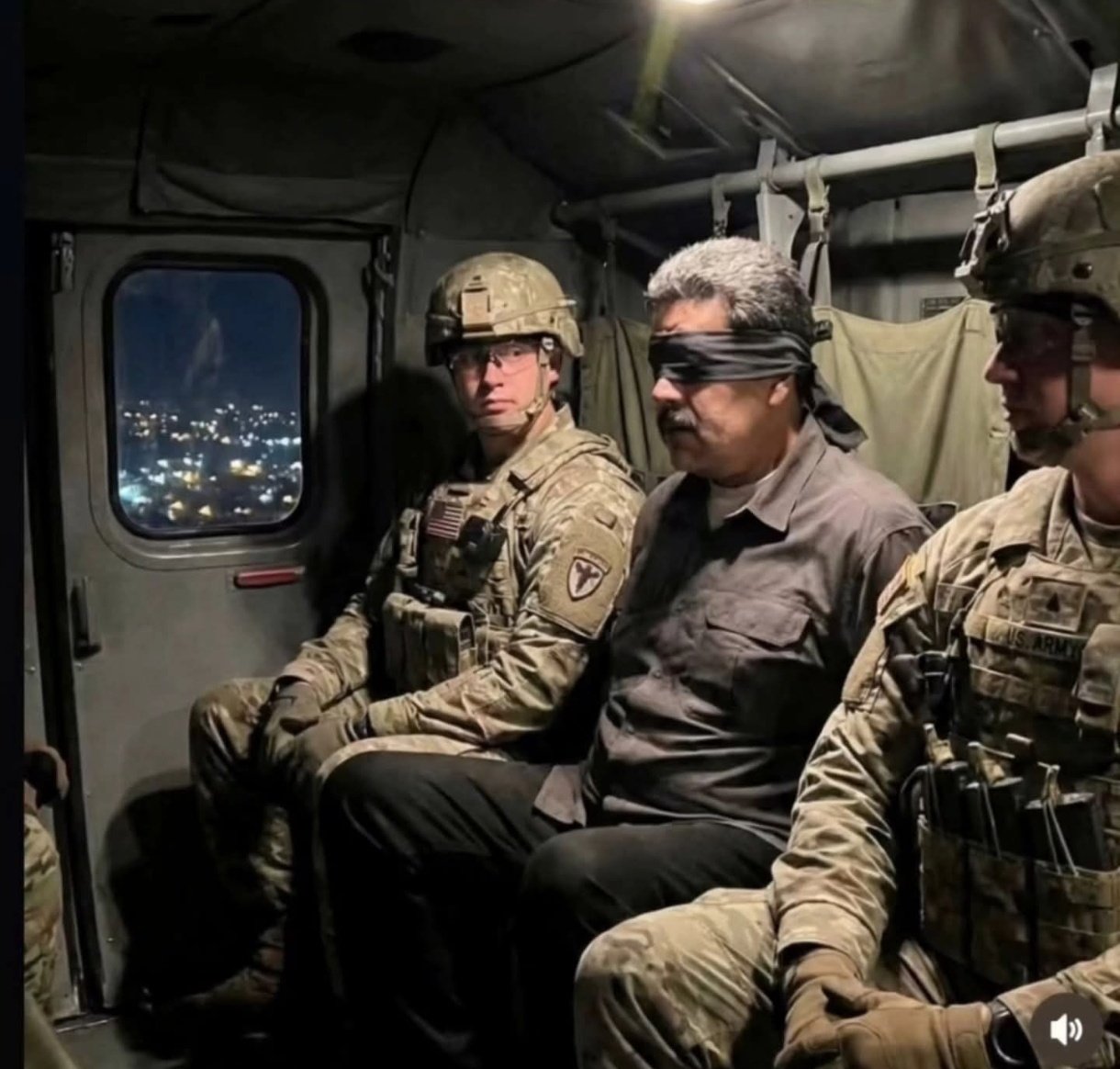
Two decades before US forces kidnapped Venezuelan president Nicolás Maduro this weekend, Hugo Chávez had already predicted the approach:
Years ago, someone told me: ‘They’re going to end up accusing you of being a drug trafficker – you personally – you, Chávez. Not just that the government supports it, or permits it – no, no, no. They’re going to try to apply the Noriega formula to you.’ They’re looking for a way to associate Chávez directly with drug trafficking. And then, anything goes against a ‘drug trafficker president’, right?
On the morning of 3 January, Trump tweeted a Happy New Year message. The US had carried out ‘a large scale strike on Venezuela and its leader’. President Maduro and his wife Cilia had been ‘captured and flown out of the Country’. Trump said more details would follow in a few hours’ time. The details, however, were confused.
Later that day, an old friend from Caracas rang to say that secret negotiations had been taking place for some time between the regime and the Americans. The Americans wanted Maduro’s head, which he refused to supply – according to the New York Times, he was offered transport to a well-cushioned retirement in Turkey, which he scorned, to his great credit. And though repeatedly offering to negotiate with Washington on questions of oil and US drug imports, he was also rallying Venezuelans against Trump’s military build-up in the Caribbean.
The Trump administration evidently preferred negotiating with Delcy Rodríguez, the vice-president, and others in Venezuela, where the two key ministers are Diosdado Cabello at the Interior Ministry and Vladimir Padrino at Defence. Both have support in the Army, some 100,000 strong, and Cabello also commands the popular militia forces, which are said to be larger still. As Trump reinforced his threatening armada over the past few months, the Maduro government responded by arming sections of the population.
The question of who now governs Venezuela has therefore become crucial. The first answer came from Trump: ‘We are going to run the country until such time as we can do a safe, proper and judicious transition.’ But the Trump Administration is caught in a cleft stick. Trump’s MAGA base is not in favour of sending American troops to be killed in foreign countries – this was a central part of the campaign they waged against the Democrats and the old GOP establishment over Afghanistan and Iraq. They do not want US troops on the ground in Venezuela. At the same time, the hard-right Latino émigré ultras represented by Rubio are unhappy that Bolivarians are still in office in Caracas.
There was talk at one point that Marco Rubio might be appointed de facto governor or consul, to give orders to the Venezuelan government. Meanwhile, messages from Caracas have been mixed. The day after the capture of Maduro, Cabello declared:
This is an attack against Venezuela. We are in position. We call on our people to remain calm and to trust the leadership. Do not allow anyone to become discouraged or make the situation easier for the aggressive enemy.
Rodríguez, confirmed by the Venezuelan Supreme Court as interim president for the next three months, went on state TV to call for Maduro’s release. Trump attacked her in an interview with The Atlantic for not being sufficiently pliant, saying she made promises that must now be kept, and threatening: ‘If she doesn’t do what’s right, she is going to pay a very big price, probably bigger than Maduro.’ He went on: ‘Regime change, anything you want to call it, is better than what you have right now. Can’t get any worse.’
The Trump administration seems incapable of grasping that – whatever people think of Maduro – very few Venezuelans welcome an invasion of their country by the United States. This is a tradition that goes back to Simón Bolívar, who warned specifically that Latin America must beware the new empire to the north and resist exchanging Spanish for American domination. Since Sunday, there have been demonstrations in many different parts of the country demanding Maduro’s release, including a huge one in Caracas itself. The dismay goes well beyond the support base of the regime. A leading anti-Maduro Catholic leader, interviewed on BBC Radio 4 on 5 January, was told, ‘You must be very happy now’. He replied: ‘No, we are not happy. We don’t like our country being occupied, and the majority of Venezuelans don’t want it to be occupied.’
*
As Chávez warned, Trump and Rubio have been trying to fit up Maduro on ‘narco-terrorism’ charges, the latest iteration of those invisible weapons of mass destruction in Iraq. ‘Maduro is NOT the president of Venezuela’, Rubio tweeted last summer, ‘and his regime is NOT the legitimate government. Maduro is the head of the Cartel de Los Soles, a narco-terror organization which has taken possession of a country. And he is under indictment for pushing drugs into the United States.’
As is well known, Rubio himself comes from a distinguished cocaine family, heavily implicated in the drug trade throughout South America. His relatives have been involved in smuggling cocaine into the United States for years. As Secretary of State, he has put drug dealers into every pro-US government on the continent. Unsurprisingly, some are saying that the assault could actually be a Rubio move to defend US-sponsored drug-runners against the more autonomous dealers who also exist in that part of the world.
Another irony is that Delta Force, the US state-terrorist special forces team that abducted the Venezuelan president, is itself widely regarded as operating a drug-trafficking network within the United States. The investigative journalist Seth Harp’s The Fort Bragg Cartel: Drug Trafficking and Murder in the Special Forces (2025) documents murder and narcotics trafficking committed in and around the US Army installation outside of Fayetteville, North Carolina. Harp’s book made it onto the New York Times bestseller list and reviewers have largely accepted its findings. So this criminal US operation was carried out by its own drug cartel. There’s no sense of shame here, or anything like that. They just do it, assuming people will keep on taking this as long as they can point to a few successes.
We now have Attorney General Pam Bondi tweeting the so-called indictments, which have a touch of insanity about them:
Nicolas Maduro and his wife, Cilia Flores, have been indicted in the Southern District of New York. Nicolas Maduro has been charged with Narco-Terrorism Conspiracy, Cocaine Importation Conspiracy, Possession of Machineguns and Destructive Devices, and Conspiracy to Possess Machineguns and Destructive Devices against the United States.
No serious lawyer in the United States could take this at face value. The whole thing is a farce. To accuse a sitting president, whom you’ve just kidnapped while bombing his capital, of ‘conspiracy to possess’ automatic weapons is grotesque. Bondi is setting up a show trial, but it may not be as easy as she thinks. Without any doubt, some of the best US lawyers will defend Maduro and take up his case. This does indicate, however, that appointments to the second Trump cabinet were largely made on the basis of loyalty rather than competence – selecting people who wouldn’t question the President and his crazy ideas – as the interview with Trump’s chief of staff in Vanity Fair makes clear. The absence of any serious opposition in the country capable of insisting on the authority of Congress suggests a process of decay within the institutions of American bourgeois democracy itself.
Many have pointed out – as Chávez himself noted – that this is the Noriega script. But there is an important sense in which Maduro, whatever his weaknesses, cannot be compared to Noriega. The Panamanian strongman had effectively worked for the CIA since the 1950s, gunrunning for right-wing groups heavily involved in the drug trade, before he fell out with Washington. He had been trained in torture at the notorious School of the Americas, where countless racketeers and drug-trafficking money-launderers had their first experience of what was required of them. The US treated him extremely badly, despite everything he had done for them. He began to get one or two ideas about national sovereignty, at which point the government of George H. W. Bush angrily decided to oust him. That operation, however, was backed by a US military invasion, before a joint Delta-SEAL detachment lifted him from his palace and handed him over to US Marshals to be locked up after a fake trial.
But there is another precedent, which should not be forgotten: that of Jean-Bertrand Aristide, President of Haiti in the early 1990s and then again from his election in 2001 until his overthrow in 2004. Initially a moderate, Aristide had the nerve to say that Haiti should be repaid by France for the massive reparations the island had been forced to pay its former colonial master for the crime of abolishing slavery after the 1791–1804 Haitian Revolution – some $21 billion in today’s money. Paris worried that this might set a precedent for Algerian demands. In February 2004, French and Haitian officials collaborated with the US to force Aristide out of the country.
There’s an interesting footnote here. In spring 2004 I happened to be at a conference in Caracas when this Franco-American operation was taking place. The day after Aristide’s abduction, I said to Chávez: ‘Why didn’t you offer him asylum?’ He said: ‘I feel incredibly upset. He was trying to ring me, and we were busy with the conference. By the time I got the message, it was too late. He’d already been sent off to South Africa, and I regret it.’ I told him that I was going to Johannesburg soon to give a lecture. Chávez said: ‘Please try and meet him and tell him he’s very welcome here. He should be back in his own region to fight back against these rogues.’ I did, in fact, send the message. But I think Pretoria had a deal that he was to be kept in South Africa until the US allowed him to return to Haiti. Maduro is the latest in a long line.
The attacks against him recall the assaults on Chávez, continually accused by the Western media of being a dictator. Why? Because he wore a uniform. But Chávez was extremely popular and won election after election; one didn’t have to go down to the Gulf States and Saudi Arabia to find people infinitely worse on every level. Chávez’s radical-democratic constitution – including the right to recall the president by referendum, if necessary – was denounced by the right-wing opposition, even though it then tried to use the same recall mechanism against him. I was in Caracas when Jimmy Carter visited the country to observe the elections. He was shocked when, entering a restaurant in the leafy eastern suburbs of the city, where the bourgeoisie lives, the local opposition spat abuse at him. Afterwards he said, ‘I’ve never seen an opposition like this anywhere’. When asked, ‘How did you think the elections went?’, he answered that he hadn’t seen such a fair election in any country, clearly including the United States.
Chávez always insisted that the Bolivarian Revolution must be a democratic experience – and it was. Many people, including myself, discussed this with him. When the first results came in for the 2004 referendum, I asked Chávez, ‘Compañero, what are we going to do if we lose?’ He said, ‘What do you do if you lose? You leave office and fight again from outside, explaining why they were wrong’. He had a very strong sense of this. Which is why it’s a travesty to accuse the Chavistas of being anti-democratic from the start. During the Chávez period, the opposition newspapers and television stations blasted propaganda non-stop, attacking the regime – something you could never have seen in Britain or the United States. When people said to Chávez, ‘We should crack down’, he said, ‘No, we fight them politically’.
Since 2013, the regime has been hollowed out. If Maduro won the 2024 election, he was not able to provide any proof of it when asked by Lula. Economically, there’s no doubt that the Bolivarians were ill-advised, even during the Chávez days. When the best Keynesian economists turned up there, including Dean Baker and Mark Weisbrot, as well as Joseph Stiglitz, their recommendations weren’t followed. Possibly it would have been better at that point if they had turned to the Chinese. But the real economic deterioration was a result of the US siege. The sanctions on oil sales, imposed by Trump in 2017-18 and maintained by Biden, effectively led to some 7 million people leaving the country, with Venezuelan refugees turning up in Miami, Colombia and other parts of Latin America. Washington knew what it was doing.
The support of the Venezuelan armed forces also came at a cost. After the 2002 coup attempt against Chávez, I said to him, ‘This is your chance to go for a massive restructuring of the Army’. But he said, ‘It’s not easy to do. We’re getting rid of all the senior generals who knew of or were involved in the coup attempt against me’. So I said, ‘Well, that’s actually very generous of you, because had such a coup attempt been made against an elected government in the United States, it’s very likely that the top general would have been executed for treason and the other generals would have been locked up for years. But you’ve been very kind, you’ve let some of these guys go out.’ He said, ‘Better to have the smell away’. It was a weakness, I felt at the time.
Yet for a long period, the Bolivarian regime combined radical democracy, far-reaching social-welfare and literacy programmes and an internationalist foreign policy. That was the constellation. The Cuban contribution was very important, the misiones and the rest of it. But the Cubans had no lessons to teach on democracy, alas. As the economic siege tightened, Caracas abandoned virtually all the Chavista reforms, turning to dollarization and austerity from 2019. On foreign policy, however, they didn’t go that route. They have cut down a lot on the oil to Cuba as a result of US sanctions, but they haven’t abandoned Havana. They maintained a tough position on Gaza and the Middle East, which obviously annoys the Americans. As Washington has made clear, they want a Rubio–Trump government which is theirs, 100 per cent.
*
At the official level, international reaction has been predictably muted. Naturally, China, Russia and many other powers have condemned the US military attack and abduction, calling for Maduro and Flores’s immediate release. After some dithering the Europeans have rallied in support of their protector, albeit with a shade more ambivalence than they displayed in backing the Israeli genocide in Gaza. Macron initially put out a statement calling on Venezuelans to ‘rejoice’ at Maduro’s abduction, then had second thoughts and issued another saying that France ‘neither supported nor approved’ US methods, before characteristically putting out a third, looking forward to a peaceful transition to a Venezuela led by Edmundo González Urrutia. Merz judges the legality of the kidnapping to be ‘complex’. Starmer too has been evasive, mumbling about ‘support for international law’ while avoiding any criticism of Trump.
Double standards the citizens of Europe are used to. Russia on the one side, against whom the EU is preparing their twentieth package of sanctions; and Israel on the other, which maintains its status of favoured nation. And now there’s a third, triple standard – the attack on Venezuela. By comparison, the attitude of The New York Times is more forthright, calling the operation an instance of ‘latter-day imperialism’, representing ‘a dangerous and illegal approach to America’s place in the world.’ It cites Republican legislators who have spoken out against Trump’s course in Congress – Senators Rand Paul and Lisa Murkowski, Representatives Thomas Massie and Don Bacon.
There may be further mobilizations in the United States itself. The new mayor of New York, Zohran Mamdani, denounced the unilateral attack on a sovereign nation as an act of war, and there have already been protests in eight US cities. Solidarity with the Bolivarian Republic is crucial. At stake is not only the future of Venezuela but also that of the Cuban Revolution – the first, and alas it would appear last, socialist revolution in the Americas. Cuba has been battered and besieged by the United States: one invasion defeated at Playa Girón, constant sanctions, constant attacks, constant lies. Without Venezuelan oil, supplied free since the Bolivarians came to power, there is reason to fear for Cuba’s future. And if the US succeeds in ‘cleaning up’ Venezuela, Cuba may well be next.
But this may prove harder than expected. The demonstrations in Caracas should serve as a warning to the Trump administration. Over the last few days, Rodríguez has been alternating between militant speeches, attacking what has happened, and reassuring noises to the Americans. Trump is saying, ‘We’re not interested in what she says, we’re interested in what she does’. He’s right. A lot will depend, not so much on her, because she’s just a figurehead, but on the Venezuelan Army, which is absolutely crucial.
The Trump administration could be faced with a dilemma. The Bolivarians still control the Venezuelan military and paramilitary forces, the courts, the oil industry and every level of the administrative bureaucracy. Emotions are running high, as the message delivered to the Venezuelan National Assembly by Maduro’s son made clear. The Rodríguez government has been negotiating, as we know. But if Trump and Rubio ramp up the pressure too far, given the general hostility to the US attack, Caracas may be forced into some show of resistance. If Rodríguez and company refuse to play ball at some point, Trump might be capable of shrugging it off, but the Rubio camp will not be. At that stage, the logic of treating Caracas as a puppet government could break down and the line will be, ‘Okay, they’re traitors, let’s go and grab them’ – finally sending in boots on the ground. That would get messy, fast. It would also cause enormous tensions within Trump’s own camp, because this is one thing he repeatedly pledged not to do.
In Chávez’s 2005 speech, he went on to say:
Fidel once told me, ‘Chávez, if that ever happens to you or me, if they invade us, the last thing we’d do is what Saddam did: go and hide in a hole. You have to die fighting, in the first line of battle.’ And that’s what I would do – if I have to die, I’ll die on the front line with the dignity of a Venezuelan who loves this country.
Nothing is settled as yet.


Writer, journalist and film-maker Tariq Ali was born in Lahore in 1943. He owned his own independent television production company, Bandung, which produced programmes for Channel 4 in the UK during the 1980s. He is a regular broadcaster on BBC Radio and contributes articles and journalism to magazines and newspapers including The Guardian and the London Review of Books. He is editorial director of London publishers Verso and is on the board of the New Left Review, for whom he is also an editor. He writes fiction and non-fiction and his non-fiction includes 1968: Marching in the Streets (1998), a social history of the 1960s; Conversations with Edward Said (2005); Rough Music: Blair, Bombs, Baghdad, London, Terror (2005); and Speaking of Empire and Resistance (2005), which takes the form of a series of conversations with the author.
ZNetwork is funded solely through the generosity of its readers.
Donate




