


Seeds are the first link in the food chain and the repository of life’s future evolution. As such, it is our inherent duty and responsibility to protect them and to pass them on to future generations. The growing of seeds and their free exchange among farmers is the basis of maintaining biodiversity and food security. For me, “seed freedom” is the freedom of the seed to keep evolving in its autopoietic freedom based on self-organisation, self-renewal and self-regeneration in coevolution with all the beings that depend on the seed and contribute to the life of the seed. This includes farmers who, over millennia, have intelligently maintained rich seed diversity.
Seed is the self-urge of life to express itself, in its diverse expressions, abundance, permanent renewal and rejuvenation. All life begins in seed. Seed is not just the source of life, it is the very foundation of our being. For millions of years, seed has evolved freely to give us the diversity and richness of life on the planet. For thousands of years farmers, specially women, have evolved and bred seed freely in partnership with each other and with nature to further increase the diversity of that which nature gave us and adopt it to the needs of different cultures. Biodiversity and cultural diversity have mutually shaped one another. We have the diversity of seeds because of the coevolution and co-creation by nature and farmers over 10,000 years.
Seed is the embodiment of millions of years of nature’s evolution and thousands of years of farmers’ evolution and breeding. It holds the potential of millions of years of future evolution. Seeds are, therefore, the repository of centuries of biological and cultural evolution. They hold the memory of the past and potential of the future.
Seed does not only hold the memory of time, evolution and history. It holds the memory of space, of the interactions in the web of life, of pollinators such as bees and butterflies to whom the flowers of the seed gave its pollen, who then fertilised the plant so it could reproduce and renew itself. Seed is also the gift of millions of organisms present in soil which nourish the seeds and plants and are in turn nourished by the organic matter produced by plants.
Seed is more than a metaphor. It emerges as the site of ethical, ecological, ontological, scientific, legal, economic and political contest between two worldviews and ontologies. One worldview is based on corporations as “persons” with minds who create “life” and can then own life, as intellectual property for corporate profits. The alternative worldview is based on the recognition of the self-organising and self-making nature of life forms, including seeds of humans sharing the earth with the diversity of life forms and beings as an “earth family”.
The duty to save seeds and defend seed freedom — Bija Swaraj — is an ethical and ecological imperative. This is why I founded Navdanya and the global seed freedom movement and sow the seeds of earth democracy — Vasudhaiva Kutumkam.
Not all seeds are the same. There are varieties bred by farmers, which are also called indigenous varieties, native seeds and heritage seeds. These seeds are “open pollinated”, which means they are fertilised by pollinators through open pollination, and are hence renewable. They can, therefore, be saved.
“Open pollinated seed” renews itself. Farmers have always saved seeds from their harvest to grow the next crop. And while saving seeds, they select and breed not just for taste but also for quality, diversity, resilience to pests and diseases as well as to droughts and floods.
But seed saving is seen as a problem by the agrichemical industry, which started out as a war industry and is now genetically modifying itself into biotechnology and the so-called life sciences industry. Industry has transformed seed from being a self-organised renewable resource into a non-renewable commodity to be bought every year. Patents on seed are central to the seed monopoly attempting to be created. About 95 per cent cotton seed in India is now controlled by Monsanto.
Monsanto has collected illegal royalties as “technology fees” since 1992, driving farmers into debt, even suicide. Most of the 300,000 farmer suicides in India since 1995 when WTO came into force are concentrated in the cotton belt.
When India amended its Patent Act, scientifically based safeguards consistent with TRIPS were introduced. Article 3 defines what is not patentable subject matter. Article 3(j) excludes from patentability “plants and animals in whole or in any part thereof other than micro-organisms but including seeds, varieties, and species, and essentially biological processes for production or propagation of plants and animals”.
Article 3(j) was used by the Indian patent office to reject a Monsanto patent on climate resilient seeds.
Monsanto tried to challenge Article 3(j) in the Delhi high court. I had intervened in the high court case on May 3, 2017, and on April 11, 2018, the high court announced a very significant decision in the context of the planet’s future, farmers’ freedom, and freedom of society from corporate power.
The high court dismissed Monsanto’s case and upheld India’s sovereignty, India’s laws for seed sovereignty, farmers’ rights and public order. Some judges don’t lie.
The courts have maintained that seeds fall within the exclusion of Article 3(j), and Monsanto does not have a patent on Bt Cotton seeds. The courts also upheld the Indian company Nuzeevedu’s claim that seeds are protected by the Plant Variety Protection and Farmers Rights Act, and Monsanto should register under this law.
I was appointed as a member of the expert group set up by the then agriculture minister to draft the Plant Variety Protection and Farmers Rights Act 2001 to implement the sui generic option in Article 27.3.b of TRIPS.
We introduced a clause on “farmers’ rights”: A farmer shall be deemed to be entitled to save, use, sow, resow, exchange, share or sell his farm produce, including seed of a variety protected under this law in the same way as he was entitled before the coming into force of this law.
Seed freedom enshrined in India’s laws is the foundation of swaraj in our times. Bija Swaraj is vital to address the crisis of hunger, malnutrition and farmer suicides.
It’s vital to bring back taste, nutrition and quality in our food. It’s central to ending the vicious and violent cycle of debt and suicides. And without conservation and evolution of biodiversity of our seeds, we will not be able to adapt to climate change.
The Delhi high court’s decision upholding Article 3(j) is, therefore, of evolutionary significance for the planet and for humanity.

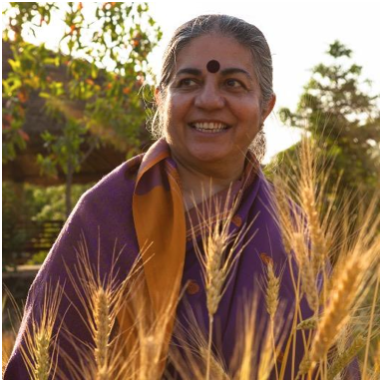
Vandana Shiva (born 5 November 1952) is an Indian scholar, environmental activist, food sovereignty advocate, ecofeminist, and anti-globalisation author. Based in Delhi, she has written more than 20 books. Shiva is one of the leaders and board members of the International Forum on Globalization, and a figure of the anti-globalisation movement. She has argued in favor of many traditional practices, as in her interview in the book Vedic Ecology (Ranchor Prime). She is a member of the scientific committee of the Fundacion IDEAS, Spain's Socialist Party's think tank, a member of the International Organization for a Participatory Society, and the founder of Navdanya, a movement for biodiversity conservation and farmers’ rights. She is also the founder and director of the Research Foundation for Science, Technology and Natural Resource Policy. Shiva fights for changes in the practice and paradigms of agriculture and food. She received the Right Livelihood Award in 1993, an award established by Swedish-German philanthropist Jakob von Uexkull, and regarded as an "Alternative Nobel Prize”.
ZNetwork is funded solely through the generosity of its readers.
Donate




