

The highly touted picture of “Middle East peace” is quite deceptive.
Nobody in the region truly believes that peace is at hand, that there is a credible path to peace, or that the thorny issues of the Arab-Israeli conflict have been resolved.
It is not the first time that a U.S. president congratulates himself — and is congratulated by Western and Middle Eastern parties — for reaching a settlement of the conflict.
Jimmy Carter was hailed when he presided over the Camp David Accords — it was supposed to end the conflict, but in reality it gave Israel a free hand to attack any combination of Arab countries and the Palestinians because the major Arab military force was neutralized (through bribes to the ruling despot and the military brass).
Ronald Reagan had his own peace plan, which triggered more wars in the region and entailed a U.S. military intervention in Lebanon, where the U.S. confronted and bombed local militias and Syrian forces.
George H. W. Bush presided over the Madrid Conference, which was also supposed to crown his achievements after he launched the devastating war on Iraq. The Syrian and Lebanese governments negotiated after Madrid, but nothing came of those negotiations because Israel values Arab lands over peace.
Bill Clinton presided over the famous Oslo Agreement, and he invited both Yasser Arafat and Yitzhak Rabin to the White House; it was claimed that this agreement was serious because the Palestinians were included in the package. The agreement was a cover for Israel to expand settlements and continue the occupation while assigning the Palestinian Authority a role in policing, repressing, and killing its own people on behalf of the state of Israel.
George W. Bush was the first president to accept “the idea” of a Palestinian state, yet he never articulated a vision of what the state would look like or what role the U.S. would play in pressuring Israel to accept two states. His idea was in response to the Arab Peace Initiative, which was set up by Thomas Friedman, who presented it to the then Crown Prince of Saudi Arabia Abdullah bin Abdul-Aziz.
Saudi Arabia was then keen on fixing its relations with Congress and the media, and it thought that pleasing Israel would be a sure bet. Saudi Arabia was right: the pressure on the Saudi government in the wake of September 11 was lifted, and demands for investigations into Saudi links to the hijackings suddenly stopped.
Barack Obama basically ended the fraudulent “peace process,” although it still existed in name. But Obama was loath to place any pressure on Israel; if anything, he spent the years of his administration (over two terms) trying to prove that his name and ancestry did not predispose him to sympathize with Palestinians.
Israel had free rein during his terms, and he signed the strategic agreement that guaranteed Israel $38 billion over ten years. It was an unprecedented agreement and spared Israel the trouble of making an annual request for the largest foreign aid package of any country in the world.
The Netanyahu-Kushner Plan

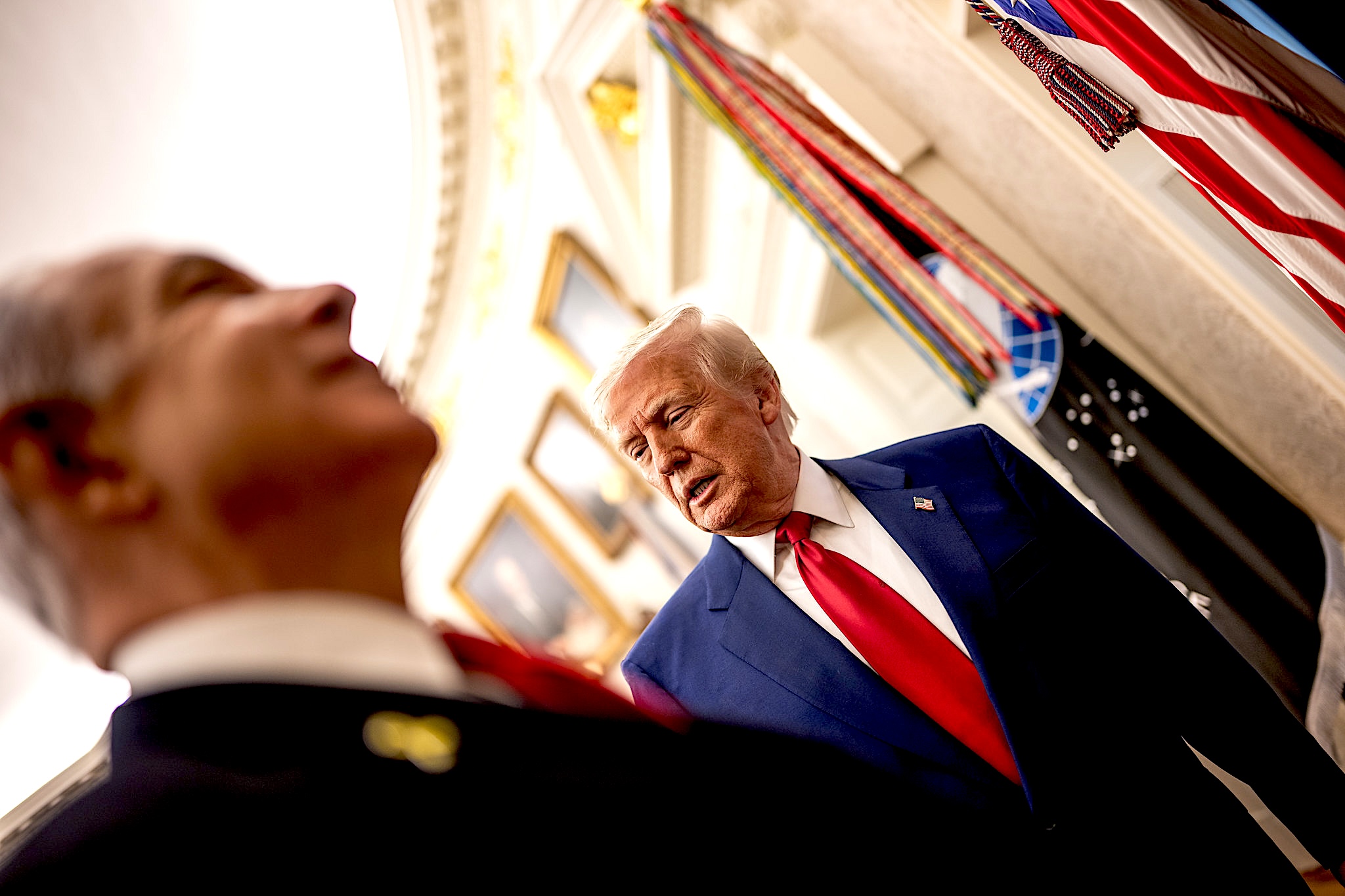
Israeli Prime Minister Benjamin Netanyahu speaking with Jared Kushner while greeting the U.S. delegation in the West Wing Lobby of the White House on Sept. 29, 2025. (White House /Joyce N. Boghosian)
Trump officially abandoned the “peace process” and adopted the Netanyahu plan, which was sold as the Trump son-in-law Jared Kushner plan. Basically, the U.S. government abandoned any search for a solution to the Palestinian problem and agreed with far-right Zionists that the Palestinian question does not deserve any official attention by the U.S.
Furthermore, the U.S. also shelved and killed the Arab Peace Plan of 2002 (which entailed a swap of 1967 Arab land in return for Arab recognition and normalization with Israel). The Netanyahu-Kushner plan operated from the premise that once diplomatic relations were established between Israel and Arab despots, the Palestinian cause would wither away and the Palestinian people would abandon their historic search for a homeland.
Even Oct. 7 did not shatter those Israeli fantasies. They think the genocide itself is sufficient to kill Palestinian national aspirations.
In this term, Trump is doubling down — allowing Israeli Prime Minister Benjamin Netanyahu to dictate U.S. foreign policy in the Middle East.
In ordering the ceasefire, the president was balancing the cries of Israeli critics of Netanyahu and Arab despots who feel that the continuation of the carnage and starvation in Gaza is hurting their own interests.
The twenty-point plan announced by the administration offers nothing political for the Palestinians. It is a return to the Balfour Declaration, which promised a homeland to the Jews (who constituted less than 10 percent of the population at the time) while offering only civil and religious rights to the Palestinian people.
(The Balfour Declaration did not name the Palestinian people; it merely referred to them as “non-Jewish communities in Palestine.”)
Trump agreed on the twenty-point plan with Arab and Islamic despots in New York at the U.N. But only the foreign minister of Pakistan admitted the obvious: the announced plan fell short of what Arab governments had agreed to with Trump in their meeting in New York. Nett edited
Arab governments, however, are too afraid to contradict Trump, especially in public. They have spent money and effort to win his good side. Qatar, Saudi Arabia, and the UAE have all committed billions to appease Trump and to ensure good relations with his administration — and all three invested billions in Trump son-in-law Jared Kushner’s fund.
The plan talks about the “de-radicalization” of the Palestinian people. This notion— a standard in both Likud and left-Zionist mindsets in Israel — attributes Palestinian opposition to occupation and Zionism to brainwashing and school curricula.
In fact, most Arab governments — under pressure from the U.S. Congress — have purged their textbooks of anti-Zionist material. Arab people oppose Israel not because of their governments, but despite their governments’ attempts to pacify them and make them accept Israeli apartheid.
De-radicalization assumes that Palestinian nationalism is no different from Nazism— and this notion started in the 1960s with people like Elie Wiesel and Amos Oz. It assumes that one can unburden a person of his or her love for their homeland.
An Old Zionist Trope
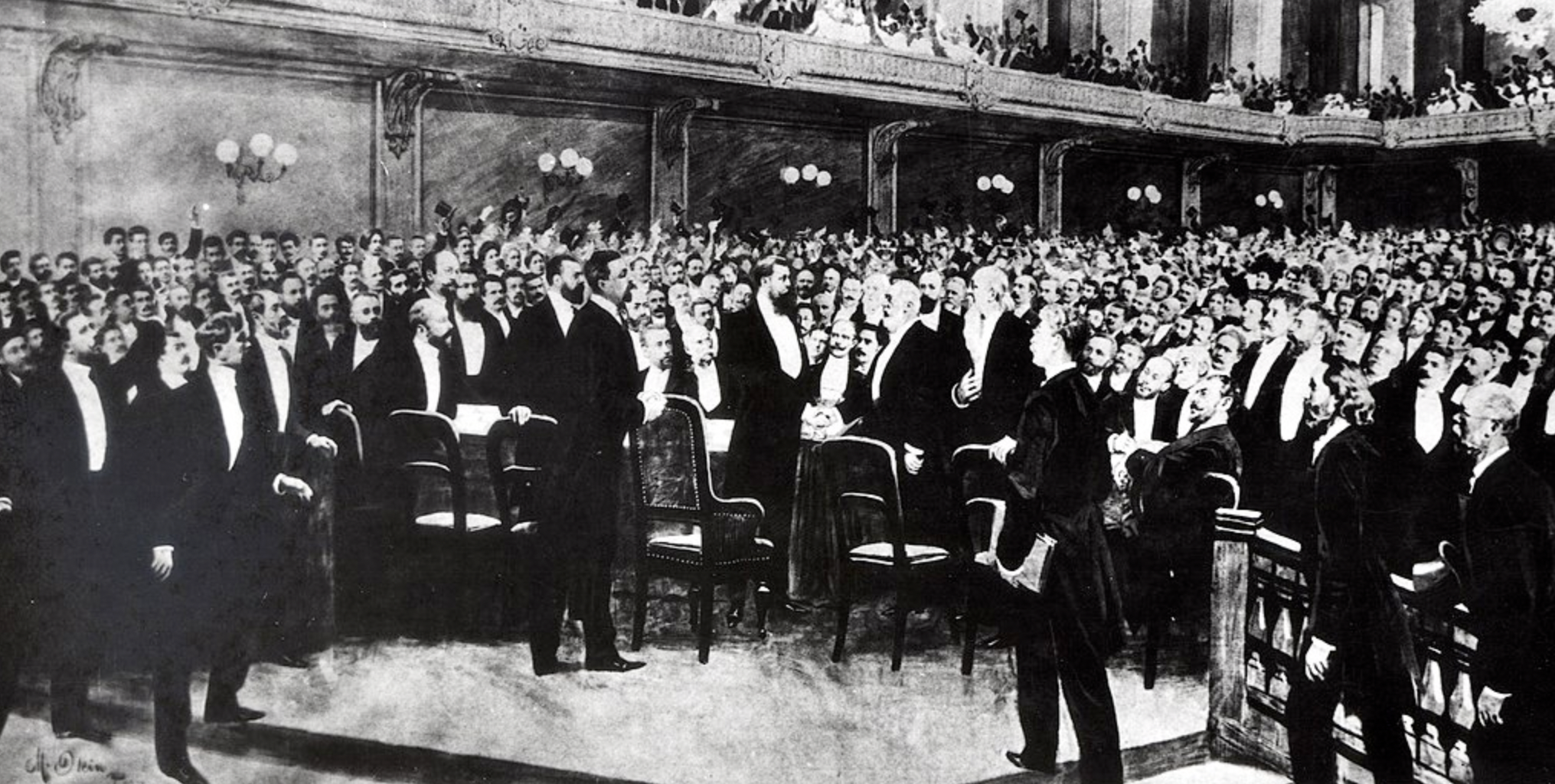
Theodor Herzl at First Zionist Congress in Basel on Aug. 8, 1897. (National Photo Collection of Israel/Wikimedia Commons)
The Trump plan also talks about economic development, which is an old Zionist trope. In his 1902 book Altneuland, Theodor Herzl wrote that Arabs would acquiesce to the usurpation of their homeland if they derived economic benefits from the Jewish state. The two years of genocide and starvation have not pushed the Palestinians to either surrender or turn against Hamas fighters in their midst.
The agreement is predicated on the old Western principle that Israeli lives and Israeli prisoners are worth much more than Palestinian lives and prisoners. The deal talks about the release of Palestinian prisoners, but that constitutes around 10 percent of all Palestinian prisoners.
Israel is known to kidnap scores of Palestinians as soon as it releases some, and only under pressure. The agreement speaks about “Gazans,” which reflects a tendency in Zionist and Western media: they want to fragment Palestinian national identity and treat all Palestinians as a disparate group of tribes and clans. (The language of Palestinian tribes is back in vogue — something the Israelis have favored since 1948.)
The plan does not offer any political rights to the Palestinian people; it merely promises a “credible pathway to self-determination and statehood.” Successive U.S. administrations strictly avoided invoking the term self-determination when it came to Palestinians; only Warren Christopher and Madeleine Albright used the term during the Oslo process.
Yet the term has disappeared ever since. This document merely speaks about the possibility of recognizing self-determination for the Palestinians down the road, but not now. As for statehood, Israel has made it very clear that it will not tolerate a Palestinian state next to Israel. The U.S. government (under both Biden and Trump) has not expressed disapproval of the Israeli stance.
This is not a “magnificent” peace deal — as Trump called it; this is an American ultimatum to the Palestinian people.
The Israeli army is authorized in this agreement to continue its strangulation, occupation, starvation, and genocide at any time of its choosing. Arab and Islamic governments have all agreed to that and hailed Trump for this agreement.
The chances for this deal to hold are slim to none.
Israel will find many reasons to violate the agreement. Since November 2024, Israel has violated the end-of-hostilities agreement with Lebanon thousands of times. Hizbullah has not fought back once, yet the U.S. has not blamed Israel for its violations.
Hamas is asked to disarm, and the Palestinian Authority will not be allowed to return to Gaza (from which it was evicted by the locals) until it reforms itself — that is, until it meets more conditions set by Israel and the U.S.
The U.S. will head a board to govern Gaza, which means that the U.S. has now become the official occupying power.
It alone can decide (along with Israel) who gets to serve as agents of the new joint Israel–U.S. occupation. But how can the U.S. square its vague language about the possibility of self-determination for the Palestinians with its direct occupation of the strip?
Hamas is unlikely to disappear, and it seems, politically speaking, in better shape than Hizbullah in Lebanon. Tony Blair (a client of UAE President Mohammed bin Zayed) and Kushner will try yet again to push for normalization between Arab countries and Israel — all in the hope of killing the Palestinian question.
As`ad AbuKhalil is a Lebanese-American professor of political science at California State University, Stanislaus. He is the author of the Historical Dictionary of Lebanon (1998), Bin Laden, Islam and America’s New War on Terrorism (2002), The Battle for Saudi Arabia (2004) and ran the popular The Angry Arab blog. He tweets as @asadabukhalil
ZNetwork is funded solely through the generosity of its readers.
Donate




