

Let me begin with a few general statements about the latest attacks on Chomsky. It is a sickening spectacle to witness private emails sent by Chomsky to a close, personal friend being used to attack him. Imagine the sordid details about a financial dispute between you and your children getting exposed to the public when you are 97 years old, suffering from a stroke, and incapable of responding. I wonder how the attackers out there would feel having their personal email being scanned for personal and political gotchas.
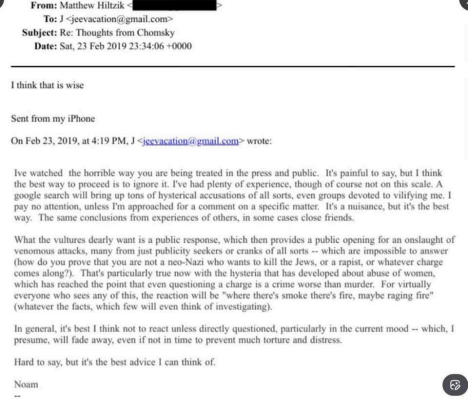
Still, if we do wish to peruse private emails, let us please do it properly, without mischaracterizing what is written. Among all the takes out there, Greg Grandin’s is probably the fairest. And yet, in its latest addendum, it contains various mischaracterizations that are worth bringing up. Most of the addendum pertains to a private email Chomsky sent Epstein, which is quoted here in full for reference.

First, areas of agreement. Grandin writes about Chomsky that “he proved strikingly incurious—or dismissive—about the real-world exploitation of children by someone in his social orbit.” Grandin also writes: “Nothing Chomsky writes in this note … suggests that Chomsky gave much thought to Brown’s reporting or to Epstein’s victims.” referring to Julie Brown’s reporting that exposed Epstein’s crimes. Indeed.
However, I have several areas of disagreement with the addendum as well. First, the framing. The addendum fails to account for the fact that the email in question above was private, and written with a strong expectation of privacy. Grandin writes his critique as though Chomsky made a public statement defending Epstein, and attacking #metoo. He contrasts the above email with Chomsky’s actions in the Faurisson affair, whereas in the Faurisson case, Chomsky went public. For instance, Grandin says “He reflexively treats emotionally wrenching matters as if they can be defused through adherence to abstract principles. In the case of Faurisson, it was free speech. With Epstein, it seems to be due process.” Given the private nature of the email, this passage rings hollow.
Grandin then states that “The message is distinguished … for Chomsky’s refusal to take seriously #metoo’s moral imperative.” This is a mischaracterization. Chomsky’s substantive points in the email including the use of the term “hysteria” in the email is not a characterization of #metoo overall, but of cancel culture specifically, and its implication on due process. Cancel culture is something that affects otherwise progressive movements like #metoo and critiquing it is not tantamount to critiquing the movement overall. It is hard to find Chomsky interviews specifically about #metoo, but a google search does yield the below response, which is his most direct take on #metoo. He describes #metoo as a “real and serious and deep problem of social pathology.” That does not sound like someone who refuses to take seriously #metoo’s moral imperative. Chomsky does caution about cancel culture, like in the email. “I think it grows out of a real and serious and deep problem of social pathology. It has exposed it and brought it to attention, brought to public attention many explicit and particular cases and so on. But I think there is a danger. The danger is confusing allegation with demonstrated action. We have to be careful to ensure that allegations have to be verified before they are used to undermine individuals and their actions and their status. So as in any such effort at uncovering improper, inappropriate and sometimes criminal activities, there always has to be a background of recognition that there’s a difference between allegation and demonstration.”
Grandin goes on to write: “he excused Epstein with the thinnest proceduralism (due process, presumption of innocence, “he served his sentence”), thus avoiding moral claims raised by the #metoo movement.” Grandin previously states, correctly, that: “Chomsky doesn’t deny Epstein’s crimes, defend Epstein’s actions, or argue that they are exaggerated.” If Chomsky doesn’t deny Epstein’s crimes, then he cannot be excusing Epstein either.
It is undeniable that Chomsky’s email merits criticism, and Grandin’s addendum is correct to address it. There is an environment of hysteria that surrounds Chomsky now. For instance, Jeffrey St Clair makes the absurd charge that Chomsky “shames the victims as hysterics.”
Grandin’s response is fairer for sure. It is a telling comment on the sad state of our discourse that the fairest take around is overstated.
[A follow up to this post has been published on Feb 9, 2026: “Chomsky-Epstein Saga: Some Additional Reflections“.]
ZNetwork is funded solely through the generosity of its readers.
Donate





8 Comments
oh come on, we are absolutely heart broken by this. long time admirers of Noam are gutted, and rightly so. he was a moral shining light, and this cannot be excused. no-one around him even suggested to stay away from that sick fucker?? 60 years of work sacrificed on the alter of this billionaire spider. what an upside down world its become. when Noam dies this will be his legacy, all the rest, burnt like the wings of Icarus.
Your emotion is quite valid. I felt similarly when I read the email first, and my note clarifies my disappointment with it. What shocked me was not the hysteria comment, which I thought was banal and didn’t see as a comment on Epstein’s victims at all, but Chomsky’s belief in Epstein’s innocence. Grandin’s analysis of all that is correct, as I note.
However, Chomsky changed his mind soon after, as Valeria Chomsky’s letter clarifies. Isn’t that enough for you to accept this is a gross, but ultimately, brief error in judgment and move on? There is also the fact that Chomsky said nothing in public. If he really felt Epstein was badly scandalized and was as close to Epstein as is claimed, why didn’t he say anything in public? There’s no hint that there was any impact of all of this on Chomsky’s politics – consider that too.
Nice comments to a good article. Breath of fresh air from the tsunami of BS out there, about Chomsky, especially from the online “left”
1. An important email that mainstream media isn’t quoting is the following, where the cunning and manipulative Epstein sold himself well to an unsuspecting, well-meaning Chomsky:
https://www.justice.gov/age-verify?destination=/epstein/files/DataSet%209/EFTA01010045.pdf
2. Further, the following extract from a private email correspondence between Chomsky and an anonymous person is also important because Chomsky said it in May 2023, where he said he wasn’t aware of Epstein’s real nature at that time. Taken from https://www.filmsforaction.org/articles/chomsky-and-epstein-what-the-evidence-actually-shows/, whose author Tim Hjersted published it with the permission of the anonymous reader as mentioned therein:
“There’s an old principle, particularly on the left but much more broadly, that someone who has served a sentence re-enters society without prejudice. One close friend spent years in prison. Epstein was well-known in Cambridge, taking part in scientific conferences in Nowak’s lab, meeting people, bringing important scientists and mathematicians to the meetings. It was well-known that he’d served his sentence. I don’t recall anyone even mentioning it.
Much later, after his incarceration, a flood of lurid stories and charges came out. But no one who knew him, Valeria and me included, ever [heard] or saw a remote hint of anything like that, and all were quite shocked, sometimes skeptical because he was so remote from anything they’d ever heard of.”
3. Another private email correspondence between Chomsky and another anonymous person is this:
https://www.reddit.com/media?url=https%3A%2F%2Fpreview.redd.it%2Fchomsky-on-the-more-recent-allegations-against-epstein-v0-8ibqo6b3k0ya1.png%3Fwidth%3D1579%26format%3Dpng%26auto%3Dwebp%26s%3Dbaabb402fe869e425a2eaea880338a3d2629c7e7
4. Unfortunately, “hysteria” is a word that Chomsky had often used in his writing. He didn’t mean to use it in a gendered manner that it is being interpreted now in. The following documents his use of the word over the years: https://www.reddit.com/r/chomsky/comments/1qvedn3/chomsky_and_the_word_hysteria/
Forgot to mention— Chomsky is old enough ( as am I) to remember the satanic day care abuse hysteria in the 1980’s.
It is bizarre how this goes unmentioned but anyone old enough to live through that knows what it was like. It was a very literal sort of witch hunt.
https://www.nytimes.com/2021/03/31/us/satanic-panic.html?unlocked_article_code=1.KVA.XrRr.T15TbN_-iC8i&smid=url-share
Very poetic but Chomsky isn’t a figure from Greek mythology— he was around people who treated Epstein as a normal person and he fell into that. He and his wife screwed up badly this time but the meaning of his life isn’t dictated by people who assume they couldn’t have made the same type of mistake.
That was supposed to be a reply to David’s Icarus comment.
I don’t think this is quite right. When you read the email what comes across to me is that Chomsky genuinely believed that Epstein , his friend, was being slandered in the ways Chomsky himself was often slandered. He was wrong.
But that doesn’t make him a terrible person who doesn’t care about ordinary people outside his class. It makes him human. It is pretty common for people to know someone and think he on she is a nice person and if you have only known them to be nice and a good friend it will be very hard to credit reports that they were in fact monstrous. Judging from my own life, we have all known such people. I am counting them off in my head.
It is more than fair to criticize Chomsky for not looking more closely at the evidence— he deserves that. But what a number of leftist writers are saying about him goes far beyond this and says he is just an elitist like all of Epstein’s other willing associates and that this shows Chomsky didn’t care about ordinary people at all, as if the evidence of his entire life just doesn’t matter. People should be able to say Chomsky was dead wrong in this case and should have examined the evidence more closely without turning him into a demon figure.
Of course, as Grandin says, future emails might show something worse, but that is how it looks based on what we know now.
I have lost some respect for some leftist writers. If this is how they approach issues it shows sloppiness of thought.