


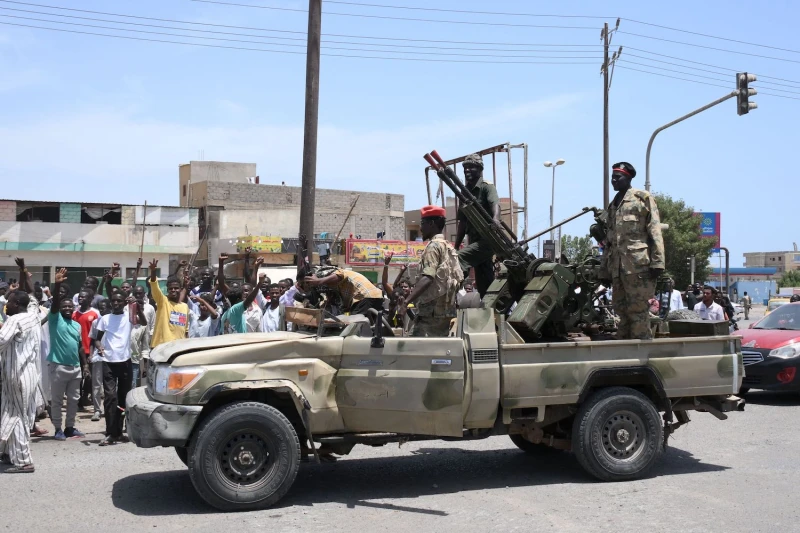
For the past two weeks, international news in much of the European media has been dominated by efforts to extract nationals from the violence in Sudan. Coverage is likely to fade as the evacuation slows down and the media moves on to other conflicts. There may, in fact, be a far greater movement of Sudanese refugees desperate to get out of the country, but this will attract minimal international attention.
The focus on the evacuation has sidelined the much longer-term issues facing Sudan, and foreign states and sub-state actors will be watching developments with a keen interest, especially if the disorder persists until one of the two generals vying for control finally succeeds.
The current violence has its origins in the ousting of long-time autocrat Omar Hassan Al-Bashir back in 2019, after nearly three decades in power.
Long before he was removed, Bashir had been under investigation by the International Criminal Court, with arrest warrants issued in 2009 and 2010 for crimes against humanity and genocide, principally for actions in the western province of Darfur.
These led nowhere and his regime remained in power for another decade. Then, public protests began towards the end of 2018 against economic conditions and their impact on living standards. These were ignored but rapidly coalesced into huge, peaceful anti-government demonstrations, culminating in a massive protest early in April 2019. This turned into an extraordinary sit-in by thousands of protesters outside the army HQ. With the police and much of the army opposing repression, Bashir’s position became untenable and he was forced from office by the army six days after the sit-in began.
Divide and rule had been a key tactic of Bashir’s regime, and his setting up of the paramilitary Rapid Support Forces (RSF) in 2013 to counter the power of the army was part of this strategy. Drawn largely from the Janjaweed militias active in Darfur, the RSF became the main means of governmental control of Darfur, a devastating conflict that has seen 2.5 million people displaced and 300,000 killed.
After the coup there was an uneasy sharing of power between two generals, the head of the regular army, Abdel Fattah Al-Burhan, and the leader of the RSF, Mohamed Hamdan Dagalo, known as ‘Hemedti’, whose huge family wealth gives him an independent source of power and influence.
It is the rivalry between the army and the RSF, partly over control of sectors of the economy, that tipped over into outright violence two weeks ago.
With over 45 million people and the third largest land area in Africa, Sudan has plenty of capacity for economic exploitation
There has been a recent if tenuous ceasefire as foreign states endeavour to engineer a peaceful transition to civilian rule, but whatever the outcome, there will be jockeying for power involving external actors for at least two reasons.
One is that Sudan is virtually surrounded by instability, in addition to its internal fighting. South Sudan is mired in inter-ethnic conflict, Chad to the west has had a recent coup, and Libya to the north-west remains deeply unstable since the 2011 war to oust Gaddafi. And to the east are the political uncertainties in Eritrea and Ethiopia, which continue in Somalia further to the east.
These circumstances could lead to international concern stemming from humanitarian factors. While these may play a role, far more important is Sudan’s considerable resource base and potential for economic development – with potential rewards for those involved, not least foreign states and corporations. Sudan, with over 45 million people and the third largest land area in Africa, has plenty of capacity for economic exploitation, and many states are keen to get in on the act.
As well as offering considerable scope for hydroelectric power, the Nile has potential for irrigation use that could greatly expand the country’s agricultural base. In addition, Sudan is the third largest producer of gold in Africa, and has rich deposits of chromite, manganese and uranium. Much of the potential for exploitation of these has been limited up to now by poor governance and the impact of sanctions imposed for sheltering Osama bin Laden for five years in the 1990s.
Immediate players looking to gain include the Libyan warlord, Khalifa Haftar, who controls much of eastern Libya towards the border with Sudan. Haftar’s supporters provided weapons to the RSF in the preparations for the current fighting. In the past, Hemedti has sent paramilitaries to aid Haftar’s troops, and Haftar forces, in turn, are reported to have trained RSF personnel in urban warfare.
The Saudis, in particular, have maintained close relations with Sudan for some years. Russia has sought naval access to Sudanese ports on the Red Sea, while Wagner, the Russian quasi-government mercenary force, is reported to have provided armoured vehicles and training in return for gold mining concessions.
China maintains an interest, as do the United States and the UK, but a less expected player in this potential ‘great game’ is Israel. In the past, Israel and Sudan were at odds, with Khartoum even sending troops to fight in wars in 1948 and 1967, as well as later hosting bin Laden. Relations were largely normalised after Bashir was deposed and Sudan signed up to the Abraham Accords two years ago.
Israel has long maintained security links in East Africa, even training Uganda Air Force units back in the 1960s. It sees much value in the potential for security and economic cooperation. A Mossad delegation from Israel visited Khartoum last year to work on counterterrorism and intelligence cooperation, and Israeli foreign minister Eli Cohen also visited this year.
In short, therefore, the scene appears set for intense competition by states and sub-state actors wanting to gain access to Sudan if some semblance of stability is restored. What looks all too likely to be missing, however, will be a transition to democracy. Given the potential shown by the huge nonviolent protests that heralded the fall of the Bashir regime four years ago, that would be little short of tragic.

Paul Rogers is Emeritus Professor of Peace Studies in the Department of Peace Studies and International Relations at Bradford University, and an Honorary Fellow at the Joint Service Command and Staff College. He is openDemocracy’s international security correspondent.
ZNetwork is funded solely through the generosity of its readers.
Donate




