

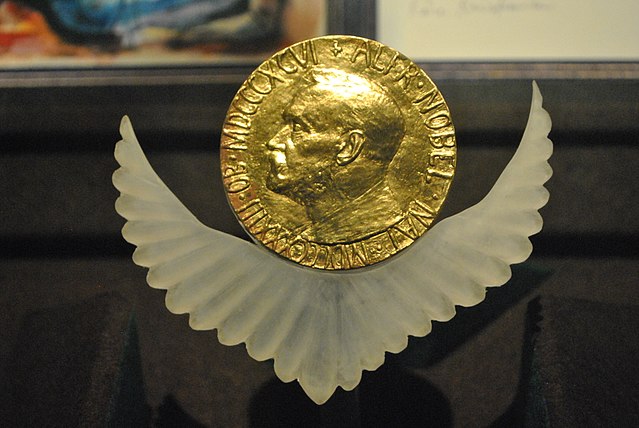
Four US presidents have been awarded the Nobel Peace Prize: Theodore Roosevelt, Woodrow Wilson, Jimmy Carter, and Barack Obama. Donald Trump is determined to be the fifth recipient. He has been campaigning for a Nobel (decided by a Norwegian committee appointed by its parliament) the same way he sells his merchandise—with a great deal of advertising, some pressure tactics, and plenty of false claims.
It’s hard to imagine that a man who is a convicted felon, an admirer (and imitator) of dictators, and an enemy of humanitarian aid and international institutions (including the International Criminal Court and the International Court of Justice) could be a candidate for the award. Yet he is—and the leaders of Israel, Pakistan, Cambodia, Azerbaijan, and Armenia have put him up for it.
Trump’s Case
Let’s for the moment take Trump’s candidacy seriously. His case rests on seven conflicts he claims to have resolved just months into his second term. Here is a brief review of those conflicts and Trump’s role in them.
- Congo-Rwanda: The US did help bring this conflict officially to an end when the foreign ministers signed an agreement in Washington in June. However, a key player in the conflict, the M23 rebel group backed by neighboring Rwanda, was not part of the agreement. M23 claims that participants in the 1994 Rwandan genocide fled to Congo and are working with the Congolese army. Efforts to bring M23 and Congo into negotiations have thus far failed.
- Egypt-Ethiopia: This conflict, which has gone on for over a decade, concerns the Grand Ethiopian Renaissance Dam on the Blue Nile River. Power generation has caused friction between Ethiopia, Egypt, and Sudan. Egypt, whose farming depends on the Nile, and Sudan, which fears flooding, oppose the dam. In July, Ethiopia declared the project complete and set September for it to open. Trump’s claim that the dispute—it’s not a war—is over thanks to his intervention is simply incorrect.
- India-Pakistan: The longstanding conflict centered in Kashmir never reached the stage of a war. Pakistan supports Trump’s claim that he helped broker a cease-fire (in return for tariff concessions), while India disputes Trump’s role altogether and bristles at Trump’s tariff hikes. Prime Minister Narendra Modi refuses to talk Nobel with Trump, and their onetime bromance has soured.
- Kosovo-Serbia: Although tensions persist between Kosovo, which declared independence from Servia in 2008, there is no war. But the two countries do not have diplomatic relations. Peacemaking is now largely in the hands of the European Union.
- Armenia-Azerbaijan: Both countries’ foreign ministers went to the White House to initial a peace agreement, and they hailed Trump’s role. But a formal treaty to end their long-running conflict over Nagorno Karabakh remains to be signed and ratified. Trump’s real role was to secure a corridor in southern Armenia that links it with Azerbaijan and Turkey. The US has been granted exclusive development rights in the corridor for 99 years. The corridor is named the Trump Route for International Peace and Prosperity.
- Cambodia-Thailand: U.S.-backed talks resulted in a cease-fire, not necessarily an end to their border conflict. Trump exerted trade pressure on both countries. Malaysia and China are also credited with helping secure the cease-fire.
- Israel-Iran: Trump’s claim comes down to dropping bunker-busting bombs to prevent a nuclear war. The evidence does not support the view that Iran was on the verge of producing a nuclear weapon. The US launched attacks on Iran’s nuclear sites in support of Israeli policy, which has long wanted a green light from Washington to eliminate Iran’s nuclear capability. Bombing to “obliterate” Iran’s military potential amounts to warmaking, not a peace initiative. The current cease-fire is most likely merely a respite as both sides recover.
Weighing the Evidence
On the evidence, Trump has a very weak case for a peace award. In only one conflict, Armenia-Azerbaijan, can he be said to have played a central role—and even then, for personal gain as much as for peace. In all the others, fighting and disputing temporarily halted. No final settlements were reached—and in most of them, other countries besides the US were involved in peace efforts. If Trump really were interested in peacemaking, he would be strengthening the State Department’s diplomatic initiatives and trying to turn cease-fires into lasting agreements rather than cutting its staff and budget.
The most glaring contradictions to Trump’s claim are the Russia-Ukraine and Israel-Hamas wars. In both, Trump has touted his peacemaking role but has failed to use US influence to force the central war-making leaders, Vladimir Putin and Benjamin Netanyahu, to accept a cease-fire and join peace talks. At every turn in those conflicts, Trump has ignored the human and economic costs of aggressive war, refused to sanction Russia and Israel for their barbaric behavior, accepted their claims to illegally occupied land, and curried favor with their authoritarian leaders, both of whom not coincidentally are indicted criminals like Trump.
Only in a world turned upside down could Donald Trump be awarded the Nobel Peace Prize or, for that matter, any prize that recognizes human decency and peace building.
Mel Gurtov, syndicated by PeaceVoice, is Professor Emeritus of Political Science at Portland State University.
ZNetwork is funded solely through the generosity of its readers.
Donate





1 Comment
In other words, you don’t like Trump, so therefore he’s disqualified.