


he urgency of halting the proliferation of nuclear weapons, and moving toward their elimination, could hardly be greater. Failure to do so is almost certain to lead to grim consequences, even the end of biology’s only experiment with higher intelligence. As threatening as the crisis is, the means exist to defuse it.
A near-meltdown seems to be imminent over Iran and its nuclear programmes. Before 1979, when the Shah was in power, Washington strongly supported these programmes. Today the standard claim is that Iran has no need for nuclear power, and therefore must be pursuing a secret weapons programme. “For a major oil producer such as Iran, nuclear energy is a wasteful use of resources,” Henry Kissinger wrote in the Washington Post last year.
Thirty years ago, however, when Kissinger was secretary of state for President Gerald Ford, he held that “introduction of nuclear power will both provide for the growing needs of Iran’s economy and free remaining oil reserves for export or conversion to petrochemicals”.
Last year Dafna Linzer of the Washington Post asked Kissinger about his reversal of opinion. Kissinger responded with his usual engaging frankness: “They were an allied country.”
In 1976 the Ford administration “endorsed Iranian plans to build a massive nuclear energy industry, but also worked hard to complete a multibillion-dollar deal that would have given Tehran control of large quantities of plutonium and enriched uranium – the two pathways to a nuclear bomb”, Linzer wrote. The top planners of the Bush administration, who are now denouncing these programmes, were then in key national security posts: Dick Cheney, Donald Rumsfeld and Paul Wolfowitz.
Iranians are surely not as willing as the west to discard history to the rubbish heap. They know that the United States, along with its allies, has been tormenting Iranians for more than 50 years, ever since a US-UK military coup overthrew the parliamentary government and installed the Shah, who ruled with an iron hand until a popular uprising expelled him in 1979.
The Reagan administration then supported Saddam Hussein’s invasion of Iran, providing him with military and other aid that helped him slaughter hundreds of thousands of Iranians (along with Iraqi Kurds). Then came President Clinton’s harsh sanctions, followed by Bush’s threats to attack Iran – themselves a serious breach of the UN charter.
Last month the Bush administration conditionally agreed to join its European allies in direct talks with Iran, but refused to withdraw the threat of attack, rendering virtually meaningless any negotiations offer that comes, in effect, at gunpoint. Recent history provides further reason for scepticism about Washington’s intentions.
In May 2003, according to Flynt Leverett, then a senior official in Bush’s National Security Council, the reformist government of Mohammad Khatami proposed “an agenda for a diplomatic process that was intended to resolve on a comprehensive basis all of the bilateral differences between the United States and Iran”.
Included were “weapons of mass destruction, a two-state solution to the Israeli-Palestinian conflict, the future of Lebanon’s Hizbullah organisation and cooperation with the UN nuclear safeguards agency”, the Financial Times reported last month. The Bush administration refused, and reprimanded the Swiss diplomat who conveyed the offer.
A year later the European Union and Iran struck a bargain: Iran would temporarily suspend uranium enrichment, and in return Europe would provide assurances that the United States and Israel would not attack Iran. Under US pressure, Europe backed off, and Iran renewed its enrichment processes.
Iran’s nuclear programmes, as far as is known, fall within its rights under article four of the non-proliferation treaty (NPT), which grants non-nuclear states the right to produce fuel for nuclear energy. The Bush administration argues that article four should be strengthened, and I think that makes sense.
When the NPT came into force in 1970 there was a considerable gap between producing fuel for energy and for nuclear weapons. But advances in technology have narrowed the gap. However, any such revision of article four would have to ensure unimpeded access for non-military use, in accord with the initial NPT bargain between declared nuclear powers and the non-nuclear states.
In 2003 a reasonable proposal to this end was put forward by Mohamed ElBaradei, head of the International Atomic Energy Agency: that all production and processing of weapon-usable material be under international control, with “assurance that legitimate would-be users could get their supplies”. That should be the first step, he proposed, toward fully implementing the 1993 UN resolution for a fissile material cutoff treaty (or Fissban).
ElBaradei’s proposal has to date been accepted by only one state, to my knowledge: Iran, in February, in an interview with Ali Larijani, Iran’s chief nuclear negotiator. The Bush administration rejects a verifiable Fissban – and stands nearly alone. In November 2004 the UN committee on disarmament voted in favour of a verifiable Fissban. The vote was 147 to one (United States), with two abstentions: Israel and Britain. Last year a vote in the full general assembly was 179 to two, Israel and Britain again abstaining. The United States was joined by Palau.
There are ways to mitigate and probably end these crises. The first is to call off the very credible US and Israeli threats that virtually urge Iran to develop nuclear weapons as a deterrent.
A second step would be to join the rest of the world in accepting a verifiable Fissban treaty, as well as ElBaradei’s proposal, or something similar.
A third step would be to live up to article six of the NPT, which obligates the nuclear states to take “good-faith” efforts to eliminate nuclear weapons, a binding legal obligation, as the world court determined. None of the nuclear states has lived up to that obligation, but the United States is far in the lead in violating it.
Even steps in these directions would mitigate the upcoming crisis with Iran. Above all, it is important to heed the words of Mohamed ElBaradei: “There is no military solution to this situation. It is inconceivable. The only durable solution is a negotiated solution.” And it is within reach.
· Noam Chomsky’s new book is Failed States: The Abuse of Power and the Assault on Democracy; he is professor of linguistics and philosophy at the Massachusetts Institute of Technology.

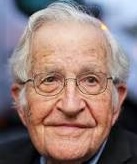
Noam Chomsky (born on December 7, 1928, in Philadelphia, Pennsylvania) is an American linguist, philosopher, cognitive scientist, historical essayist, social critic, and political activist. Sometimes called "the father of modern linguistics", Chomsky is also a major figure in analytic philosophy and one of the founders of the field of cognitive science. He is a Laureate Professor of Linguistics at the University of Arizona and an Institute Professor Emeritus at the Massachusetts Institute of Technology (MIT), and is the author of more than 150 books. He has written and lectured widely on linguistics, philosophy, intellectual history, contemporary issues, and particularly international affairs and U.S. foreign policy. Chomsky has been a writer for Z projects since their earliest inception, and is a tireless supporter of our operations.
ZNetwork is funded solely through the generosity of its readers.
Donate




