

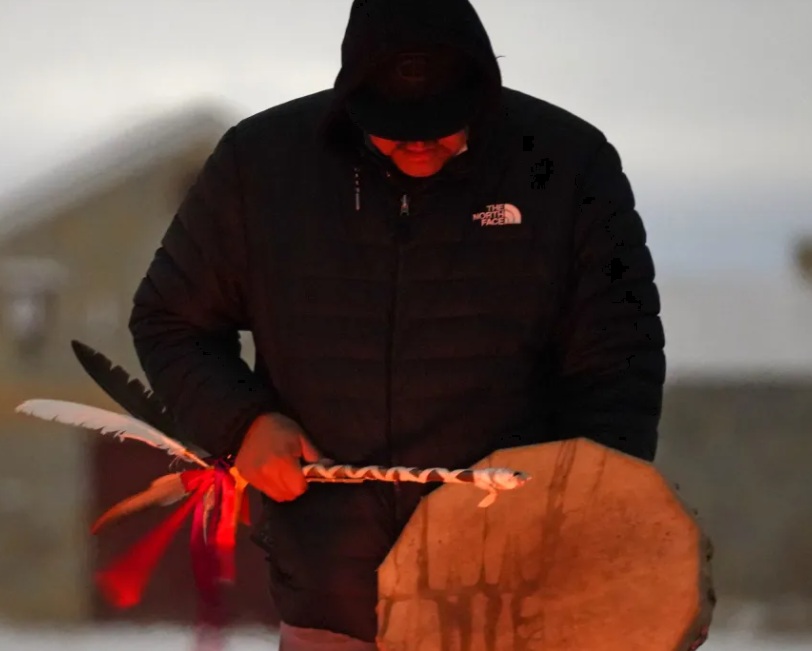
Last week, Native activists established a prayer camp near the site of a former internment camp for Dakota people.
The camp was established in Fort Snelling, Minnesota, just across a highway from the Bishop Henry Whipple Federal Building, which has become a major center for immigration enforcement detainment processing, but the site has a much longer and more complex history.
The United States used Fort Snelling as a concentration camp during the Dakota Indian Wars to imprison thousands of Dakota and Ho-Chunk people in abysmal conditions.
Migizi Spears, Red Lake Nation citizen and organizer for First Nations United, helped establish the camp, along with Dakota, Nakota and other tribal citizens. They raised four teepees at a place that the Dakota considered a creation site called Bdóte near the confluence of the Mississippi and Minnesota rivers and within earshot of the Whipple Building.
Spears said he felt it was time to take back the land that his ancestors lost and from which they were removed following the Dakota War of 1862, also known as the Sioux or Dakota Uprising. Following the conflict, 38 Dakota men were hanged in the largest mass execution in U.S. history.
“We are getting the land back for our Dakota people who were exiled out,” Spears said. “Now they’re imprisoning brown people and other Indigenous people in there. Now they’re removing them too. History is repeating itself.”
Many Native and other activists have joined Spears and the other camp founders last week, erecting yurts and bringing firewood, food and other essentials.
The camp has drawn the attention of media organizations, including CBS News Minnesota and Unicorn Riot, as well as many social media influencers.
Currently, Fort Snelling houses the Minneapolis-Saint Paul International Airport, Fort Snelling State Park, several federal buildings including the Whipple building and the recreation of the historic Fort Snelling. The Whipple building is less than a mile from the Historic Fort Snelling complex, which is owned by the state of Minnesota.
Wasuduta, Dakota, said the use of the former Fort Snelling site as a federal detention center serves as a reminder of the federal government’s ongoing efforts to deprive Native people and Hispanic immigrants of their rights.
He said he’s hopeful more Indigenous peoples, non-Native allies and tribes will get involved in the effort to get the federal government and the state of Minnesota to give land back to Native people.
Despite the Trump administration’s decision to withdraw many of the federal immigration agents who were part of the recent surge in Minneapolis, Wasuduta said the camp will remain.
“It’s time to hold them accountable with diplomacy,” he said. “We’re not here to be hostile or trigger them.”
ZNetwork is funded solely through the generosity of its readers.
Donate
