


Source: Haaretz
The mosque was opened in August 2016, and most of the people I asked, including other taxi drivers, had never heard of it. I assumed that it must be in a place that’s very accessible to anyone who wishes harm – with a convenient escape route. Near a settlement. Near military cameras. Near an Israel Defense Forces position.
My first guess was the El Bireh industrial zone, past the Beit El army checkpoint and the Civil Administration base. In October 2019 unknown individuals arrived there in a vehicle, punctured the tires of about 30 Palestinian-owned cars, and in order to remove any doubt regarding their identity – left behind graffiti in Hebrew.
But no. The mosque is not in the industrial zone. My second guess was correct: It’s situated in the city’s education complex, right next to the soccer stadium. Opposite it, to the south, less than a kilometer away as the crow flies, is the settlement of Psagot, in all its greenery.
As he does every day, muezzin Jalal Mahmoud Ayesh arrived at the mosque at 3:10 A.M. on Monday. Even before he got out of his car he noticed that the electricity in the building was off. Maybe there’s a short circuit, he thought. He entered the prayer hall via the western entrance, and immediately smelled fire. He followed the smell to the door of the eastern entrance. The handle was hot. When he opened the door, he saw flames climbing up the tiles on the mosque’s outer wall.
Ayesh wasted no time and called the local fire station. He assumed that it was a children’s prank – that perhaps they had set fire to the closet, made of wood and plastic, in which worshippers place their shoes before prayer. The firefighters, who arrived within a few minutes, said, “What are you talking about? It is not children,” and they pointed to graffiti in Hebrew, sprayed in black on a newly whitewashed wall. Later on people would come to translate the words for him: “A siege for the Arabs and not for the Jews,” with one exclamation point. “The Land of Israel for the People of Israel,” with two exclamation points.
At 9 A.M., when I was there, someone said that Palestinian police officers had arrived earlier, but they had been dressed in civilian clothing, because the site is located in what’s defined as “Area C”: under full Israeli security and civil control, where the Palestinian police are not allowed to operate. “C” is an artificial category, but the land belongs to the El Bireh Municipality, and the residential neighborhood in which it is located is within the municipal boundaries – a natural continuation of the city’s older neighborhoods.
In 2009 the settlement of Psagot and the Regavim pro-settler NGO demanded that the Civil Administration demolish the local stadium, then in the final stages of construction. They also warned that thousands of overexcited soccer fans were likely to throw “ballistae” (the term used in their petition to Israel’s High Court of Justice) at the settlement. But it turned out that already in the early 1980s, the military government had given the municipality permission to build in that area. The attempt at demolition was thwarted.
How did the arsonists arrive at the mosque? Perhaps on the road from the settlement to the city’s garbage-disposal site, and from there to the stadium near the mosque. They could have arrived in a car, if the guard at the site was not at his post then, or parked it on the slope of the hill and ascended on foot.
The arsonists’ indirect message is: Look at us, we do whatever we like and will continue to do it, because the police won’t bother to search for us and the army won’t turn us in. And if they do catch us, they won’t prosecute us, and if they do prosecute, the judges will find an excuse to acquit us. That’s how it’s been for years.
The direct message behind the arson attack is written on the wall: The Palestinians must disappear from here. And if they don’t disappear of their own free will then we, anonymous Jews, will force them to do so.

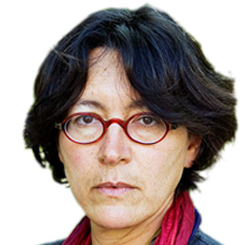
Amira Hass (Hebrew: עמירה הס; born 28 June 1956) is a prominent left-wing Israeli journalist and author, mostly known for her columns in the daily newspaper Ha'aretz. She is particularly recognized for her reporting on Palestinian affairs in the West Bank and Gaza, where she has also lived for a number of years.
ZNetwork is funded solely through the generosity of its readers.
Donate




