


It is no exaggeration to say that this year’s International Women’s Day march, called by Santiago’s Coordinadora Feminista 8M, began with an underground rumble. Line 1 of the metro, which crosses the Chilean capital from east to west, was already filled with women of all ages by 6 PM on March 8. Wearing green and purple kerchiefs, their numbers grew with each stop along the way.
They had glitter on their faces and messages on their bags and t-shirts. “Our friends are also the loves of our lives,” read one sign. “Not being angry is a privilege,” read another. They exchanged glances of recognition with workers, who observed the scene as they commuted home on public transportation.
The destination was a given, a meeting point that is assumed: Dignity Plaza, the name given to Plaza Baquedano during the 2019 uprising. Hundreds of women arrive. Later they become thousands. By the time the day was out, around 350,000 marched in Santiago, according to organizers.
That day, I stood on a spot that had been an altar to the victims of the 2019 uprising until recently. Today it is a construction site that is covered in cement. A woman in a hoodie spray painted a phrase to honor the memory of the fallen: No olvidamos [We do not forget].
The crowd pushes forward before she finishes. There are so many people—it is impossible to turn back. A cluster of tourists gets caught up among the masses of people, unsure where to go. Group after group of demonstrators joins the flood.
There are hugs of recognition. A group of women from the Universidad de Chile soccer fan club chant songs that voice their love for sport and their feminist practice. “In the street and on the field, struggle and revolution,” reads the banner that they carry with their red and blue flags.
The motto of this year’s march was: “For a future without violence and discrimination.” There was an internationalist focus, revealed by statements of solidarity with the Palestinian people and Argentine women.
Santiago wasn’t the only city in Chile in which March 8 protests took place. In at least 18 others, from the country’s north to its south, women and sexual and gender dissidents took to the streets and made public space their own.
“This year we are once again calling a feminist general strike, centered around key issues,” Gabriela Jadue, spokesperson for the 8M Coordinating Committee, told the “24 Horas” television channel. “We’re still demanding lives that are free of violence. There have already been seven femicides and 33 attempted femicides this year. We are being killed and the justice system doesn’t protect us.”
Jadue said that this March 8, “we want to talk about the guarantees we need in order to do care work, to raise children and to work, as well as to exercise our reproductive rights.” This year, the Coordinating Committee called on men not to participate in the march but to show their support in other ways.


Demonstrators with red hands painted on their faces in Santiago de Chile on March 8, 2024. Photo © Nicole Kramm.
Walking together
Three generations walk towards Los Héroes metro station, near where the main event of the March 8 activities is being held. Valentina Soto, 26, holds a sign that reads: “Domestic work sustains capital.”
Soto traveled from the province of Melipilla with her mother and her 6-year-old daughter, who is attending her first march. “It was important for me that we did this together. [My daughter] understands what 8M means and why we are here and wants to be involved,” she said.
Soto explains the message she holds in her hands. “I want to validate domestic and care work because it is not recognized to this day and it’s what sustains capital,” she said. “It makes it possible for men to function in the labor market and earn a salary, while domestic workers lack recognition, pensions and protections. We don’t even have health care.”
When President Gabriel Boric took office, he announced that his government would be feminist. In addition to appointing the first female Interior Minister (Izkia Siches, followed by Carolina Tohá), he included Antonia Orellana, Minister for Women and Gender Equality, in his cabinet. In addition to these actions, his administration announced a universal childcare law and implemented a law on Parental Responsibility and Effective Payment of Child Support Debts. In Chile, only 16 percent of men who have been taken to court for child support are up to date with their payments.
Another advance was the announcement of a reduction in the price of contraceptives and an increase in urinary tract surgeries for women in need.
These forward steps take place in the context of a general lack of progress, especially with regard to violence and sexual assaults against women. “Although this government claims to be feminist, it hasn’t introduced any reforms or laws to protect us,” said Soto. “We are always left on the sidelines.”
In another part of the march, a woman writes a message on her mobile phone while holding a huge Palestinian flag over her shoulder. She is among thousands in the march calling for a ceasefire and an end to the genocide in Gaza.
“Marches aren’t enough,” said Catalina Abdul Masih, a member of Chile’s Palestinian community, who held a banner showing the Palestinian flag next to the Mapuche flag. After the start of the war, the Chilean government summoned its ambassador from Tel Aviv and accused Israel of “systematic violations of international law” in the International Court of Justice in The Hague. Even so, according to Abdul Masih, more needs to be done. “Relations with Israel must be cut off. We have to stop subsidizing this war with our taxes. We’re talking about 75 years of genocide.”
The march offers a smorgasbord of diversity. There are so many people that we have to stop for several minutes before we can continue en route. The march is always well attended, but this year’s turnout is even bigger than previous years.
The extreme right is a significant threat in Chile: two years ago, José Antonio Kast, the candidate representing the most conservative elements in society, won a majority of votes during the first round of the presidential election, and his colleagues increased their seats in Congress. Although the election of Gabriel Boric in the second round signaled some respite from the danger, women and sexual and gender dissidents continue to protest, understanding that they cannot take gains that they have made for granted, even with a government that calls itself feminist. They continue to denounce violence on various levels and to push for their rights.
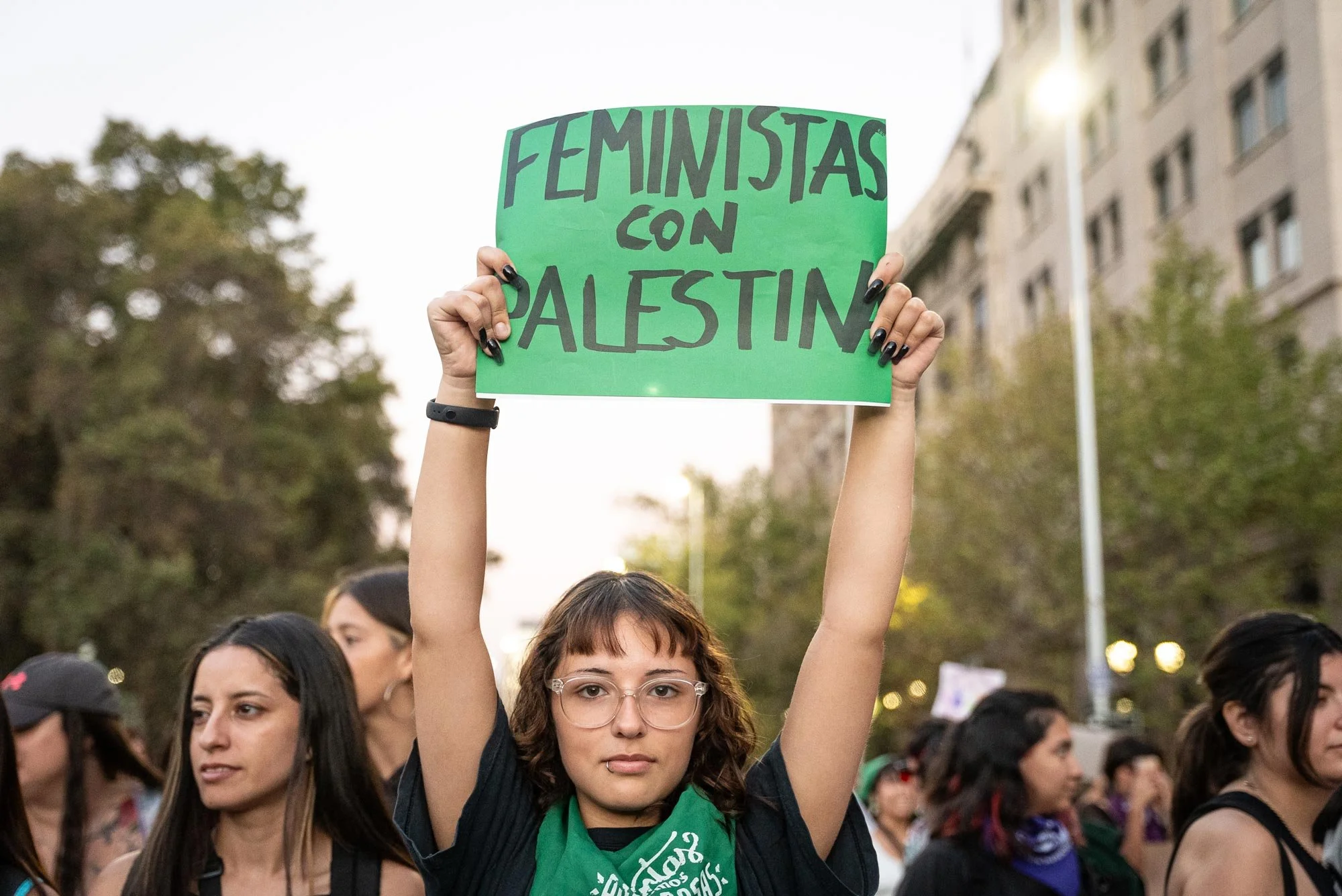
A demonstrator in Santiago de Chile holds a sign that says “Feminist for Palestine” on March 8, 2024. Photo © Nicole Kramm.
Fed up
Near Santiago’s National Library, a woman held up a sign with a portrait of herself as a young woman. Her message seems to stop the march. In small groups, women of different ages turn their attention to her sign. Passersby hug her, whisper in her ear, and embrace her silently.
“When I came to 8M in 2020 with this little sign, it was the first time that I’d spoken out about being abused when I was 16 by a layman who worked in the youth ministry of my parish” in the 1980s, said Verónica San Juan, her voice filled with the emotion that memories of the event bring to the surface. Four years ago, she put the traumatic experience of abuse she was subjected to as a teenager into words for the first time.
She says that she was shocked by what happened during her first March 8. “It was the same thing that is happening to me now: women came up to me, hugged me and I felt so relieved. It took me 36 years to speak out,” said San Juan, as she stood next to her friend, Zulema.
March 8 marked a before and after for San Juan. Then came the pandemic and her pain was transformed again, while other concerns became a priority.
“Today I wanted to come back because I’ve learned that this man didn’t abuse his power just to victimize me,” she said. “It happened to other girls, too, girls that were even younger than I was. Now I know that I’m not the only one.”
She and other women have filed charges, even though they know that the statute of limitations has expired.
“We want his name to be known. He was protected by people both inside and outside of the church. We’re going to file this case together, even if they tell us that it can’t be pursued. It doesn’t matter, because we’re going to say his name and expose him,” said San Juan, as Zulema held her arm. “By standing here, I hope that I can help someone else speak out. I don’t know if I’m brave, but I feel good, and I can move on from what happened to me.”
Mental health and discrimination
Further along, trans and dissident collectives moved past the imposing Gabriela Mistral Cultural Centre. Sexual and gender diversity was more visible during this year’s march than during previous years. Banners, chants and slogans called for transgendered people’s right to march without being attacked and demanded an end to the discrimination that this community suffered.
There is concern that trans people will continue to be made invisible, which is why the Organizing for Trans Diversity group expressed their preoccupation with conceptual errors in the way gender is addressed in Chile’s 2024 Census.
Behind them, Daniela Henríquez, a psychologist and executive director of Butterfly Effect, an NGO, held a banner calling for mental health with a gender perspective.
“Being a woman is a risk factor with regard to mental health, because of overwork, stereotypes, perception and… the double work day,” said Henríquez.
According to the Thermometer of Mental Health in Chile, published in April of last year, 26 percent of Chilean women report feeling lonely, isolated, excluded by others or lacking in companionship. It also indicated that women suffer from depression and insomnia to a greater degree than their male counterparts.
This is why Hernández is happy to see the diversity of gender expressions on the streets on March 8.
“We see more trans women, and more young people who are learning and relearning and redefining femininity,” she said.
The tide advances in the direction of the stage assembled at the end of the route, where a space has been set up for the closing political-cultural act. Under the lights, there was music, comedy, political speeches and feminist performances. Senator Fabiola Campillai, a survivor of police violence during the 2019 uprisings and an icon of the struggle for social and human rights, took the microphone and received a standing ovation from the crowd.
At 9:00 pm, the area around the stage began to clear.
Unlike other demonstrations, there were no major problems with the police. Authorities stated that no disturbances had been reported. They estimated that only 35,000 participated, but the visual record shows otherwise.
Hundreds of thousands marched and even more waved from their balconies or found some other way to say hello and join in. March 8 in Santiago was a feminist general strike and commemoration, but it was also a space in which to accompany one another and “continue building an alternative for transformation,” in the words of the organizers.
ZNetwork is funded solely through the generosity of its readers.
Donate




