Source: Responsible Statecraft

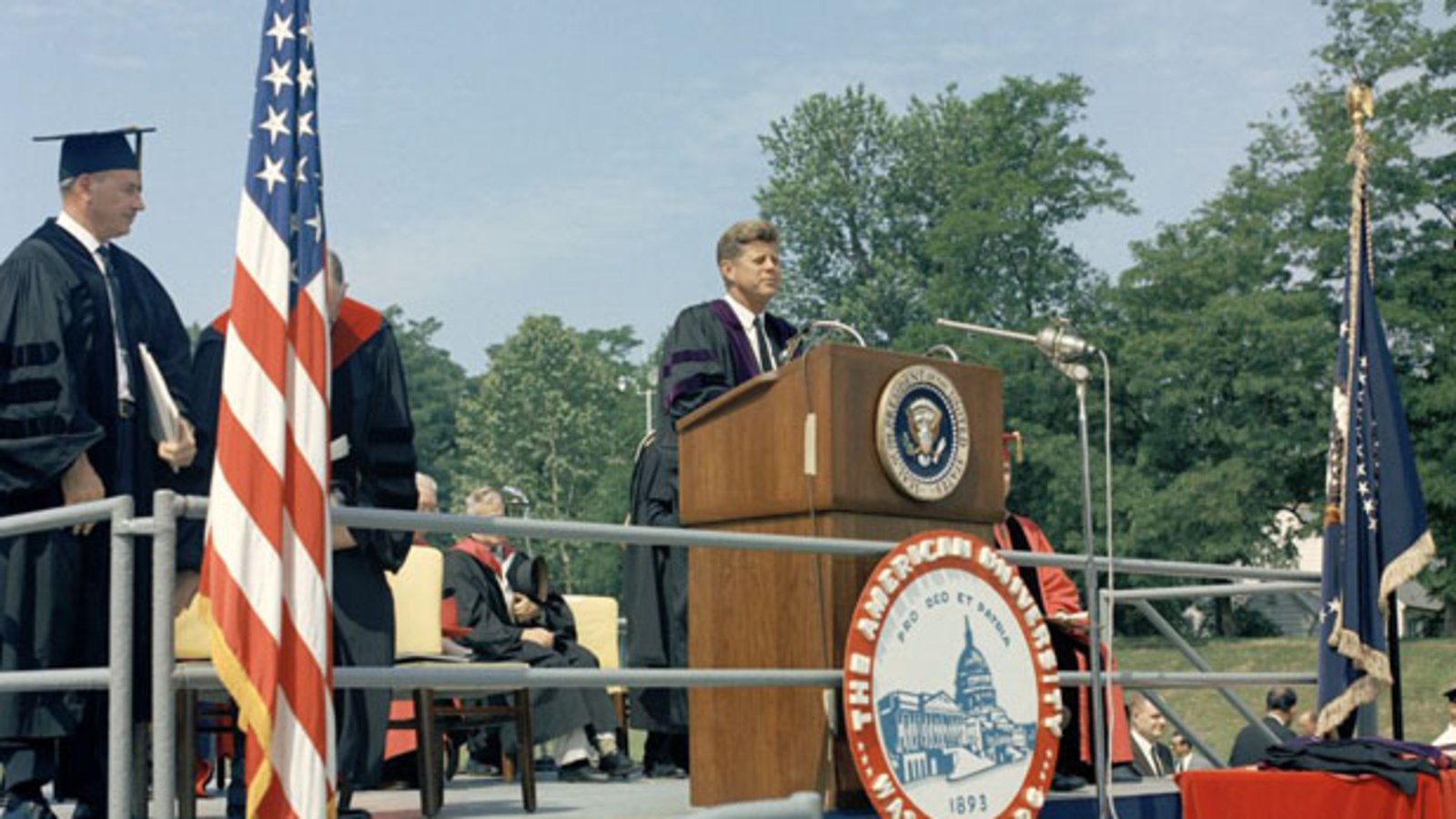
June 10 marks 60 years since American President John F. Kennedy delivered a searing critique of the Cold War and its mindset at a commencement address on the campus of American University (AU) in Washington, D.C.

In it, Kennedy expounded upon his vision of what peace might look like in the nuclear age.

“What kind of peace do we seek?,” he asked.

“Not a Pax Americana enforced on the world by American weapons of war. Not the peace of the grave or the security of the slave. I am talking about genuine peace, the kind of peace that makes life on earth worth living, the kind that enables men and nations to grow and to hope and to build a better life for their children—not merely peace for Americans but peace for all men and women—not merely peace in our time but peace for all time.”

For Kennedy, the specter of nuclear war, to which the United States and the U.S.S.R. came within a hair’s breadth the previous October during the Cuban Missile Crisis, made the pursuit of peace with the Soviet adversary an imperative. Yet it was one that put the young president at odds, perhaps fatally so, with his own national security-military-intelligence establishment.

But at AU, Kennedy took his case for a sane, rational, and above all ethical Cold War policy directly to the American people.

“I speak of peace,” said Kennedy, “as the necessary, rational end of rational men. I realize that the pursuit of peace is not as dramatic as the pursuit of war—and frequently the words of the pursuer fall on deaf ears. But we have no more urgent task.”

And Kennedy had, over the course of his presidency, and to the great consternation of the Pentagon and CIA, found a most unlikely partner in that pursuit, Soviet leader Nikita Khrushchev. Over the course of a series of U.S.-Soviet crises (the Bay of Pigs, the Vienna summit, and the Berlin Crisis) Kennedy and Khrushchev had developed a rapport which helped steer us away from apocalypse during the Cuban Missile Crisis. And in the aftermath of that crisis, the two began working toward a Nuclear Test Ban Treaty.

Kennedy realized that progress was contingent upon seeing the other as we might wish to be seen, in other words, upon empathy.

“No government or social system is so evil,” said Kennedy, “that its people must be considered as lacking in virtue.”

“So, let us not be blind to our differences but let us also direct attention to our common interests and to the means by which those differences can be resolved. And if we cannot end now our differences, at least we can help make the world safe for diversity. For, in the final analysis, our most basic common link is that we all inhabit this small planet. We all breathe the same air. We all cherish our children’s future. And we are all mortal.”

Such a way of thinking about the current Russian adversary is now notably absent in the corridors of power of President Joe Biden’s Washington.

Indeed, in our view, Kennedy’s speech now stands as an important indictment of how far in the wrong direction recent Democratic administrations have traveled in the decades since. While we are both on record condemning Putin’s invasion, we are mindful of the Biden administration’s failure to pursue diplomatic avenues to both prevent and end the war.

Today we stand perilously close to nuclear escalation as the administration ignores the red lines it set and succumbs to assorted hawks by agreeing to send F-16s to Ukraine. One can only hope President Kennedy’s message, delivered six decades ago this Saturday, somehow and in some way is understood by a new generation inside and outside Washington D.C., and has an impact on the course of war—and peace.


This article was originally published by Responsible Statecraft; please consider supporting the original publication, and read the original version at the link above.

ZNetwork is funded solely through the generosity of its readers.

Donate
Donate
Leave A Reply

Subscribe

All the latest from Z, directly to your inbox.

Institute for Social and Cultural Communications, Inc. is a 501(c)3 non-profit.

Our EIN# is #22-2959506. Your donation is tax-deductible to the extent allowable by law.

We do not accept funding from advertising or corporate sponsors.  We rely on donors like you to do our work.

ZNetwork: Left News, Analysis, Vision & Strategy

Subscribe

All the latest from Z, directly to your inbox.

THE WIND CRIES FREEDOM

The Wind Cries Freedom, the new book from Z co-founder Michael Albert, is a sweeping oral history of a future American revolution.

Through thirty interconnected chapters, it draws out the strategies, failures, turning points, and hard-won wisdom of a movement that called itself the Revolutionary Participatory Society. These are not the polished memoirs of politicians: they are the unfiltered accounts of people who organized in neighborhoods, hospitals, universities, stadiums, courthouses, and places of worship, and kept a shared vision alive through cynicism and exhaustion.

The result is speculative political fiction that reads like history: messy, human, and quietly hopeful in the way that only real experience and long thought can produce.

Get your copy and peruse more features on the book’s website below.

“Read it, argue with it, but don’t look away. The future it recalls is one we must still fight to deserve.”

Yanis Varoufakis

“The most unusual and intriguing combination of prophecy, manifesto, and movement building manual that I have ever encountered.”

Bill Fletcher Junior

“This work fills a huge gap in our social movement literature.”

Cynthia Peters

You've just read your article on Z this month.

DOES Z'S SURVIVAL MATTER?

You keep coming back for a reason: serious political analysis, movement reporting, and debate beyond the priorities of corporate media. Today, Z is in a precarious financial position. If Z is part of how you understand the world, help keep it going. The readers who give monthly are the reason this work survives between fundraisers.

Z is in a precarious financial position. If it’s part of how you understand the world, help keep it going.

Number of donors705
Our goal1,000

Sustainers at $9/month or more receive the digital Z Magazine.

Already a sustainer? Click here and we won’t ask again. Thank you!

Your reading count is stored only in your browser and is never sent to us.

Sound is muted by default.  Tap 🔊 for the full experience

CRITICAL ACTION

Critical Action is a longtime friend of Z and a music and storytelling project grounded in liberation, solidarity, and resistance to authoritarian power. Through music, narrative, and multimedia, the project engages the same political realities and movement traditions that guide and motivate Z’s work.

If this project resonates with you, you can learn more about it and find ways to support the work using the link below.

Z is in the most precarious financial position in its history.

Z is a place to think beyond the limits of the present.

For decades, Z has brought together political analysis, movement reporting, debate, and visions of a different future from writers and activists around the world. That work is more than journalism. It is movement infrastructure: movements need places to develop ideas, test arguments, learn from experience, and imagine what comes next.

In the first two days of this fundraiser, 19 donors and 8 new monthly sustainers stepped up. Help us reach 1,000 donors who keep Z independent, for everyone.

For decades, Z has published the analysis, debate, and visions movements need, free of paywalls, ads, and billionaire owners. If that work should continue, Z needs your support now.

Number of donors705
Our goal1,000

Sustainers at $9/month or more receive the digital Z Magazine.

Subscribe

Join the Z Community – receive event invites, announcements, a Weekly Digest, and opportunities to engage.

Exit mobile version

