


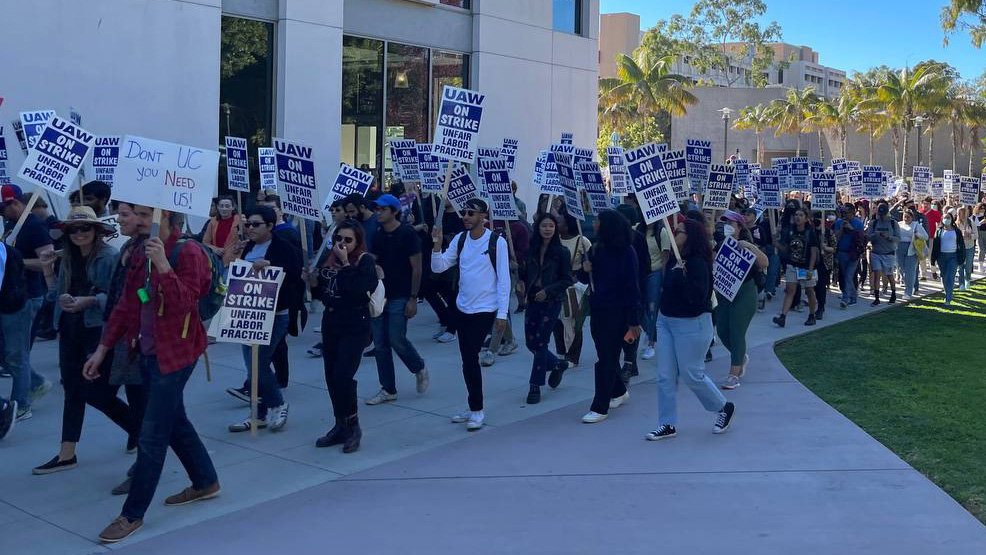
Around 48,000 unionized academic workers at every University of California campus on Monday began what’s being called “the largest higher education strike in U.S. history” as they demand a living wage and better benefits and working conditions.
Striking workers include teaching assistants, postdoctoral scholars, graduate student researchers, tutors, and fellows across U.C.’s 10 campuses, as well as staff at the Lawrence Berkeley National Laboratory.
The strikers—who are members of United Auto Workers (UAW) 2865, UAW 5810, and Student Researchers United-UAW—are seeking higher pay, childcare reimbursements, job security protections, sustainable transit incentives, elimination of fees for international student researchers, and improved disability access.
“We are overworked and underpaid, and we are fed up,” Jamie Mondello—a graduate student worker at the University of California, Los Angeles (UCLA) and member of UAW Local 2865 and Student Researchers United—told the Los Angeles Times.
Mondello also said that 25 unfair labor practice complaints have been filed against U.C. with the state’s Public Employment Relations Board, which in numerous cases found evidence supporting workers’ claims.
“Our proposals bring everyone into a livable wage,” she asserted. “We’re, as a whole, just asking to be treated with dignity. We really keep the U.C. running.”
According to the Times:
U.C. Irvine strikers began demonstrating on campus at 8:30 am, while walkouts at some other campuses were set for 9 am, including U.C. Davis and U.C. San Francisco. The 48,000 workers, represented by four UAW bargaining units, have demanded base salaries of $54,000, a wage increase that would more than double their average current pay of about $24,000 annually. U.C. has offered a salary scale increase of 7% in the first year and 3% in each subsequent year, but workers have said that’s not sufficient.
Lavanya Nott, 30, a UCLA graduate student and researcher, said she earns $24,000 a year from her job and around $2,000 more as a grader.
“It’s almost impossible to live in L.A. or most cities in California,” she told the Times. “Many of us have second or third jobs. We’re always thinking about how little money we have and how constrained we are financially, and I think it would give us some peace of mind and freedom to focus on our work and have some dignity. We just want to be brought out of poverty.”
UAW 2865 president and UCLA graduate worker Rafael Jaime told the Guardian that “we’re fighting so those of us who do the majority of teaching and research do not have to live with severe rent burdens and debt, while highly paid administrators live in publicly funded mansions.”
Jacob Kemner, a doctorate student in environmental studies at U.C. Riverside who earns about $28,000 annually, said he donates blood plasma twice a week for around $200 in supplemental income.
“I’m making ends meet by selling plasma,” Kemner told The Washington Post. “I am less able to be effective in my job as a result of this because I spend six to 10 hours going to and from the plasma donation center. If I wasn’t spending time on that, I could be lesson planning and grading.”
Bernard Remollino, a researcher and teaching assistant at UCLA, said that for most of the 2018-2019 academic year he lived out of his car because he could not afford housing.
“The rent situation in Los Angeles was untenable both in the graduate student housing and in the private market,” he told the Guardian. “It is physically draining trying to scrimp and save and feeling that those efforts were in vain. There had to be more dignity to the work than that.”
“This action is happening because of U.C.’s failure to support a diverse workforce. That failure undermines the quality of research and education,” Remollino added. “U.C. works because we do. It functions off the intellectual, emotional, and physical labor of its academic workers, but despite our contributions, we work in difficult conditions while being severely undercompensated.”

Brett Wilkins is a San Francisco-based writer and activist whose work focuses on issues of war and peace and human rights. He is a staff writer at Common Dreams and a member of the international socialist writers’ group Collective 20. Before joining Common Dreams, he was a longtime freelance journalist and essayist whose articles appeared in a wide variety of print and online publications including Counterpunch, Truthout, Salon.com, Antiwar.com, Asia Times, The Jakarta Post, Alternet, teleSUR, Yahoo News, Mondoweiss, EcoWatch, and Venezuela Analysis.
ZNetwork is funded solely through the generosity of its readers.
Donate




