

It's clear that most everyone in Wisconsin is opposed to Governor Scott Walker's bill. What is not clear is what exactly are we for? I mean this in a larger scale outside the context of the specific bill. What exactly will bring hundreds of thousands of people together again? Will it be to protect free lunch or will it be to protect reduced lunch? Will it be to save food share or will it be to save BadgerCare—health insurance to low income families with children under age 19? Will it be a social justice movement "to save the middle class?" Let's be clear, there is nothing radical about saving the middle class. So are we building a social justice/popular movement? Or a movement at all? In this sense, there's a lack of unity.
It's very clear that we are collectively shouting "Kill the Bill." But what is not clear is what is the alternative. Is the vision to simply go back to the way things were a year ago? Or is the vision something greater?
Kwame Ture, also known as Stokely Carmichael, brings up an interesting point in thinking about building movements. He says there's a significant difference between mobilizing and organizing. Mobilizing is when a group of people are against the same things. Organizing is when a group of people are for the same things. While we've been proud of the work we've been doing in Madison, in fact, it's a huge mobilization effort and not so much a big organization effort.
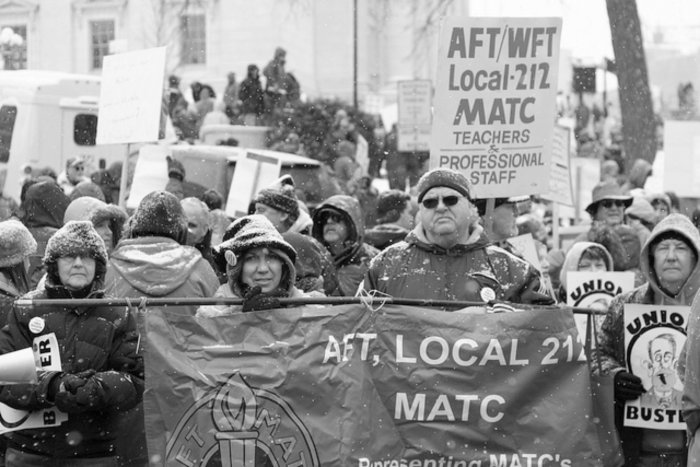 Union protest, February 27—photo by Greg Tarnoff
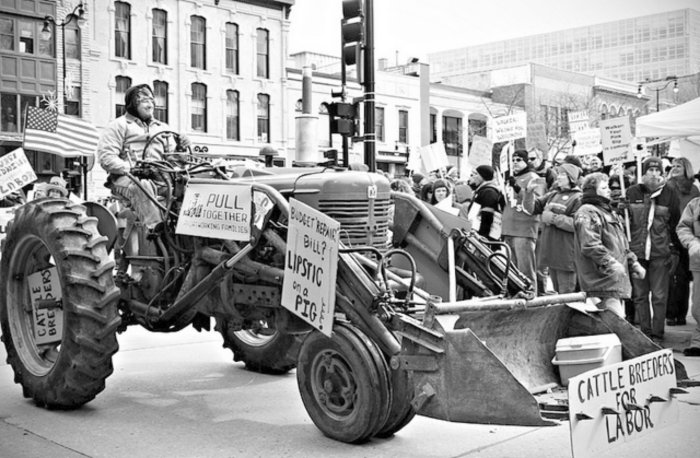
Mass demonstration, March 12—photo by Mackenzie Holmes |
I think we need to spend more time figuring this out. If we're all trying to build a vision or to figure out what it is we're for, we know our work has to go beyond the sectors in which we participate. What's happening in Wisconsin can no longer be talked about as just what's affecting public sector workers. It can no longer be talked about as just a movement of unions. It can no longer be talked about as groups of people—firefighters or cops or teachers. We have to understand the response to what is happening in Wisconsin as part of a larger movement that strives for racial and gender justice, queer liberation, as well as dismantling ableism and other larger forms of oppression.
My experience doing the work in Wisconsin is that it has been incredibly inspiring to be part of a large group of people who are out mobilizing to achieve something. But, at the same time, it has also been troubling. The harsh truth of the matter is that a lot of the workers who are out there mobilizing against Governor Walker are the people who put him in office to begin with. It's important to understand this because it's going to determine how to build a solid base in order to build a movement. A lot of people who voted for Walker initially did so because they believed the all-too-common narrative of "lazy workers"—thinking it was just a targeted attack on people of color and immigrants, when, in actuality, he was talking about all of us. Surprise.
While we are supporting worker rights, people of color, immigrants, and fighting in solidarity, we have to ask the critical question: "Will the same group of people be with us on our issues?" For example, in the bill there is a piece of legislation that says health care providers will no longer be required to pay for contraceptives for women, but they would still pay for viagra. Instead of thinking of this as just some small piece of legislation or something peripheral to the larger fight around collective bargaining, we must view this as a fundamental attack on women's reproductive health rights.
What's central in movements is that people have an identity around something and it cannot just be a mobilization. It cannot be that we all just agree on this—that's a coalition. If we're talking about a movement, we all have to collectively strive for something and be able to identify with each other on some sort of level. So the question is, "Who is the we of Wisconsin?" Is the we just the workers or just the middle-class public sector or is it also the undocumented workers who make up a significant part of the dairy industry? Is it the chronically unemployed, underemployed, and those who never get the chance at a meaningful job due to structural racism, classism, and cisgenderism?
Also, is the playing field leveled for all to be able to participate in this movement? For example, what does the leadership and decisionmaking look like? Frankly, I've been in too many places where all the people look the same. If we are building a movement of people and for the people, where the hell are all the people?
I think what's unique about this opportunity is now we are forcing an alliance of folks who are not traditional allies. This could be something incredibly good, but we have to be able to do the hard work of ensuring that it's something incredibly good and not give Walker, Republicans, and Tea Partiers the opportunity to play divide and conquer antics.
Also, in that spirit, we've been doing a lot of assuming around us having a common enemy, therefore necessitating that to mean that we are friends. I think we see on many different levels that's not necessarily true. So, how deep is the alliance? Is it really solidarity? For instance, what happens if we win collective bargaining? What happens if Walker says, "Dammit, I'm tired, you've won"? What if he says he'll leave the rights of collective bargaining alone? Do we all go home? Or do we say, "No, we're going to knock this Capitol down if you don't give us back BadgerCare."
In thinking about identities of folks, we also have to translate that into what kind of strategies we take up to further the movement. As I mentioned, not all of us have the same indentities, so all of us can't equally participate in the same strategies. For example, I ask you, do you honestly think that 150,000 black people can occupy the Capitol for 16 days? We have the ability to mobilize that many, but will we be there in solidarity with the police? Absolutely not. So this means we have to think about building inclusive strategies. I also think it took an incredible amount of privilege to be there. I was there for a few days, but I also had the privilege to be able to be there because I didn't have children. Folks I knew who had children who wanted to be there could not do so. Like all these other things, if we're talking about building a movement for the people, we have to create entry points so that all people can participate in all of the work that we are doing.
In that same spirit, we have to do the hard work of base building, but coming from a place of solidarity, which means we need ongoing political education around not just what it means to be a Republican or what it means to be a Democrat or how the mayor's office runs, but around what have been the struggles of folks of color in this country. How is 100 years of oppression tied to current policies?
In addition to political education, we need to get back to grassroots training. I think it's very attractive and very easy in ways to engage in some of this academic and high policy work, but what about the everyday ability to knock on doors and get people out who have no idea that this is going on?
Also, I think we need to begin to escalate strategies, which we are beginning to see more of. So we need to be training folks around direct action organizing. Not only are we going to peacefully protest—we're still going to be non-violent—but we're going to turn up the fire. Yes, we're going to shut down M&I Bank, but we're going to do more things. It's very clear that the right—Walker and others—has a very escalating strategy. Not only do we need to match it, we need to be able to defeat it, which requires us to develop our own escalating strategy.
We also need to be able to develop strategies that feel relevant for people in their everyday lives. Marches and protests feel very attractive, but we need to use people's skills and put them in more relevant areas. For example, if teachers want to strike, by all means strike. But I also think teachers are in a unique position to be able to mobilize an entire youth body by using their teaching skills to educate and politicize the youth. We know all social movements need young folks and there are more schools than just UW-Madison. We also need to think about the way that people live their daily lives and how that can be politicized and connected to a larger movement. There's a lot of wisdom in the resistance that folks carry every day, so I really want to connect that to a larger structure/struggle.
Lastly, we need to start to build alternatives. I question any structure, any government that is able to take away so many rights so quickly. How does that happen? We cannot support such a structure. My rights should not be determined by whether or not this person in office is hopefully a good person. We should also begin to invest in grassroots structures, in folks building alternative societies who have been doing it all along. As written on the BadgerCare card, as the state motto goes, as the movement demands it: "Forward."
Z
Monica Adams is a community organizer working in the black, Southeast Asian, and queer people of color communities. Her work strives to build an alternative society as the means to end our oppression. This is a transcript of her talk at the Left Forum 2011. DVDs of both talks on Wisconsin will soon be available at the Z Store.




