


T
hose
who have any concern for Haiti will naturally want to understand
how its most recent tragedy has been unfolding. For those who have
had the privilege of any contact with the people of this tortured
land, it is not just natural, but inescapable. Nevertheless, we
make a serious error if we focus too narrowly on the events of the
recent past or even on Haiti alone. The crucial issue for us is
what we should be doing about what has taken place. That would be
true even if our options and our responsibility were limited; far
more so when they are immense and decisive, as in the case of Haiti.
And even more so because the course of the terrible story was predictable
years ago—if we failed to act to prevent it—and fail we
did. The lessons are clear, and so important that they would be
the topic of daily front-page articles in a free press.
Reviewing
what was taking place in Haiti shortly after Clinton “restored
democracy” in 1994, I was compelled to conclude, unhappily,
in
Z Magazine,
that “It would not be very surprising,
then, if the Haitian operations become another catastrophe,”
and if so, “It is not a difficult chore to trot out the familiar
phrases that will explain the failure of our mission of benevolence
in this failed society.” The reasons were evident to anyone
who chose to look. The familiar phrases again resound, sadly and
predictably.
There
is much solemn discussion today explaining, correctly, that democracy
means more than flipping a lever every few years. Functioning democracy
has preconditions. One is that the population should have some way
to learn what is happening in the world. The real world, not the
self-serving portrait offered by the “establishment press,”
which is disfigured by its “subservience to state power”
and “the usual hostility to popular movements”—the
accurate words of Paul Farmer, whose work on Haiti is, in its own
way, perhaps even as remarkable as what he has accomplished within
the country. Farmer was writing in 1993, reviewing mainstream commentary
and reporting on Haiti, a disgraceful record that goes back to the
days of Wilson’s vicious and destructive invasion in 1915 and
on to the present. The facts are extensively documented, appalling,
and shameful. They are deemed irrelevant for the usual reasons:
they do not conform to the required self- image, and so are efficiently
dispatched deep into the memory hole, though they can be unearthed
by those who have some interest in the real world.
They
will rarely be found, however, in the “establishment press.”
Keeping to the more liberal and knowledgeable end of the spectrum,
the standard version is that in “failed states” like Haiti
and Iraq the U.S. must become engaged in benevolent “nation-building”
to “enhance democracy,” a “noble goal,” but
one that may be beyond our means because of the inadequacies of
the objects of our solicitude. In Haiti, despite Washington’s
dedicated efforts from Wilson to FDR while the country was under
Marine occupation, “the new dawn of Haitian democracy never
came.” “Not all America’s good wishes, nor all its
Marines, can achieve [democracy today] until the Haitians do it
themselves” (H.D.S. Greenway,
Boston Globe
). As
New
York Times
correspondent R.W. Apple recounted two centuries
of history in 1994, reflecting on the prospects for Clinton’s
endeavor to “restore democracy” then underway, “Like
the French in the 19th century, like the Marines who occupied Haiti
from 1915 to 1934, the American forces who are trying to impose
a new order will confront a complex and violent society with no
history of democracy.”
Apple
does appear to go a bit beyond the norm in his reference to Napoleon’s
savage assault on Haiti, leaving it in ruins, in order to prevent
the crime of liberation in the world’s richest colony, the
source of much of France’s wealth. But perhaps that undertaking
too satisfies the fundamental criterion of benevolence: it was supported
by the United States, which was naturally outraged and frightened
by “the first nation in the world to argue the case of universal
freedom for all humankind, revealing the limited definition of freedom
adopted by the French and American revolutions.” So Haitian
historian Patrick Bellegarde-Smith writes, accurately describing
the terror in the slave state next door, which was not relieved
even when Haiti’s successful liberation struggle, at enormous
cost, opened the way to the expansion to the West by compelling
Napoleon to accept the Louisiana Purchase. The U.S. continued to
do what it could to strangle Haiti, even supporting France’s
insistence that Haiti pay a huge indemnity for the crime of liberating
itself, a burden it has never escaped —and France, of course,
dismissed with elegant disdain Haiti’s request, recently under
Aristide, that it at least repay the indemnity, forget- ting the
responsibilities that a civilized society would accept.
The
basic contours of what led to the current tragedy are pretty clear.
Just beginning with the 1990 election of Aristide (far too narrow
a time frame), Washington was appalled by the election of a populist
candidate with a grass-roots constituency just as it had been appalled
by the prospect of the hemisphere’s first free country on its
doorstep two centuries earlier. Washington’s traditional allies
in Haiti naturally agreed. “The fear of democracy exists, by
definitional necessity, in elite groups who monopolize economic
and political power,” Belle- garde-Smith observes in his perceptive
history of Haiti; whether in Haiti or the U.S. or anywhere else.
The
threat of democracy in Haiti in 1991 was even more ominous because
of the favorable reaction of the international financial institutions
(World Bank, IADB) to Aristide’s programs, which awakened traditional
concerns over the “virus” effect of successful independent
development. These are familiar themes in international affairs:
U.S. independence aroused similar concerns among European leaders.
The dangers are commonly perceived to be particularly grave in a
country like Haiti, which had been ravaged by France and then reduced
to utter misery by a century of U.S. intervention. If even people
in such dire circumstances can take their fate into their own hands,
who knows what might happen elsewhere as the “contagion spreads.”
The
Bush I administration reacted to the disaster of democracy by shifting
aid from the democratically elected government to what are called
“democratic forces”: the wealthy elites and the business
sectors, who, along with the murderers and torturers of the military
and paramilitaries, had been lauded by the current incumbents in
Washington, in their Reaganite phase, for their progress in “democratic
development,” justifying lavish new aid. The praise came in
response to ratification by the Haitian parliament of a law granting
Washington’s client killer and torturer Baby Doc Duvalier the
authority to suspend the rights of any political party without reasons.
The law passed by a majority of 99.98 percent. It therefore marked
a positive step towards democracy as compared with the 99 percent
approval of a 1918 law granting U.S. corporations the right to turn
the country into a U.S. plantation, passed by 5 percent of the population
after the Haitian Parliament was disbanded at gunpoint by Wilson’s
Marines when it refused to accept this “progressive measure,”
essential for “economic development.” Their reaction to
Baby Doc’s encouraging progress towards democracy was characteristic—worldwide—on
the part of the visionaries who are now entrancing educated opinion
with their dedication to bringing democracy to a suffering world—although,
to be sure, their actual exploits are being tastefully rewritten
to satisfy current needs.
Refugees
fleeing to the U.S. from the terror of the U.S.-backed dictatorships
were forcefully returned, in gross violation of international humanitarian
law. The policy was reversed when a democratically elected government
took office. Though the flow of refugees reduced to a trickle, they
were mostly granted political asylum. Policy returned to normal
when a military junta overthrew the Aristide government after seven
months and state terrorist atrocities rose to new heights. The perpetrators
were the army—the inheritors of the National Guard left by
Wilson’s invaders to control the population—and its paramilitary
forces. The most important of these, FRAPH, was founded by CIA asset
Emmanuel Constant, who now lives happily in Queens, Clinton and
Bush II having dismissed extradition requests—because he would
reveal U.S. ties to the murderous junta, it is widely assumed. Constant’s
contributions to state terror were, after all, meager; merely prime
responsibility for the murder of 4,000 to 5,000 poor blacks.
Recall
the core element of the Bush doctrine, which has “already become
a de facto rule of international relations,” Harvard’s
Graham Allison writes in
Foreign Affairs
: “those who
harbor terrorists are as guilty as the terrorists themselves,”
in the President’s words, and must be treated accordingly,
by large-scale bombing and invasion.
When
Aristide was overthrown by the 1991 military coup, the Organization
of American States (OAS) declared an embargo. Bush I announced that
the U.S. would violate it by exempting U.S. firms. He was thus “fine
tuning” the embargo for the benefit of the suffering population,
the
New York Times
reported. Clinton authorized even more
extreme violations of the embargo: U.S. trade with the junta and
its wealthy supporters sharply increased. The crucial element of
the embargo was, of course, oil. While the CIA solemnly testified
to Congress that the junta “probably will be out of fuel and
power very shortly” and “Our intelligence efforts are
focused on detecting attempts to circumvent the embargo and monitoring
its impact,” Clinton secretly authorized the Texaco Oil Company
to ship oil to the junta illegally, in violation of presidential
directives. This remarkable revelation was the lead story on the
AP wires the day before Clinton sent the Marines to “restore
democracy,” impossible to miss—I happened to be monitoring
AP wires that day and saw it repeated prominently over and over—and
obviously of enormous significance for anyone who wanted to understand
what was happening. It was suppressed with truly impressive discipline,
though reported in industry journals along with scant mention buried
in the business press.
Also
efficiently suppressed were the crucial conditions that Clinton
imposed for Aristide’s return: that he adopt the program of
the defeated U.S. candidate in the 1990 elections, a former World
Bank official who had received 14 percent of the vote. We call this
“restoring democracy,” a prime illustration of how U.S.
foreign policy has entered a “noble phase” with a “saintly
glow,” the national press explained. The harsh neoliberal program
that Aristide was compelled to adopt was virtually guaranteed to
demolish the remaining shreds of economic sovereignty, extending
Wilson’s progressive legislation and similar U.S.-imposed measures
since.
As
democracy was thereby restored, the World Bank announced, “The
renovated state must focus on an economic strategy centered on the
energy and initiative of Civil Society, especially the private sector,
both national and foreign.” That has the merit of honesty:
Haitian Civil Society includes the tiny rich elite and U.S. corporations,
but not the vast majority of the population, the peasants and slum-
dwellers who had committed the grave sin of organizing to elect
their own president. World Bank officers explained that the neoliberal
program would benefit the “more open, enlightened, business
class” and foreign investors, but assured us that the program
“is not going to hurt the poor to the extent it has in other
countries” subjected to structural adjustment, because the
Haitian poor already lacked minimal protection from proper economic
policy, such as subsidies for basic goods. Aristide’s minister
in charge of rural development and agrarian reform was not notified
of the plans to be imposed on this largely peasant society, to be
returned by “America’s good wishes” to the track
from which it veered briefly after the regrettable democratic election
in 1990.
Matters
then proceeded in their predictable course. A 1995 USAID report
explained that the “export-driven trade and investment policy”
that Washington imposed will “relentlessly squeeze the domestic
rice farmer,” who will be forced to turn to agroexport, with
incidental benefits to U.S. agribusiness and investors. Despite
their extreme poverty, Haitian rice farmers are quite efficient,
but cannot possibly compete with U.S. agribusiness, even if it did
not receive 40 percent of its profits from government subsidies,
sharply increased under the Reaganites who are again in power, still
producing enlightened rhetoric about the miracles of the market.
We now read that Haiti cannot feed itself, another sign of a “failed
state.”
A
few small industries were still able to function, for example, making
chicken parts. But U.S. conglomerates have a large surplus of dark
meat, and therefore demanded the right to dump their excess products
in Haiti. They tried to do the same in Canada and Mexico too, but
there illegal dumping could be barred. Not in Haiti, compelled to
submit to efficient market principles by the U.S. government and
the corporations it serves.
One
might note that the Pentagon’s proconsul in Iraq, Paul Bremer,
ordered a very similar program to be instituted there, with the
same beneficiaries in mind. That’s also called “enhancing
democracy.” In fact, the record, highly revealing and important,
goes back to the 18th century. Similar programs had a large role
in creating today’s third world. Meanwhile the powerful ignored
the rules, except when they could benefit from them, and were able
to become rich developed societies; dramatically the U.S., which
led the way in modern protectionism and, particularly since World
War II, has relied crucially on the dynamic state sector for innovation
and development, socializing risk and cost.
The
punishment of Haiti became much more severe under Bush II—there
are differences within the narrow spectrum of cruelty and greed.
Aid was cut and international institutions were pressured to do
likewise, under pretexts too outlandish to merit discussion. They
are extensively reviewed in Paul Farmer’s
The Uses of Haiti
,
and in some current press commentary, notably by Jeffrey Sachs (
Financial
Times
) and Tracy Kidder (
New York Times
).
Putting
details aside, what has happened since is eerily similar to the
overthrow of Haiti’s first democratic government in 1991. The
Aristide government, once again, was undermined by U.S. planners,
who understood, under Clinton, that the threat of democracy can
be overcome if economic sovereignty is eliminated and presumably
also understood that economic development will also be a faint hope
under such conditions, one of the best- confirmed lessons of economic
history. Bush II planners are even more dedicated to undermining
democracy and independence and despised Aristide and the popular
organizations that swept him to power with perhaps even more passion
than their predecessors. The forces that reconquered the country
are mostly inheritors of the U.S.-installed army and paramilitary
terrorists.
Those
who are intent on diverting attention from the U.S. role will object
that the situation is more complex—as is always true—and
that Aristide too was guilty of many crimes. Correct, but if he
had been a saint the situation would hardly have developed very
differently, as was evident in 1994, when the only real hope was
that a democratic revolution in the U.S. would make it possible
to shift policy in a more civilized direction.
What
is happening now is awful, maybe beyond repair, and there is plenty
of short-term responsibility on all sides. But the right way for
the U.S. and France to proceed is very clear. They should begin
with payment of enormous reparations to Haiti (France is perhaps
even more hypocritical and disgraceful in this regard than the U.S.).
That, however, requires construction of functioning democratic societies
in which, at the very least, people have a prayer of knowing what’s
going on. Commentary on Haiti, Iraq, and other “failed societies”
is quite right in stressing the importance of overcoming the “democratic
deficit” that substantially reduces the significance of elections.
It does not, however, draw the obvious corollary: the lesson applies
in spades to a country where “politics is the shadow cast on
society by big business,” in the words of America’s leading
social philosopher, John Dewey, describing his own country in days
when the blight had spread nowhere near as far as it has today.
For
those who are concerned with the substance of democracy and human
rights, the basic tasks at home are also clear enough. They have
been carried out before, with no slight success, and under incomparably
harsher conditions elsewhere, including the slums and hills of Haiti.
We do not have to submit, voluntarily, to living in a failed state
suffering from an enormous democratic deficit.
Noam Chomsky
is professor of ling- uistics at Massachusetts Institute of Technology.
He is the author of numerous books and articles.

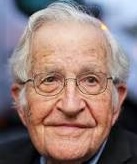
Noam Chomsky (born on December 7, 1928, in Philadelphia, Pennsylvania) is an American linguist, philosopher, cognitive scientist, historical essayist, social critic, and political activist. Sometimes called "the father of modern linguistics", Chomsky is also a major figure in analytic philosophy and one of the founders of the field of cognitive science. He is a Laureate Professor of Linguistics at the University of Arizona and an Institute Professor Emeritus at the Massachusetts Institute of Technology (MIT), and is the author of more than 150 books. He has written and lectured widely on linguistics, philosophy, intellectual history, contemporary issues, and particularly international affairs and U.S. foreign policy. Chomsky has been a writer for Z projects since their earliest inception, and is a tireless supporter of our operations.




