

 |

In Jo Sol's film Fake Orgasm, the protagonist Lazlo Pearlman, a performance artist and self-styled "gender anarchist," tackles questions of gender, sexuality, and identity in a radical manner. Echoing the views of many feminist intellectuals, Pearlman highlights the oppressive nature of the assumption that gender and notions of masculinity and femininity are natural. For Pearlman, proof of the unfixed nature of gender can be seen in continuous attempts by patriarchal society to constantly reinforce and re-establish what it means to be a "man" or "woman." This subversive perspective agrees with the feminist theories of Judith Butler when she highlights that far from being a biological set-in-stone phenomena, gender is, on the contrary, a performative act, an ideology that requires human individuals to act out.
If this is so, then subversion and resistance will always be possible. However, in our modern or indeed post-modern 21st century Western democratic society where women have supposedly achieved their "liberation," patriarchy successfully adapts to the current situation. If capitalism can "constantly revolutionize the means of production" in Karl Marx's words, then patriarchy can clearly adapt culturally. Male and female behavior contribute to this depressing reality, creating what Ariel Levy calls a "raunch culture" where post-feminist women glorify their own objectification and exploitation through a consumer caricature of female sexuality. The reduction of female desire to G-strings, implants, porn, Playboy, and lap-dancing, all now becoming mainstream, has very little to do with the kind of sexual freedom that feminists have addressed. Within this context, something even more sinister is occurring among the crowds of horny and sex-obsessed men: the rise of the pick up artist (PUA) and the so-called seduction community.
A PUA can be defined as a man who is skilled in attracting and seducing women. Entering the term PUA into Google will result in many websites from individual PUAs with various techniques and different styles on how to meet and seduce women. For example:
· Richard La Ruina, aka Gambler, teaches a non-verbal stealth seduction approach ideal for the nightclub
· Adam Lyons approaches attraction with his "entourage game," which is based on the psychological assumption that women are attracted to men who keep themselves in the company of other attractive women
· Mehow teaches his bizarre "microloop theory" and a "10 second sexual attraction" system, often recording his victories on video
· Julian Foxx boasts the "Supernatural System," adopting a style that seeks to mimic those men considered to be "naturals" in pick up
· Vin DiCarlo unveiled his "Pandora's Box," a course that helps men "understand" women on a deep psychological level and even ridiculously categorizes women into eight types, supposedly allowing men the edge to develop individual pick up strategies
· Kezia Noble, a female PUA, also offers her services by teaching men seduction and a unique insight into the "female mind"
· Derek Lamont promotes an Internet attraction course where pick up can be transferred from the clubs and bars to Facebook and MySpace

|







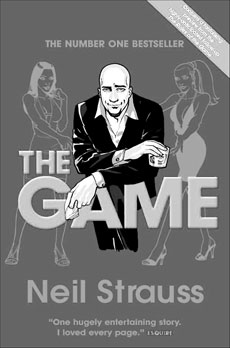




The origins of the seduction community can be traced to the self-improvement and life coaching industry, personified by gurus such as Richard Bandler. The fascination with Bandler's teachings, neuro linguistic programming (NLP), and Miltonion hypnosis, have become traits of the self-improvement industry and PUAs. This is epitomized by Ross Jeffries, one of the founding fathers of the PUA community, and his so-called "Speed Seduction" system, which offers a manipulative approach to teaching hypnosis techniques for seduction. The other big daddy of the seduction community is Mystery, author of the Mystery Method, a kind of bible for the PUA in the way it has established much of the language, terminology, and alpha male ideology. For Mystery and many other PUAs, the process of seducing and attracting women is referred to as "the game." An important aspect of the game is for the male PUA to demonstrate that he is a high-value alpha male. The PUA desire to train their male students in becoming alpha is a perspective that is pseudo-scientific and ultimately biologically determinist. Rigid biological notions of masculinity and femininity accentuating difference are therefore reinforced in the PUA world. Many gurus identify specific traits which demonstrate "alphaness," implying a dominant man who will immediately attract women. Mystery explains in his book that the ultimate purpose of life is replication due to natural selection and thus humans are little more than biological machines.
It is clear from the subtitle of Mystery's book, How To Get Beautiful Women Into Bed, that the mission of the PUA community is not to simply provide a dating service, especially when all the students, clients, and customers are men. The goal is to have sex with as many women as possible with no strings attached. That is why many PUAs claim to offer rejection proof strategies on approaching women in clubs at night or the streets in the day. The PUA gurus map out an entire strategy, from the opener to a conversation riddled with psychological power games, hypnosis, cold reading, and kinesthetic touches which supposedly build comfort and attraction. The conclusion to the strategy always ends with sexual escalation and either an "N close" (number close), "K close" (kiss close), or "F close" (use your imagination). In this bizarre situation, women become passive objects to be dominated and who are assumed to be biologically and psychologically wired in a specific way.
This perverse PUA domination fantasy is confirmed not only through some of the obscene sexist language used by PUAs, but also in the way PUAs such as Gary Brodsky teach a viciously sexist bad-boy approach where men are advised to blatantly objectify their female "targets." His "any woman, anywhere, anytime" philosophy has taken PUA biological determinism to extremist heights through his online sale of ISA Formula 5, a pheromone enhancer which supposedly hits a woman's sexual receptors through their sense of smell. This disturbing yet laughable nonsense is also clear in many of the seminars of Ross Jeffries, who often uses boxing metaphors to describe the seduction process. The romancing of women is therefore reduced to a power game or struggle where men must defeat the desired female object. The main requirements for the PUA in the post-feminist woman are Victorian values of submission and obedience.
PUAs may claim to be revolutionary in improving the confidence of men to talk to and pick up women, but in truth what is offered is merely a backward conservatism, yet another product of 1980s backlash politics. Ross Jeffries has often mentioned in his seminars that men have lost their masculinity and have become effeminate and that this undesirable feminization of men is a product of the 1960s counterculture politics, feminism, radical leftist ideas, and political correctness. Kezia Noble has also stated this same anxiety on her regularly updated website videos. "Where are the men?" she asks, citing how the lack of powerful male role models is responsible for the decline of confident, powerful, alpha males that can lead the female gender. She lists a number of examples of great male role models which include Winston Churchill, John Wayne, and Ronald Reagan known for their right wing political stances, let alone racist views.
Do They Work?
If the above information can explain why PUAs exist and how they justify their existence separate from mainstream dating services, the other question to also ask is whether PUA strategies work? Are they successful in satisfying the male ego's search to add as many notches to their belt as possible? Many PUAs may consider themselves players, claiming to have slept with hundreds of women and may indeed be "good" with the opposite sex. However what does that say about the agency of women in our society? As mentioned already, the pick-up process assumes a specific kind of behavior with regards to women. For example, PUAs will claim that women like dominant "bad boys" and find "nice guys" or needy men unattractive. This supposedly explains why some women are in relationships with men that can be defined as abusive. Gary Brodsky explains to his students that "women want to be dominated and taken."
Kezia Noble supports this PUA perspective through her validation technique, a well-known PUA/NLP tactic using psychology. In conversation she teaches that men should demonstrate that they are high-value alpha males by showing their positive and negative approval for something the female target has done, said, behaved, acted, or worn. She justifies this through references to psychoanalysis, claiming that all women want to please men. For Noble, the origins of this psychological reality can be explained by Freud's Electra complex and a daughter's relationship with her father. The father's show of approval and disapproval for his daughter creates a situation where she seeks only approval and therefore looks for that subconsciously in her other relationships with men. Noble also trains her male students to use tasks on women, originally a hypnosis technique where, in the PUA context, men will slowly increase their control and power over a woman by giving her physical or conversational orders and challenges incrementally and stealthily. For example, a PUA may politely order a girl to get up and do a dance for him or ask her to tell him three reasons why she likes something specific as part of a conversation. This supposedly conditions a woman to be responsive and obedient to a man, building rapport and leading the interaction to sexual escalation.
However, the fact that this kind of behavior may happen in nightclubs does not prove that women seek to please men as something ordained by nature or psychology. If PUA tactics achieve some success for men, then this merely highlights the ideological and cultural workings of patriarchy. Power is defined not simply by the social structure of domination but also the behavior of the subordinate oppressed group socialized through both implicit and explicit cultural norms. The main problem with PUA biological determinism and pseudo-psychological assumptions about the sexes are in the way they construct female sexuality as subordination and male sexuality, masculinity and male desire as something that is concerned with power over the female. PUAs merely embody this cliché. The PUA community, much like pornography, eroticizes this power relation, reducing sex to patriarchy. This is confirmed through PUA Bobby Bradshaw's 2 Girls Teach Sex DVD series, a collaboration with porn stars Tori Sinclair and Shawna Lenee, yet another journey into the fantasy of domination as attraction.
PUAs are clearly subscribing to mainstream society's obsession with gender and the assumption of fundamental differences between men and women. Such a perspective will never see beyond difference and will always justify patriarchy and male domination. If masculinity in Western society has become a cliché unable to conceive male sexuality in any way other than through notions of power and domination, then violence against women and rape are the most extreme inevitabilities. PUAs contribute to this reality and in this sense the orientalist fantasy of a democratic liberal Western society where women are liberated becomes unconvincing. Religion-obsessed Mullahs and porn-obsessed PUAs are kindred spirits, sharing something in common. Both view women as a problem, a threat to the social order, and ultimately both share the same misogynistic desire to regulate and control female sexuality as a solution to that threat. With this in mind, the next time the likes of Mystery or Ross Jeffries appear triumphantly on a talk show or through the mass media promoting pick up, one should be very suspicious.
Z
Adam Khan is a London-based writer, musician, and former activist on social justice issues. Previous work involved helping organize solidarity with the Zapatistas as well as anti-racist campaigns in London and involvement in the anti-capitalist movement.




