


Palestinian Authority (PA) President Mahmoud Abbas and his supporters in the Fatah Party want us to believe that dramatic changes are underway in the occupied Palestinian territories. This is part of a strategy intended to offset any public dissatisfaction with the self-designated Palestinian leadership in the West Bank. The PA hopes the news will help it survive the current climate of major showdowns engulfing the Middle East.
Anticipating a potential popular uprising in the occupied territories, the PA is now taking preventive measures. First, there was the resignation of the chief Palestinian negotiator, Saeb Erekat, on February 12. Erekat was clearly implicated in negotiating, if not squandering, Palestinian rights in successive meetings with Israeli and American officials. This was revealed in nearly 1,600 leaked documents, which Al Jazeera and the Guardian termed the "Palestine Papers."
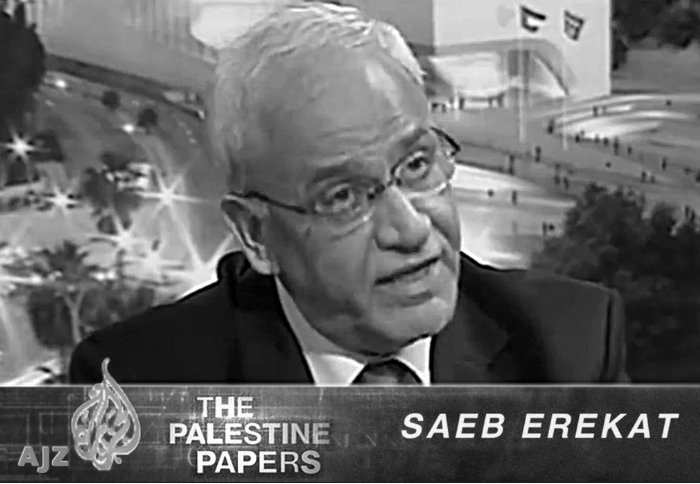
Erekat, who made his entrance at the 1991 Madrid peace conference, claimed to have left merely because the leak happened through his office. Erekat clearly wants to be seen as an "example of accountability." According to the Washington Post (February 16), he claimed: "I'm making myself pay the price for the mistake I committed, my negligence. These are the ethics and the standards. Palestinian officials need to start putting them in their minds."
Two days after Erekat's departure, the PA cabinet in the West Bank also suddenly resigned. The cabinet had met earlier that day. Its Prime Minister, Salam Fayyad, submitted his resignation to President Abbas. The latter, in turn, accepted the resignation and immediately reappointed Fayyad to form a new government. An exercise in futility? Of course, but the resignation was tactical, aimed at quelling the current popular discontent and preventing it from spilling over into street protests. But it was also tactless, for it reintroduced the very person who formed the old government to assemble a new one.
If Fayyad's political performance was lacking—and thus deserving of rebuke and mass resignation—what is the point of putting the same man in charge?
Clearly, the move was meant to show the people that the PA did not need a popular uprising to initiate reforms and change. Fayyad was reappointed because he is valuable to the current structure of the PA. He's also the most trusted Palestinian official as far as the U.S. is concerned.
On top of all this, the PA set September as a deadline for elections in the occupied territories. This date acquired a compounded value when Western officials began assigning other great expectations to September as well. One such call was made by EU foreign policy chief Catherine Ashton, who expressed her hopes—along with those of the international community—that a peace deal between Israel and the Palestinians would be reached by September.
Based on the current political reality of a rejectionist Israeli front—a Palestinian front that is polarized and largely self-seeking and a U.S.-led Western front that is unwilling to do much more than press the Palestinians for more concessions—it seems certain that no peace will come in September. Abbas, a pragmatic person by his own admission, knows this as well. The September deadline is largely aimed at creating further distraction so there will be no need to worry about the here and now.
But September is also not too far off, a reality that called for early steps. Hamas rejected the call for elections without a platform of political and territorial unity. Why should Hamas get involved if an unfavorable outcome will further punish the Palestinian people? A sound concern, of course, but that rejection allowed Abbas, on February 17, to condition the elections based on Hamas's participation and, once more to position Hamas as the hurdle that stands between the Palestinians and unity, political normalcy and democracy. Now Hamas will be continually derided for delaying the Palestinian national project, until September arrives and disappears, leaving behind no mark of meaningful change.
Abbas and his trusted advisors already know the outcome of this endeavor. The strategy is aimed at deepening the divide among Palestinians and distracting from the main problem, which is that the PA serves no purpose other than managing the administrative side of the Israeli military occupation.
The Palestinians must move past this dismal political moment and seek an alternative—an all-inclusive, representative, and truly democratic institution to lead the next stage in their fight for freedom. The PA wants to stall until September. But will Palestinians wait that long?
Z
Ramzy Baroud is an internationally-syndicated columnist and the editor of PalestineChronicle.com. His latest book is My Father Was a Freedom Fighter: Gaza's Untold Story (Pluto Press).


Ramzy Baroud is a US-Palestinian journalist, media consultant, an author, internationally-syndicated columnist, Editor of Palestine Chronicle (1999-present), former Managing Editor of London-based Middle East Eye, former Editor-in-Chief of The Brunei Times and former Deputy Managing Editor of Al Jazeera online. Baroud’s work has been published in hundreds of newspapers and journals worldwide, and is the author of six books and a contributor to many others. Baroud is also a regular guest on many television and radio programs including RT, Al Jazeera, CNN International, BBC, ABC Australia, National Public Radio, Press TV, TRT, and many other stations. Baroud was inducted as an Honorary Member into the Pi Sigma Alpha National Political Science Honor Society, NU OMEGA Chapter of Oakland University, Feb 18, 2020.




