


The upheavals in the Middle East have created acute problems for establishment officials and pundits, and their discomfiture, squirming, and gyrations have added further pleasure to the shifting political scene. "We" are allegedly strongly in favor of democracy and hostile to one-party rule and repression, but sometimes geopolitical calculations (also called "our interests") override this democratic proclivity. But in reality, the public has nothing to do with making these decisions; the public never voted to seek favorable climates of investment over the entire globe, or to move to a permanent war system, or to keep pumping up the arms business as the civil society cries out in pain. These have been elite decisions, reflecting elite interests and values. The use of "we" and "our" in this context is thus deceptive and trickery.
Furthermore, can democracy be "our" true value if it is so systematically overridden? Is it a true value even at home if the more aggressive quest for a favorable climate of investment in the United States itself has steadily weakened the electoral choices and effective political participation of ordinary citizens and brought with it intensified and savage class warfare? (See my "Toward a Homeland Favorable Climate of Investment," Z Magazine, March 2011.)
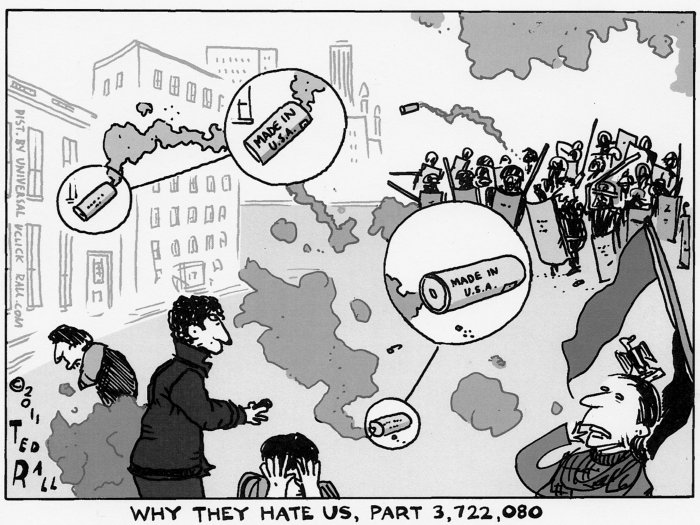
It did produce a period of oscillation in the case of Egypt, when our leaders were not sure that Hosni Mubarak was finished, so that while they lauded democracy in the abstract and the efforts of people in the streets, Mubarak's merits were still highlighted. Hillary Clinton mentioned her close personal relationship with Mubarak and his wife, and both she and Barack Obama emphasized Mubarak's contribution to "stability" and peace. As his status faded, they were sure that Mubarak still had an important role to play in an "orderly transition" to a democracy that he, with steadfast U.S. support, had fended off for some 30 years. But in the end, which for the Mubarak dictatorship arrived on February 11, 2011, with his political survival impossible without unleashing mass killing, Mubarak was ushered out and "our values" were brought to the fore.
The rapid transformation of word usage in this evolving scene was notable. "Dictator" and "autocracy" became much more heavily used, and "stability" suffered an eclipse as acute instability disturbed the area formerly stabilized by the protected dictator. Word-usage started shifting against Mubarak during the week of January 24-28. In particular on or about January 28, a Friday, by which time massive street demonstrations were taking place in Cairo, Suez, Alexandria, and elsewhere, and the news providers had become fixated on Egypt, especially in the aftermath of rapid events in Tunisia. By January 28, the Mubarak regime went from near zero descriptions as a "dictatorship," to daily descriptions as a "dictatorship." In the case of Tunisia's Ben Ali (who fled Tunis on January 14), the shift was even more dramatic.
In earlier years, the word dictator was also applied to Chilean General Augusto Pinochet much more frequently after he was deposed than during the period when he also was providing "stability" and a favorable climate of investment in Chile. In its obituary to Pinochet, the New York Times even used the words "dictator" and "terror" in the very title (Jonathan Kandell, "Augusto Pinochet, Dictator Who Ruled by Terror in Chile, Dies at 91," Dec. 11, 2006), showing how far this earlier stabilizer and favorite of Milton Friedman, Friedrich Von Hayek, and the U.S. corporate and political establishment had fallen. In earlier years, when such an invidious word was used in the New York Times in reference to Pinochet, it was usually qualified in a context of apologetics, as in Shirley Christian's "Pinochet, a 'Very Peculiar Dictator,' Faces Voters," October 2, 1988—the "peculiarity" being that he was willing to risk a voter repudiation—and with strong intimations by the reporter that Pinochet had become a democrat.
In the Mubarak regime's death throes the Times even had Egypt an "autocracy," with Mubarak having ruled with an "iron hand" ("Egypt's Agonies," ed., NYT, Feb. 4, 2011). But as Mubarak exited, establishment media journalists spent very little time reflecting on the fact that their government and leaders, and they themselves, had given crucial support to the iron-handed autocracy, mainly by looking the other way. Their attention level and indignation at the problematics of the Iran election of 2009 was massive and enough to service the regime-change program of U.S. and Israeli leaders. But their attention to the far more dubious Egyptian elections of 2005 and 2010, or that in Honduras in 2009, was modest and insufficient to arouse the public to concern and action, in the standard pattern of the free press (see Edward S. Herman and David Peterson, "Iran and Honduras in the Propaganda System, Part 2: The 2009 Iranian and Honduran Elections," MRZine, October 24, 2010; see also Edward S. Herman and Noam Chomsky, Manufacturing Consent).
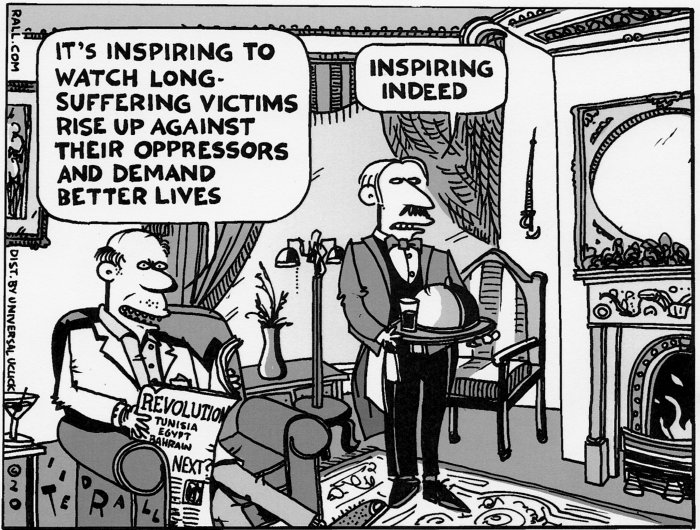
As Mubarak's power sagged, the U.S. establishment worried about an "orderly transition" to a democratic government. This was another Kafkaesque beauty, only slightly obscuring the establishment hope that even if Mubarak was doomed, possibly with enough patience and time, and the help of the U.S.-funded and trained army and further Western money and advisers, the basics of the old regime could be maintained—Mubarackism without Murarak, or a democratic façade covering over the preservation of an obedient client state. An orderly transition to not much transition.
 |
For a brief period the U.S. establishment seemed to hope that foreign intelligence chief Omar Suleiman might take the transitional reins: he was a "close ally of Washington," "deeply distrusting Iran," and having "managed most of Egypt's hottest issues, including dealing with Hamas, Hezbollah and the Sudan" (Michael Slackman, "A Choice Likely to Please the Military, Not the Crowds," NYT, January 30, 2011). While Slackman finds space to mention that Suleiman was a "dapper dresser," his lengthy piece never points out that Suleiman was a torturer and managed Egypt's participation in the "extraordinary rendition" program, notorious for providing exceptionally brutal torture. This role played by Mubarak's Egypt was rarely even mentioned in passing in the mainstream media.
Of great importance to U.S. officials was the preservation of the Egyptian state's friendly relationship with the state of Israel, which had assured "peace." One of the notions disseminated in the media was that Mubarak (and Suleiman as well) was important in advancing the "peace process." We are back in the world of Franz Kafka: the "peace process" is a sick joke, assuredly never bringing peace, but with the pretense of an ongoing "process" providing cover for steady dispossession. And the Egyptian "peace with Israel" meant that, with Egypt neutralized and even positively aiding Israel, Israel was freed to attack Lebanon and make war on and ethnically cleanse Palestinians. This of course rested on U.S. bribery of Mubarak and his military-police and the economic-plundering elite, with disregard for the welfare and opinion of the Egyptian people.
So the threat of democracy imperils this system of corruption and dictatorship and Egyptian support of Israel's war and oppression. This will never do, and we may hope that an "orderly transition" can provide a renewed "stability" that will satisfy "our" values and interests.
Z
Edward S. Herman is an economist, media critic, and author of numerous articles and books. His latest book is The Politics of Genocide (with David Peterson).


Edward Samuel Herman (April 7, 1925 – November 11, 2017) . He wrote extensively on economics, political economy, foreign policy, and media analysis. Among his books are The Political Economy of Human Rights (2 vols, with Noam Chomsky, South End Press, 1979); Corporate Control, Corporate Power (Cambridge University Press, 1981); The "Terrorism" Industry (with Gerry O'Sullivan, Pantheon, 1990); The Myth of the Liberal Media: An Edward Herman Reader (Peter Lang, 1999); and Manufacturing Consent (with Noam Chomsky, Pantheon, 1988 and 2002). In addition to his regular "Fog Watch" column in Z Magazine, he edited a web site, inkywatch.org, that monitors the Philadelphia Inquirer.




