



Withdrawing
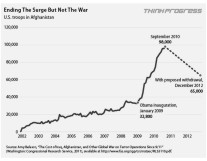

FAIR notes that if the reductions are carried out as planned, the United States would still have far more troops in Afghanistan than it did when Obama came into office and more than at any point during former president George W. Bush’s administration. This means that the troop reduction would not put us much closer to actually ending the war by the end of 2012.
But that’s not the impression many in the media were giving–which often made it sound as if the war was ending. “Obama Moves Toward Exit from Afghanistan” read one Reuters headline (6/22/11). USA Today reported (6/23/11), “President Obama heralded the beginning of the end of the nation’s 10-year war in Afghanistan on Wednesday.”
The reporting also nearly universally excluded any mention of the 100,000 Pentagon contractors currently in Afghanistan, which doubles the U.S. military commitment there. Given the full context, it’s hard to read a phased pullout of 30,000 out of 100,000 over the course of an entire year as a “rapid” withdrawal (Los Angeles Times, 6/23/11). Nor is it clear how this withdrawal merits a headline like the New York Times’ “Obama Will Speed Military Pullout From Afghan War” (6/23/11).
The pace of the withdrawal, and the remaining U.S. presence in the country, reveal that the Afghan War is a long way from being over.
Dukes v. Wal-Mart
Colorlines.com sent news of the Supreme Court decision in the Dukes v. Wal-Mart sex discrimination case that exempted the company from accountability. The court decided 5-4 that up to 1.5 million female employees cannot file suit together as a class. The case highlights the difficulty of addressing discrimination at a time when intentional bias is considered both illegal and socially unacceptable. Yet obvious gender and racial gaps remain.
Wal-Mart’s numbers are not in question. Women comprise more than 65 percent of hourly employees, but only 34.5 percent of management jobs. This is significantly different from similar retail chains, in which women hold 56.5 percent of management jobs. It takes women on average 4.38 years to rise to a management post at Wal-Mart, but it takes men only 2.86 years. Of 41 Wal-Mart regional vice presidents, only 5 are women and only 9.8 percent of Wal-Mart’s district managers are women. Wal-Mart’s internal documents acknowledge that they are far behind the rest of their field.
The plaintiffs in the case argued that Wal-Mart’s corporate culture invited managers to act on their own worst instincts. They cited the research of William Bielby, a sociologist who posits that people naturally hold stereotypes and biases, often unconsciously, and we act on them when we have the power to do so and nothing stops us.
Certainly, there has been some blatantly sexist behavior among Wal-Mart managers, such as management meetings in which men called their female colleagues “little Janie Qs.” But mostly, Wal-Mart’s system runs on silence. Silence about what exactly are the criteria for management positions; silence about the additional subjective criteria that individual managers apply for promotion; silence about actual availability of management positions; silence about whether to give an employee a raise of 10 or 25 cents per hour. Male managers fill all that silence, the plaintiffs’ lawyers and expert witnesses said, with subjective decisions that are often influenced by stereotypes.
In the majority opinion, Justice Antonin Scalia wrote that common elements tying all these employment decisions together were “entirely absent” in this case.
Americans will be tempted to take this decision as proof that Wal-Mart is not guilty of gender discrimination, and employers will take heart from the Supreme Court turning a blind eye. If some bad managers make sexist decisions, companies will say, that can’t be helped; gender stereotyping is an intractable problem.
But the real lesson is that Americans can’t rely on the courts alone to check all forms of bias. Wal-Mart and other corporations need to hear from everyone—consumers, workers, and other employers who are building equitable workplaces.
Civil Disobedience at the Tar Sands
Thenation.com sent a communique from Bill McKibben, Naomi Klein, Wendell Berry calling for civil disobedience on tar sands, one of the largest remaining deposits of oil in the world. Efforts to extract the resource from a mix of clay and other materials underneath Canada’s Boreal forest have created the biggest, and by the accounts of numerous scientists and environmental groups, the most environmentally devastating, energy project on earth. TransCanada, one of the largest companies involved in tar sands exploration, has proposed a 1,661 mile, 36-inch extension of the newly built Keystone Pipeline from Alberta, Canada to oil refineries of the United States. This would expand the capacity for refining oil produced from Alberta tar sands by approximately one million barrels per day.
A group of leading environmental activists, many associated with the grassroots group 350.org have issued a call for concerned citizens to take part in a campaign of non-violent direct action this summer in Washington, DC, in all likelihood, during the last two weeks of August. Why DC? That’s when the State Department and the White House have to decide whether to grant a certificate of “national interest” to some of the biggest fossil fuel players on earth, some of whom want to build the so-called “Keystone XL Pipeline” from Canada’s tar sands to Texas’s refineries.
Encampment at Park Place


Calling their takeover and sleep-in Bloombergville—a reference to the infamous shanty towns known as Hoovervilles that sprung up during the Great Depression–they are New Yorkers Against the Budget Cuts (NYABC), a coalition of different groups and individuals united by their opposition to Mayor Michael Bloomberg’s proposed budget for next year and their determination to press the City Council not to adopt it.
Appalachia Rising
An email from Commondreams.org announced news of Appalachia Rising involving hundreds beginning a 50 mile march to Protect Blair Mountain in Southern West Virginia. Marchers are calling for end to mountaintop removal, protection of Blair Mountain, strengthened labor rights, and a transition to a sustainable economy in Appalachia.
Chuck Keeney, great grandson of a famed UMWA leader during the 1921 Battle of Blair Mountain, spoke at a kick-off conference. Also speaking were Coal Country producer Mari-Lynn Evans; Salt Rock native Brandon Nida, and Wilma Steele, a Mingo county art teacher. “We’re here to build a better future for our kids, for our community,” said Nida, Salt Rock, West Virginia native and doctoral student of archaeology at Berkeley.
Marchers are following the same route that coal miners took when they marched to Blair Mountain in 1921 in an effort to gain basic human rights and civil liberties. The ensuing battle between 10,000 coal miners and the coal industry’s hired gunmen is remembered as the largest armed uprising in United States history since the Civil War, and was a landmark event in labor struggles of the early 20th century.
In March of 2009, Blair Mountain was placed on the National Register of Historic Places, but coal operator pressure on state agencies led to its de-listing nine months later.
“Mountaintop removal eliminates jobs, not creates jobs,” said retired UMWA miner Joe Stanley, “I’m doing this to preserve the history and culture Blair Mountain represents. If we allow them to destroy Blair Mountain we’ll forget the actions done by brave men that led to strengthening the labor movement and creating the middle class.”
Mountaintop removal is an extreme form of coal mining that involves blasting off the tops of mountains in order to extract the seams of coal underneath. Overburden–the industry term for topsoil, trees, and rock containing toxic heavy metals–is dumped in valleys, finding its way into water sources and contaminating the drinking water of those who live nearby. Community members living near mountains permitted for mountaintop removal often choose to vacate their homes rather than endure these adverse conditions, which also include increased flooding and poor air quality.
Steele said, “King coal owns our land and our politicians, they lead them to ignore mining safety laws and ignore every environmental law in the book. Our mountains are special and shouldn’t be destroyed for this.”
No Body of Evidence
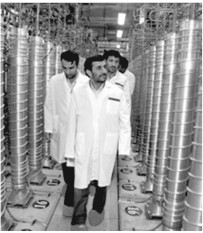

Seymour Hersh argues: “There’s just no serious evidence inside that Iran is actually doing anything to make a nuclear weapon….. We’ve been looking—Cheney was convinced, Dick Cheney, the former vice president, there was a secret facility à la what we probably saw in the movie Bananas. Remember Woody Allen’s movie, the little robots running underground?–the International Atomic Energy Agency, which monitors nuclear developments, they consistently report that there’s no evidence of any diversion of any of the enriched materials they now have…. The Iranians are enriching to about 3.7 or so percent to run civilian power plants. There’s one small pilot project for medical research that gets up to 20 percent. But everything that’s being enriched is under camera, under watch, by the IAEA. There’s just no sign of any diversion. There’s just no evidence. “
Without Libraries?


“In Oak Park, Illinois, when I was in high school, I went to the library two or three times a week, though in my classes I was a middling student. Even in wintertime, I’d walk the dozen blocks to the library, often in rain or snow, carrying a load of books and records to return, trembling with …anticipation at all the tantalizing books that awaited me there. The kindness of the librarians, who, of course, all knew me well, was also an inducement. They were happy to see me read so many books, though I’m sure they must have wondered in private about my vast and mystifying range of interests.
“This was just the start. Over the years I thoroughly explored many libraries, big and small, discovering numerous writers and individual books I never knew existed, a number of them completely unknown, forgotten, and still very much worth reading. No class I attended at the university could ever match that…wherever I found a library, I immediately felt at home. I heard some politician say recently that closing libraries is no big deal, since the kids now have the Internet to do their reading and school work. It’s not the same thing. As any teacher who recalls the time when students still went to libraries and read books could tell him, study and reflection come more naturally to someone bent over a book.
“Seeing others, too, absorbed in their reading, holding up or pressing down on different-looking books, some intimidating in their appearance, others inviting, makes one a participant in one of the oldest and most noble human activities. Yes, reading books is a slow, time-consuming, and often tedious process. In comparison, surfing the Internet is a quick, distracting activity in which one searches for a specific subject, finds it, and then reads about it–often by skipping a great deal of material and absorbing only pertinent fragments. Books require patience, sustained attention to what is on the page, and frequent rest periods for reverie, so that the meaning of what we are reading settles in and makes its full impact.
“How many book lovers among the young has the Internet produced? Far fewer, I suspect, than the millions libraries have turned out over the last 100 years. Their slow disappearance is a tragedy, not just for those impoverished towns and cities, but for everyone everywhere terrified at the thought of a country without libraries.”
Millions for Robots?


“Methods for the establishment and infusion of robotics in educational curricula and research to gain a better understanding of the long term social, behavioral, and economic implications of co-robots across all areas of human activity are important parts of this initiative,” says the NSF.
Obama’s unveiling of the initiative came as part of a larger stimulus announcement of a $500 million package designed to boost America’s manufacturing industry by combining the resources of government agencies, educational institutions, and corporations to spearhead new research and development opportunities.
“Investing in robotics is more than just money for research and development, it is a vehicle to transform American lives and revitalize the American economy,” said Helen Greiner, president of the Robotics Technology Consortium ‘Indeed, we are at a critical juncture where we are seeing robotics transition from the laboratory to generate new businesses, create jobs and confront the important challenges facing our nation.”


