


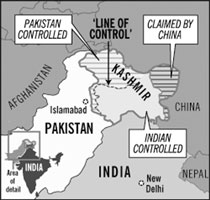

Between June 11 and September 22, 2010, Kashmir witnessed the execution of 109 people by India's police, paramilitary, and military. Indian forces opened fire on crowds, tortured children, detained elders without explanation, and coerced false confessions. Since June 7, there have been 73 days of curfew and 75 days of strikes. On September 11, this year's Muslim holiday of Eid-ul-Fitr, the violence continued as the paramilitary and police verbally abused and physically attacked civil society dissenters.
But Kashmir has been subjected to much worse. The use of public and summary execution for civic torture has been deemed necessary to Kashmir's subjugation by the Indian state. The fabrications of the military—fake encounters, escalating perceptions of cross-border threat—function as a truth-making apparatus. Kashmir is about spectacle. The Indian state's violence functions as an intervention to discipline and punish, to provoke and dominate. In the summer of 2010, India maneuvered against Kashmir's determination to decide its future. The use of violence by the Indian forces was deliberate, their tactics cruel and precise, amid a groundswell of public dissent. This was the third summer, since 2008, of indefatigable civil society uprisings for "Azaadi" (freedom).
What is the Indian state hoping to achieve? That Kashmiris submit to India's domination, forsaking their claim to separation from India as an independent state or, for some, to be assimilated with Pakistan or for full autonomy. If India succeeds in both provoking local armed struggle and linking Kashmiri resistance to foreign terror, it will acquire international sanctions on grounds of "national security" and India can then reinforce its armed forces in Kashmir, presently 671,000 strong, to prolong the killing spree. Such provocation as policy is a mistake. Attempts to legitimize military rule will produce intractable conflict and violence. All indications are that Kashmiri civil society dissent will not abate. It is not externally motivated, but historically compelled.
Dominant nation-states overlook that freedom struggles actually reflect a desire to be free and that the greater the oppression, the more fervent is resistance. At the same time, the greater the violence, the more likely is the provocation to counter-violence. If India's subjugation persists, it is conceivable that the movement for nonviolent dissent, mobilized since 2004, will erode and that India's brutality will induce Kashmiri youth to close the distance between stones and petrol bombs, or more. If India fails to act, if Pakistan acts only in its self-interest, and if the international community does not insist on an equitable resolution to the Kashmir dispute, it is conceivable, that, forsaken by the world, Kashmiris will be compelled to take up arms again.
Will To Power
In Summer 2010, dominant discourse focused on the use of stone pelting and on the instances of violence by youth in Kashmir as reasons for armed action on the part of the state, while Indian Prime Minister Manmohan Singh talked about the need for efficient tactics for "crowd control." India's elite intelligentsia, inculcated into "rational" conduct and no longer outraged by suffering, assessed the costs and benefits of militaristic violence.
But civil society demonstrations in Kashmir are not a law and order problem, as has been reported. Stone pelting and incidents of arson and violence are not causal to the violence that is routine in Kashmir. Stone pelting does not seek to kill and has not resulted in deaths. Pro-freedom leaders (termed "separatists" by the Indian state) have emphasized nonviolent civil disobedience and have appealed to civil society to avoid violent protests in reaction to the violence and killings by Indian forces.
The government of India continues to monitor the resistance movement, shifting the boundaries of civil liberties. Kashmiris are allowed to protest in New Delhi, while in Kashmir sloganeering ("Go, India, Go Back," "Indian Dogs Go Home," "Quit Kashmir") is met with force. When Masarat Alam Bhat, a rising pro-freedom leader, issued an appeal to Indian soldiers in July to "Quit Kashmir," Indian authorities banned its circulation.
On September 13, crowds in Kashmir torched a Christian missionary school and some government offices while protesting the call to desecrate the Qur'an by Florida Pastor Terry Jones. Also on September 13, 18 civilians were killed by the Indian forces in Kashmir (a police officer also died). Provoking Kashmiri dissenters to violence serves to confirm the dominant story of Muslims as "violent." Yet again, several pro-freedom leaders condemned the attack on the Christian school and renewed their call for nonviolent dissent. The Indian government stated its willingness to engage with Kashmiri groups that reject violence, but New Delhi did not apply the same precondition to itself nor did it acknowledge that pro-freedom groups have repeatedly opposed the use of violence in recent years.
Instead, the Kashmiri Muslim is caricatured as violent by India's dominant political and media apparatus. There is a refusal to recognize the inequitable historical-political power relations at play between Muslim-prevalent Kashmir's governance by Hindu-dominant India. The racialization of the Muslim as "Other," and hence barbaric, reveals the xenophobia of the Indian state. Distinctions in method and power between stone pelter and armed soldier, between "terrorist" and "freedom fighter," are rejected as inconvenient.
The Indian state's discourse is also animated by the prejudice that Kashmiri inclinations to violence are subsidized by Pakistan. Such misconceptions ignore that while some Kashmiris did travel to Pakistan to seek arms training, such activity was largely confined to the early days of the armed militancy, circa the late-1980s through the mid-1990s. Pathologies of "violent Muslims" legitimate the physical violence of the Indian "security" forces, which is presented as necessary protection for the maintenance of the Hindu majority Indian nation.
First Hand Look At Injustice
I spent considerable time between July 2006 and July 2010 learning about and working in Kashmir. In undertaking the work of the International People's Tribunal on Human Rights and Justice in Kashmir, I have traveled across Kashmir's cities and countryside, from Srinagar to Kupwara, through Shopian and Islamabad (Anantnag), with Parvez Imroz, Zahir-Ud-Din, and Khurram Parvez. I have witnessed the violence that is perpetrated against Kashmiris by India's military, paramilitary, and police. I have walked through the graveyards that hold Kashmir's dead and have met with grieving families. I have sat with witnesses who described how Indian forces chased down and executed their friends for participating in civil disobedience. I have met women whose sons were disappeared. I have spoken with youth, women, and men who are enraged. I have also spoken with persons who were violated by militants in the 1990s. Peoples' experiences with the reprehensible atrocities of militancy do not imply the abdication of their desires for self-determination. The Indian state deliberately conflates militancy with the people's mass movement for liberation.
I have met with torture survivors, non-militants, and former militants who testified to the sadism of the forces—men who had petrol injected through the anus, water-boarding, mutilation, being paraded naked, rape of women, children, and men, starvation, and psychological torture.
Who are the forces? Disenfranchised castes and other groups—Assamese, Nagas, Sikhs, Dalits (erstwhile "untouchable" peoples), as well as Muslims from Kashmir—are being used to combat Kashmiris. Why did 34 soldiers commit suicide in Kashmir in 2008 and 52 fratricidal killings take place between January 21, 2004 and July 14, 2009? Why did 16 soldiers commit suicide and 2 die in fratricidal killings between January and August in 2010?
Laws authorize soldiers to question, raid houses, detain and arrest without charge, and prolong incarceration without due process. They blur distinctions between military/paramilitary, legality/illegality. Citing "national security," Indian forces in Kashmir shoot and kill on uncorroborated suspicion, with impunity from prosecution. Yet, revoking the Armed Forces Special Powers Act (1958), for example, will not stop the horror in Kashmir. India's laws are not the primary contention. India's political and military existence in Kashmir is the issue. Legal impunity is the cover for the moral impunity of Indian rule.
Is the military willing to withdraw from Kashmir? Since 2002, the Indian government has procured $5 billion in weaponry from the Israeli state. Five billion dollars is a colossal sum for India where 38 percent of the world's poor reside. Eight of the poorest states in India are more impoverished than the 26 poorest countries of the African continent. Five billion dollars, in addition to the other monies and resources invested in the militarization of Kashmir, do not evidence an intent to withdraw.
Human rights violations in Kashmir will not stop without removing the military. The military cannot be removed without surgically rupturing India's will to hold power over Kashmir.
Inflexible Diplomacy
What constitutes India's dialogue with Kashmiris in conditions of extreme subjugation? The government of India has scheduled a hurried time frame to secure a proposal for a resolution that is acceptable to India, Pakistan, and, ostensibly, to Kashmiris. The terms of reference set by New Delhi exclude discussions of self-determination or heightened autonomy, boundary negotiations, the Siachen glacier and critical water resources, and renegotiations of the Line of Control.
New Delhi and Islamabad appear to be in collusion. If Pakistan overlooks India's annexation of Jammu and Kashmir, India would be willing to forget Pakistan's occupation of another fragment of Kashmir. The Musharraf Formula is no longer acceptable to the government of Pakistan, as Afghanistan is the current priority, not Kashmir. Conversations on the phased withdrawal of troops by India and Pakistan at the border, on local self-government, and the creation of a joint supervision mechanism in Jammu and Kashmir, involving India, Pakistan, and Kashmir, are at an impasse.
The government in New Delhi is looking to neutralize Kashmir's demand for self-determination or unabridged autonomy, pushing forward a diluted "autonomy," seeking to assimilate Kashmir with finality into the Indian nation-state.
New Delhi hopes that the Kashmiri leadership, including pro-freedom groups, can be restrained for a price and weakened through infighting. Certain segments of the pro-freedom leadership have throughout history lacked vision, honesty, and the ability to prioritize collaboration for justice and peace in Kashmir. Certain segments of the religious and political leadership have been unable to collaborate meaningfully with civil society, with observant Muslims and those irreligious, and with non-Muslims. The spiritual commitment to justice in Islamic tradition has receded as religious determinations embrace political rationality. The determination of what "freedom" is has been deferred since 1931. Instead there has been a focus on immediate and small political gains. This has plagued and rendered ineffectual segments of the complex Hurriyat alliance in the present, which is often unable to capitalize on the exuberant people's movement. Segments of the pro-freedom leadership have focused on New Delhi rather than Kashmir civil society. New Delhi has fixated on enabling this dynamic, using vast resources to create a collaborator class in Srinagar that undermines the will of the Kashmiri people.
While Pakistan's politicians have pointed to India's injustices, they have not addressed the management of Pakistan-held Kashmir, including the deflation of movements for the unification of Kashmir. The crisis of state in Pakistan and the role of its ruling elite in vitiating people's democratic processes, remains a pitfall for regional security.
The logic that Muslim-prevalent Kashmir must stay with secular India or join Muslim-dominated Pakistan is configured by India's and Pakistan's internal ideological needs and identitarian politics. Neither is inevitable. Neither speaks to the foremost aspiration of Kashmiris.
What do a majority of Kashmiris want? First, to secure a good faith agreement with New Delhi and Islamabad regarding the right of Kashmiris to determine the course of their future, set a time frame, and define the interim conditions necessary to proceed. Following which, civil society and political leaders would ensure processes to educate, debate, and consult civil society, including minority groups, in sketching the terms of reference for a resolution, prior to negotiations with India and Pakistan.
Significantly, pro-freedom leader Syeed Ali Geelani's statement of August 31 sought to shift the terms of engagement, not requiring the precondition of self-determination or the engagement of Pakistan. Unless New Delhi responds, the protests in Kashmir will continue. Geelani's statement, supported by the All Parties Hurriyat Conference leader Mirwaiz Umar Farooq, testifies to this. The mood in the streets testifies to this.
New Delhi's current approach repudiates what Kashmiris want. The omissions made by New Delhi are roadblocks to a minimum agenda for justice and an enduring and relevant peace process. The government of India's "inclusive dialogue" does not recognize Kashmir as an international dispute. The government of India's "inclusive dialogue" does not include:
- An immediate halt to, and moratorium on, extrajudicial killings by the Indian military, paramilitary, and police
- An immediate halt to, and moratorium on, the use of torture, kidnapping, enforced disappearance, and gendered violence by the Indian military, paramilitary, and police
- A plan for the release of political prisoners, the return of those exiled, and contending with the issue of displacement
- Agreements on an immediate "soft border" policy between Kashmir, India, and Pakistan, to enable the resurgence of Kashmir's political economy
- Agreements to non-interference in the exercise of civil liberties of Kashmiris, including the right to civil disobedience, and freedom of speech, assembly, religion, movement, and travel
- A plan for the proactive demilitarization and the immediate revocation of all authoritarian laws
- A plan for the transparent identification and dismantling of detention and torture centers, including in army camps
- A plan for the installment of a Truth and Justice Commission for political and psychosocial reparation and for reckoning loss
- A plan for international, transparent investigations into unknown and mass graves, which constitute crimes against humanity committed by the Indian military, paramilitary, and police
Such omissions are a travesty of any process promising "resolution."
Islamophobia And Realpolitik
New Delhi has been the self-appointed arbitrator in determining the justifications of Kashmir's claims to freedom. Kashmir's claims are historically unique and bona fide. The United Nations Resolutions of 1948, Nehru's promise of a plebiscite (to rethink the temporary accession determined by the Hindu-descent Maharaja, Hari Singh), Article 370 of the Indian Constitution—all are jettisoned as official nationalism seeks to rewrite history, affixing Kashmir to India.
The Indian state is apprehensive that any change in the status quo in Kashmir would foster internal crises of gigantic proportion in India. Adivasis (indigenous peoples), Dalits, disenfranchised caste groups, women, religious, ethnic, and gender minorities are fatigued by the nation's deferred promises. Forty-four million Adivasis have been displaced since 1947. Central India is torn asunder and, as Maoists are designated the latest "threat," national memory forgets the systematic brutalization of peoples in the tribal belt that led to a call to arms. Then there is the Northeast, Punjab, the massacre of Muslims in Narendra Modi's Gujarat, riots against Christians in Orissa, farmer suicides, the plight of peasants and Adivasis of the Narmada Valley where dams are not the "temples of India," but its burial grounds.
Indian civil society decries Kashmir as not deserving of autonomy or separation, as it, an assumed Islamist state, would be a threat to India's democracy. To assume that a Muslim-majority state in Kashmir will be ruled by Islamist extremists in support of global terror reflects majoritarian India's racism. Dominant Indian civil society must rethink its characterization of Kashmiri civil society as prevalently "Jamaati." Jamaat is Arabic for assembly. "Jamaati" is used to imply Islamist or fundamentalist. The reference can often be translated as Muslim equals Jamaati, and Muslim-observant equals fundamentalist.
Indians of Hindu descent largely overlook that India's democracy is infused with Hindu cultural dominance. Indian civil society assumes that Islam and democracy are incompatible, supported by the inflamed Islamophobia in the polities of the West. Importantly, India forgets that in its own history with the British, freedom fighters noted that the oppressor cannot judge when a stateless people are "deserving" of freedom.
Freedom is fundamentally an experiment with risk that Kashmiris must be willing to take. The global community must support them in making such a risk ethical. Jammu and Kashmir is a Muslim majority space. The population of India-held Kashmir was recorded at approximately 6,900,000 in 2008, of which Muslims are approximately 95 percent. Kashmir's future as a democratic, inclusive, and pro-secular space is linked to what happens within India and Pakistan. Kashmiris who wish to be separate from India and Pakistan must assess the difficult alliances yet to be built between Kashmir, Jammu, and Ladakh and between Muslims and Hindu Pandits, Dogra Hindus, Buddhists, Sikhs, Christians, indigenous groups, and others. Then, there is the question of what lies ahead between Indian-held Kashmir and Pakistan-held Kashmir. Minority groups, such as Kashmiri Pandits, must refuse the Indian state's hyper-nationalist strategy in using the Pandit community to create opposition between Muslims and Hindus in Kashmir, as part of a strategy to religionize the issue and govern through communalization.
Where is the international community on the issue of Kashmir? In present history, Palestine, Ireland, Tibet, and Kashmir share correspondence. In Tibet, 1.2 million died (1949-1979) and 320,000 were made refugees. In Ireland, 3,710 have died (1969-2010). For Israel, the occupation of Palestine has resulted in 10,148 dead (1987-2010), with 4.7 million refugees registered with the United Nations (1987-2008). In Kashmir, 70,000 are dead, over 8,000 have been disappeared, and 250,000 have been displaced (1989-2010).
During British Prime Minister David Cameron's recent visit to India, he was asked to refrain from bringing up the "K" word. President Barak Obama's proposed visit to New Delhi in November is already laden with prohibitions. India's rule in Kashmir and its larger human rights record are among them. As well, right-wing Hindu advocacy groups have been successful in securing the silence of many on Capitol Hill on the issue of Kashmir. The Kashmiri diaspora has been partly effective in bringing visibility to the issue, even as the community remains ideologically and politically fragmented. International advocates have propagated an "economic" approach to "normalcy." This avoids the fact that militarization impacts every facet of life, making economic development outside of political change impossible.
The United States and United Kingdom have debated the reasons for involvement in Kashmir. As of September 23, 351 soldiers from the United States have died in Afghanistan, this year, while the UK sustained 92 fatalities. Of paramount concern for both is bringing their forces home without compromising the principles of NATO operations in the region. To accomplish this would require that Pakistan move sizeable forces from the Indo-Kashmir-Pak border to the Af-Pak frontier. This cannot be done without the cessation in Indo-Pak hostilities, which cannot be achieved without the resolution of the Kashmir dispute. However, Kashmir's resolution cannot mean a sanction to Pakistan's encroachment on Afghanistan, which, given the political situation in the region, remains a likely possibility. For the United States and India, the containment of China is another issue, also linked to Kashmir.
Kashmiris in Kashmir are caught in world events, regional machinations, and the unresolved histories of the subcontinent. The Indian state's military governance penetrates every facet of life. The sounds of war haunt mohallas. Armed control regulates and governs bodies. It has been reported that, since 1990, Kashmir's economy has incurred a reported loss of more than 1,880,000 million Indian Rupees ($40.4 billion). The immensity of psychosocial losses is impossible to calculate. The conditions of everyday life are in peril. They elicit suffocating anger and despair, telling a story of the web of violence in which civil society in Kashmir is interned.
India's relation to Kashmir is not about Kashmir. Kashmir's aversion to being subsumed by the Indian state is not reducible to history. If violence breaks lives, Kashmir is quite broken. If oppression produces resistance, Kashmir is profusely resilient. Realpolitik triumphs against a backdrop of persistent refusal. Through summer heat and winter snow, across interminable stretches of concertina wire, broken windowpanes, walls, barricades, and checkpoints, the dust settles to rise again. "We are not free. But we know freedom," Khurram Parvez tells me. "The movement is our freedom. Our dreams are our freedom. The Indian state cannot take that away. Our resistance will live."
Z
Angana Chatterji is a professor in the Anthropology Department at the California Institute of Integral and a co-convener of the International People's Tribunal on Human Rights and Justice in Indian-administered Kashmir.


