


India, a civilisation built on renewable energy and biodiversity economies is currently at a cross roads – will she continue on its renewable energy path based on biodiversity, and energy equity, or will she follow the non-sustainable energy path of the west, based on fossil fuels, nuclear power and energy slaves?
India is not among the historical carbon dioxide polluters of the world because through culture and economic policy, preference was given to localised, decentralised labour intensive economies, not centralised, industrial economies which displace people by depending on non-renewable energy inputs.
However, with globalisation and neo liberal economic reform, the renewable is being replaced by the non-renewable, people are being displaced by fossil fuels, decentralised and diverse systems are being replaced by centralised monocultures of transport, manufacture, and agriculture.
Not only does this add to the threats of climate change, it also usurps the ecological space for tribals, small scale farmers, and women since the land use for an energy intensive economy based on energy slaves must shift from peoples’ sustenance needs to producing and processing industrial, commercial energy and dumping waste, or building superhighways, or growing monoculture plantations for “biofuels” to maintain the infrastructure of the fossil fuel economy in a period which will witness the end of cheap oil.
In 1973, I was training to be a nuclear physicist. Some of my most exciting times were the periods I spent at the Bhabha Atomic Center in Bombay, working as a summer trainee in the experimental fast breeder reactor. But I gave up a career in nuclear physics after my sister, Mira, a medical doctor, humbled me.
She pointed out that while I was trained in all the sophisticated minutiae of energy transitions and chain reactions, I was illiterate when it came to nuclear hazards. It was that lesson in humility that precipitated my shift toward sciences that defend life and away from those that annihilate life. It also made me more conscious of the links between knowledge and power, the construction of social irresponsibility built into war – and profit-centered science, and the field’s willful mystification of the public regarding all matters of social consequence, which shuts out democratic control of dangerous technologies.
When the nuclear tests were carried out by India in Pokhran on May 11, 1998, the tests were described as “explosions of self-esteem” and “megatonnes of prestige”. The major media dubbed the bomb a “Hindu bomb”.
By May 30, Pakistan had announced six nuclear tests at Chagai. This new bomb was deemed an Islamic bomb by the same media. This identical nuclear threat could not be interpreted as a defense of cultural “difference”. The masculine, militaristic minds on both sides of the border that divided our people half a century ago saw the bomb as a symbol of sectarian power. The Vishwa Hindu Parishad (VHP) announced that with the nuclear tests, India had finally demonstrated its “manhood”.
These tests also confirmed how India’s position on nuclear arms has undergone a radical shift. The search for peaceful power has been replaced by the display of violent power. Models of nuclear missiles have become popular phallic symbols of militarized patriarchal power to mobilize hate.
It is thought that India has between seventy five and a hundred nuclear warheads, for which the delivery systems are one Agni Prithvi and one Mirage 2000, under the doctrine of “No First Use”.
Pakistan has between twenty five and fifty nuclear weapons, its delivery systems are the missiles Ghauri and Ghaznavi, and F-16 aircraft. The Indian Agni’s range is 2000 Km, and the Pakistani Ghaniri’s range is 1500 km. Either country’s missiles could strike in fifteen minutes. The estimated number of people who would be killed varies between 2 million and 12 million. Gandhi has said that nuclear weapons “represent the most sinful and diabolical use of science”.
On July 14, 1957, Nehru had said in the Lok Sabha, the Indian House of Representatives, “We have declared quite clearly that we are not interested in making atom bombs, even if we have the capacity to do so, and that in no event will we use nuclear energy for destructive purposes….. I hope that will be the policy of all future governments.”
Following the tests, Japan, the United States, and many other countries imposed sanctions and cut off aid, loans, and credit to both India and Pakistan. In June of 1998, the UN Security Council passed a resolution, confirmed by the UN General Assembly in November that year that condemned the nuclear tests and called for restraint.
The U.S – India nuclear agreement is in effect a reversal of India’s policies and an expansion of nuclear power in India and nuclear fuel sales to India. The agreement was signed on July 18th, 2005 and finalised during President Bush’s India visit in March 2006. It is being offered as a “clean energy” – an alternative to fossil fuel use and CO2 emissions. It is aimed at addressed the two challenges of energy security and safeguarding the environment. As Lalit Mansingh, who was India’s Ambassador to U.S. states
“The Indo-US nuclear deal is a significant achievement. Not only does it offer the most promising solution for India’s looming energy crisis, it implicitly recognises India as a nuclear weapon state, thereby ending their decades of nuclear isolation and technology denial” (India Today, March 6, 2006)
In the agreement, Bush committed that he would work to achieve full civil nuclear energy cooperation with India, and would work with allies to adjust international regimes to enter into nuclear trade with India and also supply it with nuclear fuel. India has 15 civilian nuclear power reactors that generate 3360 MW of power. Six of these civilian reactors have already been placed under IAEA safeguards, nine additional reactors will be placed under safeguards in perpetuity.
India will not accept safeguards on the Prototype Fast Breeder Reactor and the Fast Breeder Test Reactor, both located at Kalpakkam. 65% India’s reactors would be under international scrutiny by 2014.
Cirus and Dhruva are two known military reactors which produce weapons grade plutonium. Under the agreement, India will shut down Cirus reactor permanently in 2010. India has stockpiles which could make 250 atomic bombs. India has enough uranium to fuel nuclear plants to produce 10000 MW energy. Mr. Manmohan Singh, India’s Prime Minister has announced that he would like to see the nuclear power sector to generate 40000 MW within a decade.
Nuclearisation of India’s energy is nuclearisation of India’s military options. The separation plan is in effect recognition of this reality.
Nuclear power is being offered as “clean energy”, because it does not generate CO2 emission. The pollution due to nuclear waste is being ignored, and the fact that nuclear power has the potential to generate nuclear war is also being conveniently ignored. The US India Agreement is in effect suggesting that a nuclear winter is better than global warming. However, for sustainable energy, we need alternatives to both, and these will come from renewable energy.
Towards genuine sustainability
To achieve genuine sustainability, energy systems need to be embedded in society and ecosystems. They can be considered sustainable socially if they do not enclose and usurp the ecological space of the poor and they lead to better energy equity.
They can be considered sustainable ecologically if they facilitate the shift to decentralised low impact economies, and do not introduce risks of atmospheric pollution or nuclear pollution.
These choices need to be made by people, and should not be driven by industry, which is driving centralised state systems, and is using the climate change crisis it has created to create new crisis of nuclear pollution, nuclear waste, nuclear wars or new crisis of destroying biodiversity to create industrial monoculture plantations for biofuels as substitute for fossil fuels.
Ecological democracy must be the context for sustainable energy choices.

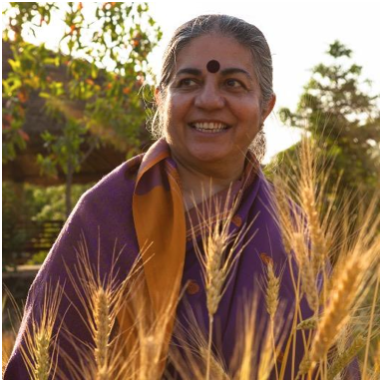
Vandana Shiva (born 5 November 1952) is an Indian scholar, environmental activist, food sovereignty advocate, ecofeminist, and anti-globalisation author. Based in Delhi, she has written more than 20 books. Shiva is one of the leaders and board members of the International Forum on Globalization, and a figure of the anti-globalisation movement. She has argued in favor of many traditional practices, as in her interview in the book Vedic Ecology (Ranchor Prime). She is a member of the scientific committee of the Fundacion IDEAS, Spain's Socialist Party's think tank, a member of the International Organization for a Participatory Society, and the founder of Navdanya, a movement for biodiversity conservation and farmers’ rights. She is also the founder and director of the Research Foundation for Science, Technology and Natural Resource Policy. Shiva fights for changes in the practice and paradigms of agriculture and food. She received the Right Livelihood Award in 1993, an award established by Swedish-German philanthropist Jakob von Uexkull, and regarded as an "Alternative Nobel Prize”.




